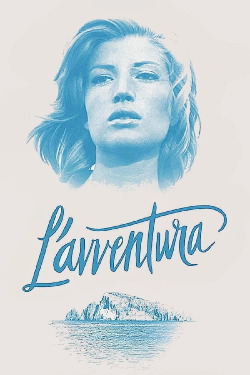
Review of L'Avventura (1960) by Brett C — 30 Mar 2014
Michelangelo Antonioni is a director I knew very little about, and I happen to stumble upon this film in the library, and out of curiosity decided to give it a try. Before coming in, I scrolled through what films this director has made and it turns out he has made quite a few notable films; I just didn't know he directed them. I came into L'avventura expecting to be satisfied, and for the most part I was. But there are a few things about it that brought the film down for me, and could be improved through a little more understanding.
L'avventura's screenplay was written by Michelangelo Antonioni, Elio Bartolini, Tonino Guerra. Both Guerra and Bartolini have worked on other films directed by Antonioni. I felt two things after finishing the film, curiosity and confusion. The film is essentially two halves, with the former focusing on the disappearance of Anna and the latter exploring the aftermath of the incident through the relationship that has formed between Anna's best-friend and boyfriend/fiancee, Claudia and Sandro. The first half of the film was really interesting, it got me excited and engaged all the way through it. This half of the film establishes it's characters and helps the audience understand the current condition of Anna and Sandro's relationship. I don't think it was intentional or not, but Anna was written in a way indicating that she might be depressed, due to the struggling relationship she has with her father and her boyfriend. This was only a theory that I thought of in my head, as a rationale for her actions. For all we know, she did it in order to start anew or maybe just to gain a bit of attention, this was what it seemed like she was doing with the whole shark incident. The search for Anna, I felt was very thrilling. I just had this urge in me to find out what exactly happened to her, and why she did it. This side of the film also some minor exploration with a bunch of characters that was with them on the cruise. They weren't important to the plot but they were a nice break from the drama between the lead characters. The second half of the film focuses more on the romance being developed between Claudia and Sandro, which I wouldn't really mind exploring but by the end of it, I was left really confused on what the reason was for it and what the writers wanted us to gain from it. But at the same time, I didn't feel it was an overall disappointment because I was left curious and wanting to go back and figure out what it all means; I'll come back to this film later after enough time has passed, in order to come into this film fresh again. This half of the film shows us the difficulty in being in a relationship like this, feeling emotions of guilt and sadness as they go on with it. Both Claudia and Sandro never gained any closure for the sudden abandonment of their beloved friend but yet they kept on forward into this relationship because I think they both internally needed each other in order to get through it, even if rash and impulsive decisions are being made from it. I'm not so sure on what to make of the ending of L'avventura, as it felt really ambiguous. I think coming back to this once more may give me a clearer understanding on what it meant.
The film was directed by Michelangelo Antonioni. I am not very familiar with the style and ideas that are commonly found in his films as L'avventura was the first film I have experienced from the director. I was happy with the way he handled this film, as he truly captured the intimate feelings between the characters. I felt that the disconnection between Anna and Sandro was real and the spark of romance between Sandro and Claudia also felt genuine. It never at all came at me in a forced kind of way. I can't say that this film is the most romantic film I have ever seen, and I don't think Antonioni was trying to aim for that. I think he was focus was to try and have the audience care and understand these characters, making us ask questions like "why would they be involved in a relationship with such a complicated circumstance?" or "what really happened to Anna and why did she just decide to vanish?" because the director doesn't really give us any answers; he wants us to find it for ourselves and create our own theory on what the film means. As I have said before, I was more engaged with the events that has happened during the first half of the film rather than the events found on the second half because Antonioni made us feel like we were there also looking for Anna. He built up all this drama before the incident, exploring feelings, thoughts and intentions from Anna, therefore making me care about her. He was also able to create this layer of mystery on what exactly happened to her, and it stays intriguing because we never gain any resolution for it. The director made us feel like a failure for not being able to find her and we end up empathising the grief that the characters are in. The second half, aside from the romance, seems to explore the idea of desire. Though I cannot go really into it as I haven't fully understood what the intentions are of the director when it comes to that concept. We can see the theme of desire or lust through certain events, including the woman being followed and "adored" by men, and the looks that men were giving to Claudia when she stood alone somewhere. The sexual passion between Claudia and Sandro could also be related to the idea of "desire" but I need another watch to understand it. That theme of desire may also be related to Anna, as the film gives us clues of her being wanted or cared for, and seems to act out in strange ways when she doesn't get it. The film's pacing was good, though it could have been shortened by 10-15 minutes. There were just some scenes during the second half of the film that was important I guess in developing the character, but wasn't executed in a way that had me interested. The first half of the film moved very well, not wasting any time in developing it's characters and plot, always giving us something to latch onto.
The film's director of photography was Aldo Scavarda, who has worked on other films including Before the Revolution and Blood in the Streets. His work for L'avventura was fantastic, it looked really beautiful. The highlight of his work was found during the scenes on the island, which I am positively sure was shot on location. Throughout the film, Scavarda and Antonioni have composed shots that highlights or focuses both the foreground and the background, similar to what was done on Citizen Kane. The backdrops in this film are gorgeous, particularly on the island scenes, with clouds and the sun creating a beautiful painting. The second half also was good but not as beautiful as what was done for the first half of the film. Scavarda and Antonioni made use of this depth of field by having actors interact with the foreground and background of the scene, at times it made me think of Terrence Malick as I see it a lot from his films. The film also is presented in black and white which was an odd choice at first, because Antonioni would have had the opportunity to create some beautiful imagery but then I started to see why he decided to opt the black and white approach; it haves the audience be more focused on the internal feelings and thoughts between the characters instead of being distracted by the background and it's colors. The film also consists of a lot of close ups, though not very tight as Scavarda leaves enough room for something to happen on the back, which I thought was quite clever. Throughout the film, we could see slow pans from crashing waves or from something in the environment to the actors, I wasn't quite sure what the meaning behind it was but I thought it was really effective; though then again, it could be just an excuse to provide beautiful imagery.
L'avventura's score was composed by Giovanni Fusco, who has also collaborated with Antonioni multiple times in films like L'eclisse and Red Desert. I found Fusco's score for L'avventura to be entertaining, particularly the main theme, as it's so catchy and fun. Though it does feel a tad bit out of place as the film's subject never seem to work well with that particular piece of music. The score that comes up throughout the film on the other hand was both enjoyable and effective. It only really comes up on moments where dialogue isn't emphasised or spoken, and is present more to move the film along and keep us interested instead of setting up the film's tone.
The film's acting overall was delightful with great performance from it's main three players; Monica Vitti, Gabriele Ferzetti, and Lea Massari. The first 20-30 minutes of the film's acting weight is mostly carried by Massari and she did a pretty good job. She plays a woman who seems to be in pain inside and as we go further along the film, we start to see more of her exterior being consumed in frustration. After her character disappears, the acting is then carried by both Vitti and Ferzetti. Both did justice to their roles, showing us layers to these characters that would have been difficult or forced if expressed through dialogue. It's the subtle things on their faces and actions that sell their acting, which is why a bulk of the film consists of close ups of these actors.
L'avventura, for me, was short of being perfect but that may improve as time passes. The film leaves you intrigued and curious rather than being frustrated, and definitely requires multiple viewings in order to gain appreciation of the ideas that are found throughout L'avventura.
This review of L'Avventura (1960) was written by Brett C on 30 Mar 2014.
L'Avventura has generally received very positive reviews.
Was this review helpful?