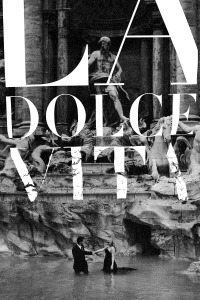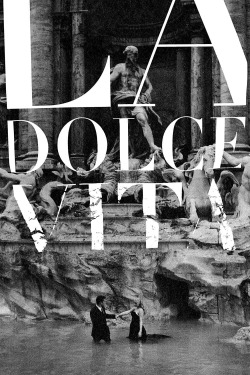
Review of La Dolce Vita (1960) by Edward S — 28 Mar 2012
This film is a timeless masterpiece.
Many eons ago, on my first viewing, I originally found the film to be difficult to delve into. It's admittedly a challenge where its greatness is more easily appreciated by the post-viewing reflections rather than the ideas and themes that impound the viewer during the initial viewing; therefore, a second viewing where one tries to engage their own theories, taken from a first viewing, is imperative and essential to fully experience this film's percolating greatness.
The film itself is uncompromising in its unorthodox narrative and storytelling structure; it might leave impressions of pretension or the illusion of bloviating as it introduces another seemingly dissonant episodic entry of Marcello's life. Then again, people usually vilify or trivialize that which they do not comprehend.
Surely it's a terribly daunting task, and a hard one, to quantify a character study of a man's life into a week, which is then compressed into 3 hours of film. "The Sweet/Good Life" achieves just that, and is a film unafraid to use the analysis of that man's life to provide a lengthy, complex, and cold reflection on the nature of how we live and the vices we should confront. Let's be thankful we were able to watch this film in our lifetimes.
The way the film so pithily and ambiguously portrays Marcello aimlessly cruising through his life and experiencing the meaningless pleasures of incessant late-night parties, spontaneous hedonism, and other ubiquitous debaucheries in search of satisfaction is just so well done in giving the viewer substance to work with. Here is one such message I've gleefully constructed: If we do not rise to the feat of going "beyond passions, like a great work of art" and to love and live "outside of time," then perhaps we will all end up as a hapless fool trapped in a hopeless cycle of empty hedonism, blinded by our own debauchery and self-righteousness that when an Umbrian angel attempts to save us from the outside, all we can do is wave in ignorance and turn back.
Surely I, too, wouldn't want to find myself so myopic in the future, blinded by my unslakable instincts, that I end up failing my own potential for finding a greater, illuminating, transcendent purpose in life. The "dolce vita," the life of "heedless pleasures and luxury," is inexorably unfulfilling and a carrot on a stick.
There are many other arbitrarily interpreted messages the film contains between its rich and intrepid lines. Finding more and more content in these lines with every viewing (whether it be from the ruthless on-payroll Paparazzo and his gang of cameras, the pitifully washed up state of Marcello Sr., the midnight strolls full of wonder and awe, the potent tragedy of Steiner, etc) is only part of the film's indefinite magic and fun.
This movie isn't just a cerebral celebration, though. It's absolutely beautiful. Rarely while watching another film will you feel so transported; watching this film was, and is still, like booking a full trip to Rome with friends and breathing the air of a novel land. Rome just looks fantastic in this film, and the way it takes you through the late-night streets and entertainment establishments of the city is breathtaking. Not much else should be said of the movie's mise-en-scene or cinematography, because if I were to start now I would never be able to stop. Even if you don't like to be challenged by films, by simply being a neophile, which everybody is to some extent, you will enjoy this film.
In hindsight, "La Dolce Vita"s format, method of storytelling, and very dense content would have also worked, perhaps better, as a book. Then again, only more for us lovers of cinema.
This review of La Dolce Vita (1960) was written by Edward S on 28 Mar 2012.
La Dolce Vita has generally received very positive reviews.
Was this review helpful?