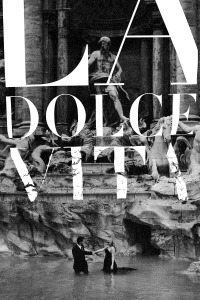
Review of La Dolce Vita (1960) by Evan K — 03 Feb 2016
La Dolce Vita exposes that the "sweet life" isn't so sweet after all. Marcello's life is empty because he is looking for meaning in a hollow social context. Through his escapades with Maddalena, Sylvia, and Steiner, he realizes that people in high society seem fulfilled, but they're actually miserable and adrift; the image is the only thing that matters not only to the public but to Marcello as well. Caught in an idealistic fantasy, Marcello fails to recognize the importance of looking deep into the human spirit and beyond the façade played out by the stars, ultimately leading to a life of loneliness.
The first instance of imagery overpowering substance occurs during the first night when Marcello meets Maddalena, a beautiful heiress, in a nightclub. After being seduced by Maddalena, Marcello has trouble resisting temptation and eventually submits to his desires. Surprisingly, Marcello feels no shame. In fact, his lust for Maddalena becomes stronger. The noncommittal relationship and desire highlights the superficial nature of both characters.
Shortly thereafter, Marcello meets Sylvia, the Swedish-American actress, and begins to pursue her. However, what he is really chasing down is her image, that of a free-spirited, beautiful, and lively woman. True to her superficial character, the only things that matter in her life are pleasure, attention, and wealth. Because of this, she completely ignores Marcello when he tries to woo her. Infatuated with her public persona, Marcello fails to step back and question what is in front of him. Because of the reliance on this image, Marcello ultimately never gets her and furthers himself into the meaningless misconception of fame and fortune.
Similar to the encounter with Sylvia, Marcello once again finds himself a victim of a meaningless narrative. He travels to the site where two children claim to have seen the Virgin Mary. When he arrives, however, it is completely different than what he expected. Instead of a reserved landscape with humble followers of Christ seeking peacefulness, it is a gigantic theatrical operation. The cameras are there only to capture the false image of the Madonna. Consequently, the viewers of this event try to convince themselves that what they see is true. In reality, it is just an illusion.
Following this night is the party at Steiner's rich, ornate apartment. Once again, similar to his experiences with Maddalena and Sylvia, Marcello is caught in a situation perceiving someone as an ideal image. Marcello admires the "sophistication" and "happiness" of Steiner, idolizing him as the perfect man with a perfect life. Both inspirational and admiring to Marcello, Steiner represents the hollowness of the aristocracy. A seemingly happy married man, Steiner is wealthy and powerful. However, his materialism does not conceal his lack of depth and character. Although he has all these material possessions, Steiner is clearly missing something spiritually. Tragically, Steiner takes his life as well as his children's. This symbolically represents a loss hope in the dreams of Marcello, but, more importantly, it signifies the bleakness and fruitlessness of the luxurious lifestyle, something Marcello thought was so great. His suicide shows that his life has become meaningless, for he cannot cope with the disenchantment and loneliness.
By affiliating himself with members of high social status, Marcello tries to discover meaning. However, he cannot find what he is looking for because his search is characterized by people with hollow lives. The elite are seemingly content and are looked upon as exhibiting an ideal life. In actuality, these individuals are emotionally lost with no purpose. Maddalena is bored with her money and, despite being a beautiful heiress, cannot find meaning. Sylvia is only an image and turns out to be a simpleminded fool. The faking of the Virgin Mary turns out to be a sham. Oblivious to the meaningless social context, Marcello does not look past the persona of Steiner and finds himself disillusioned. In the end, his reliance on the facades of his acquaintances dooms him to a life of emptiness.
This review of La Dolce Vita (1960) was written by Evan K on 03 Feb 2016.
La Dolce Vita has generally received very positive reviews.
Was this review helpful?