Review of Harlan County U.S.A. (1977) by Zujia H — 30 Oct 2013
Out from the darkness.
--my review of Harlan County, USA.
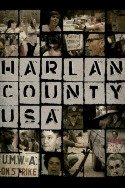
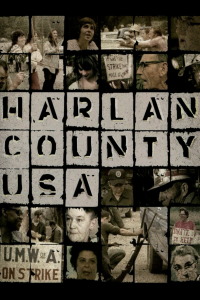
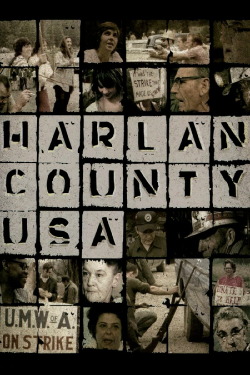
The film I'm going to discuss here is called Harlan County, USA. I do not know why it's added with a "USA" in its title, but that does not affect the directness of the title: the story simply took place majorly in Harlan County, USA. This is a intense, thought-provoking documentary with plenty of interviews involved, directed and produced by Barbara Kopple.
The film depicts the arduous struggle in a variety of angles, including footages and/or interviews of figures from Duke Power, Eastover Mining, Consolidation Coal, UMW-A etc, as well as of ordinary participants of the year-long strike such as Lois Scott, an activist in a league of women supporting the strike. Her distinct personalities shown in the film------whether during meeting, on picket lines or in jail------made her a central figure in the documentary (in which point I agree Wikipedia.).
Harlan County, USA can be classified as participatory for that it was intended to exhibit the struggle to a larger audience, in the viewpoint and in support of the miners. Also, the filming partly contributed to the strike: for example, some footages were used as testimony for the accuse of 'the bad guy' Basil Collins, the hated scab leader threatening picket lines with a gun.
I'm here trying to discuss how the film provokes our feelings and incites our sympathy for the workers and antipathic towards the coal operators. Different from observatory documentaries like Spellbound or High School, this documentary took a clear stance alongside the miners. I'll try to rationalize the cause of my aroused sentiments when I watched the film, even if the whole story happened long before I was born; this will be explained mainly by the analysis of typical cinematic techniques applied to the film. On the other hand, it is clear we can see much exposure of 'the dark side': the struggle is not simply concluded into love, peace, courage, etc. Then why did Kopple add those 'negative' parts?
To reach the conclusions we must have first watched this 102 minutes long film in whole; therefore if you haven't watched the film yet, please DO NOT proceed for I'll summarize the major storyline below.
The film expands around a strike started in Brookside Mine, Harlan, Kentucky, protesting the running company, Duke Coal Company, which banned the miners from joining the United Mine Workers America. The strike went on for over one year, continuously escalating with state police interfering with the strike; scabs/thugs threatening the safety of picket liners; the significant changing of power within the UMW, and the whole event reached the tightest point when a young miner/striker was shot and killed in a conflict when he was on the picket line. The tragic event, however, contributed to the cease of further conflict and a negotiation reached between workers and the company. Though the film focused on the progress of the strike before the agreement was reached, it states in near the end that this agreement was far from satisfactory and the laborers continued to struggle for their rights from then on.
The first cinematic aspect I notice is an intense use of Close-ups: very often we can see the shot going focused on a person being interviewed, his/her face taking up the whole frame. large amounts of CU interviews which transmits not only the verbal message. We can see a lot of complication going on on each person being interviewed or simply being filmed in CU mode. Besides, shallow focus is preferred by the movie maker in many scenes. Sometimes there's changing of focus or possibly unintentional blurring that shows a more realistic and dynamic way of filming and also expressing some sort of uncertain, instability, etc in the progress of the strike.
The CU technique is applied in so many cases in this film that we can feel the chemistry going on as if we were looking into the characters in their eyes. The subtle change of the facial expression of Sudie Crusenberry, a firm, calm female leader, is one clear example. From around 1:00:30, after a conflict occurs in the conference, she speaks out her motivation for supporting the strike; then the camera zooms in from the left side to her face, and we can hear her speaking faster as she tries to control her emotions. Finally there are tears crawling on her cheeks, as the camera further closes in. Here we can see that although she is unable to hold tears, her eyes are still sharp, firm and determined.
The shallow focus technique in many scenes also hints the audience to be more sensitive to atmosphere or emotion. We can see strikes depicted with blurred, murky background, shallow focused weathered faces or hands sharpening sticks in tension. For another instance, at around 17 minute when we first see the state police coming to commence road control, there is a handful of CUs upon the policemen's facial expressions. One particularly symbolic shot is at 17:34: the camera first focuses on a young police officer's look, which seems hollow and numb , then the camera zooms out and let us see the interesting moment when the officer and suppressed striker stared each others in eyes; a wall of policemen retrains the strikers from getting on the road, and the camera puts a shallow focus on the two glaring men as cars pass by behind them. This scene, in my opinion, is a mixture of tension and irony. The film's skillful use of CUs and shallow focus here implies that the police interfering the Brookside picket line didn't consider their job just or something; they were simply getting the job done. Here we can see the challenge faced by the strikers: by choosing to strike they chose a way with obstacles that may be merely complying to rules and orders.
The second aspect I've enjoyed is the film's non-diegetic sounds, or music. It has good use of folk music (some of which are completely vocal) throughout the film, with contents connected to the strike's progress and striker's feelings. Some of them might seem overlapping ------for instance, Which Side Are You On------but when they are sung in different ways, they are carrying different messages. Most of the songs are created by and was popular among ordinary strikers, and even sung in part by Lois Scott when in jail.
A typical example here is at around 35min, when the song Mannington starts playing. As the lyric goes, 'tell'em how safe the mines are today/and be like daddy bring home a big pay', Kopple gives us a heartbreaking contrast by showing a series of grieved faces of women who were made widows when after the Mannington Mine disaster. Notice here that there is also a perfect application of CU and shallow focus. After the this, the song consequently goes 'But don't you believe it boy, that story is a lie/Remember the disaster at Mannington Mine'. The steady and seemingly warm instrumental parts also helps in forming this contrast, making this set of scenes very tragic and emotionally provoking. Given the neighboring parts, a message is insinuated that to the capitalists running the coal mines, the miners' lives were just considered as expendables.
The third aspect is the use of color and light. The hue of the whole film basically coincides with what we can imagine with a coal miner's work: gloomy, dusty, smoky etc. As we can see at around 36:45, echoing with the background music Black Lung is a scene of a working miner in a very dusty low-key surrounding. There are then cutscenes form different angles and distances, each of them coated in a grim, murky gray, indicating the harsh condition of miners' health care.
However, the most appealing part in the tone of the film occurs not in the actual scenes of deep in the mine, but the scene of strikers on the picket line 4 or 5 in the morning, getting caught by police or attacked by thugs and scabs in a very dark, misty hue, and we can only see people by shadows. When conflicts took place we see the whole thing in chaos. The very most impressive scene occurred at around 1hr04min. First we can see only a pair of blinding headlights in the darkness. Before we have a sense of what's going on, gunfire breaks the silence, followed in no time by screams. As the camera crew use flashlights, The next thing we see is Basil's truck passing in slow-mo, with Basil on the driver's seat holding a revolver, his face tightened in ferocity. The only light source of this scene was the flashlight, which made this low-key scene extremely thrilling. The depiction of Basil Collins, the arch-enemy of the picket crowd, reaches the worst point at this moment.
The three aspects mentioned above all contribute to a multisensory empathy into the miner's struggle. Harlan County, USA shows us a persistent, complex struggle to a non-satisfactory agreement; it shows many aspects of modern work right conflicts. Instead of dividing everybody in black or white stance, everything we see in the film convince us about the complexity of the conflict, of laborers and capitalists' nature.
The filming infiltrates into their lives - the lives of the strikers & supporters - so deeply that we can not only see them going on picket lines with courage and persistence, but also their time of uncertainty, psychological struggle, despair, doubt, disappointment or agony. Even for the baddest guy Basil, we can see an interview of him around 11min, showing his (own?) concern of workers uprising. He associates unionized workers with communists, which was a typical accuse in the cold war age: we can see that his view might be a product of education and enterprise rules/culture of that time. Although in the film he is regarded as a devil, he acts merely as an executer, or an endpoint, representing just a corner of a gigantic iceberg of the capitalist hierarchy. On the other hand, the film is not avoiding scenes of the struggle's negative side. In the film we can see how the women's club members are frustrated when they did not have a large enough picket line; we can see how the union is not what some strikers naively believed to be at all; we can see how people like Tom Boyle uses the flaws within the union and plays the trust of union people to get the power he desires; we can see how the strikers are finally paltered with a not-so-perfect deal and they have to continue struggling. In fact, the film discredit all these bureaucracies: companies, unions, government etc...one example is the scene of part of a speech by John Lewis at around 9min. The stiff and "emotionless" look of his face gives me a weird feeling that he is merely reading some article written by others and as if he did not care much about it. Everything comes down to the group actually fighting and actually suffering, and actually suffering more if they fail: the miners, their wives and daughters, and all Harlan County people on the picket line. The film makes some kind of summarization in the very-long, motivating story about the old Harlan County uprising told by an retired miner, starting at around 12min. At the end of the story, the old striker meaningfully states that:
'I learned that politicians worked with the coal companies, I found out that union officials were working with the coal companies, I also found out that the catholic hierarchy was working with the coal officials.'.
In my opinion, rather than undermining the meaning of the strike, the negative factors I mentioned actually directly show us all the obstacles of the whole thing, external and internal: the company is their enemy but also their wage-provider; the union is what they trusted but also what they learned cannot totally trust; some of their fellow workers become scabs or even turn into violent thugs; some of them are beaten by fear and despair which almost keep them from maintaining the picket line. They have nothing else to rely on; the only choice is to stick together and stick to the faith. As how I understand this film, it is a sincere tribute to those who faced so much distress, darkness and danger and still did not back down from the picket line.
Oct 30, 2013.
This review of Harlan County U.S.A. (1977) was written by Zujia H on 30 Oct 2013.
Harlan County U.S.A. has generally received very positive reviews.
Was this review helpful?