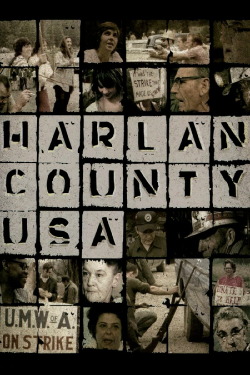
Review of Harlan County U.S.A. (1977) by Yongxin W — 30 Oct 2013
Struggled Life under the Earth.
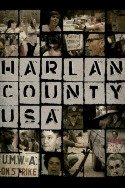
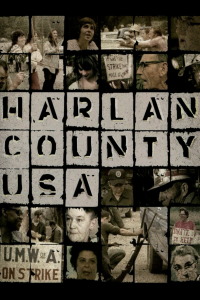
Through out the history of the United States on labor issues, the struggle of the coal minors is one of the most brutal chapters. Those under-the-earth workers struggle with gaining their rights and support from the society. Their unsafe working condition and their limited wage are hardly recognized. The 1976 Oscar wining documentary film, Harlan County, USA, directed by Barbara Kopple, records the yearlong strike in June 1972, carried on by the coal miners and their wives at the Brookside in Harlan Coutny, Kentucky, against the Duke Power Company. Even though some of the film's editing and shots are ragged, these film's imperfections provide immediacy and credibility on showing the brutality of the authority, evoke the viewer's sympathy and admiration toward the coal miners and their wives, and reveal the problem of social unfairness.
In June 1972, when miners at the Brookside Mine in Harlan County go on strike, Kopple films the violent protest against the Duke Power Company, for being too controlling and denying the contract with the United Mine Workers of America. Those miners, who work for minimum wage and have been treated unfairly, are facing a high risk of death due to deadly disease and accidents under the unsafe working conditions. As they strike to get back their labor rights, their wives stand up and form a women's club to support them. Together, they try numerous ways to get attention, including protesting against the company, forming a picketing line, and reaching out for support from society. The drama reaches its peak when the strike becomes more brutal, such as when the anger within the miners grows after a mine's explosion that kills many miners and after the murder of Yablonski, an American labor leader and a candidate for president of the United Mine Workers, and his family commission by Boyle, his competitor for the presidency of the United Mine Workers. As the strike drags on, the miners find out that they confront not only the company but also the police and the courts as well. This documentary records the miserable life and misfortune of the coal miners and reveals significant conflict between different social classes.
In Harlan County, USA, Kopple uses many long takes, one of the cinematographic properties, to keep track of actions, which immediately reveal the brutality of the higher authority. Especially during the scenes of the picketing lines, the long takes without stabilizing the camera captures the brutal actions of the policemen on the protesters and even the filming crews. Unfortunately, those long takes sometimes cut out the character's heads, and sometimes they give a shaky image due to the instability of the camera. At one point in the scene of the picketing line, we even see the camera get smashed, which causes the camera to shake and tilt. However, those ragged shots provide immediacy and truthfulness to the film. During an interview, Harry Patrick, the UMW secretary-treasurer who is one of the camera operators, describes the conditions where they film the documentary, which explains to the damage of the quality of some shots. In the interview, Harry says:
"we had just hooked up with Barbara again, and had set up and turned on the sun-guns to film, when all a sudden these two guys came running at us ...... they had tried to smash the camera, and this guy hit me in the face with his pistol and chipped my front teeth ...... I got up and the camera was still working, so I kept on shooting although I didn't put it up my eye because I knew I'd just get hit again" (Crowdus 24).
Through the ragged long takes, Kopple displays the immediate and true actions of the policemen when they beat and arrest the miners in the picketing line. Under this special case, those imperfections of the film give the audience an immediate feeling of the brutality and the bloodiness at the picketing line. Those ragged long takes also increase the credibility of the film.
At the beginning of the film, Kopple uses elements of mise-en-scene to depict what it looks like down in the mine, which shows her pity toward the coal miners' harsh working condition and their hard works. The setting of the film, the coal mine, shows where the miners work, while the preps, tools used by the miners, tells how they work under the earth. The setting and preps not only displays the nasty mine, but also the daily hard work. Moreover, The lighting, an element of mise-en-scene, is dark as it takes place in the mine under the ground. It immediately gives the viewers an impression of the dirty, dusky, and dangerous mine. Even though the dark lighting might display fewer details, the natural lighting, the setting, and the preps, give the viewers a direct view of the terrible working condition in the mine and the daily hard work the miners have to put in. Through Kopple's use of elements of mise-en-scene, the viewers can feel the same sympathy as Kopple has toward the coal miners.
The film revokes viewer's sympathy toward the miners and admiration toward the women's club through the use of cinematographic properties. In the film, Kopple interviews different people to gain different perspectives of what people think coal miners have been treated in Harlan County. During those interviews, Kopple uses close up camera distance on the retired old coal miner, a young coal miner, and the girl, whose grandfather was a coal miner died because of black lung disease. These two frequently used camera distances keep the viewers concentrate on the interviewees. Another filmmaking technique, shallow focus, also has been used during interviews to clear distractions from the background and allow viewers to focus on the interviewees and their words. These filmmaking techniques keep the viewer's attention on the stories that each of them is telling. Through their sad and terrifying stories, viewers can feel the harshness of the company on its workers and the affect of the coal mining to their health and life. The life experience under the earth and under the press of the Duke Power Company that have been told by the interviewees evokes viewer's pity. As the women's club plays an essential role in the strike, Kopple tries to emphasis the women's power. The camera angle was low when Lois Scott, an organizer of the strike and the leader of the women's club, gives a speech. An upward camera angle usually gives a superior vision of the character. In this case, it depicted Lois and the other women in the club as articulate, indomitable, courageous soldiers, who are ready to fight for their families. As Kopple elevates women's role in this strike, the viewers admire them even more through their superior image and their passion and spirit. In Harlan County, USA, Kopple uses one cinematographic property, close up and extremely close up camera distance, to keep the viewer's attention on the sad stories of the miners in order to evoke the viewer's sympathy, and she also uses another cinematographic property, low camera angle, to depict the powerful image of the wives in order to evoke viewer's admiration.
Throughout the film, Kopple always stands by the miners. Living with the people and striking with them, Kopple bonds with the miners and their wives. During an interview, Barbara Kopple says that she is indeed good friends with Lois and Bessie in the women's club, and she also says: "the thing that happened was that we were there for so long that people didn't recognize us a lot of times without our gear on" (Crowdus 23). She fights for the miners because she believes Duke Power Company has abused them. When the conflict builds up, Kopple reveals the fact that because coal miners live at the bottom of the lowest social class, they gain no rights or respect in Harlan County, Kentucky. The devil image that Kopple depicts for the higher authority carries out the strong voice that against the social unfairness. As she puts her heart into creating this documentary, Kopple believes that the problem will be solved only if the problem has been revealed, and her work that reveals the conflict between the lower class and upper class can stop the inequality.
Harlan County, USA records one of the darkest moments of the labor rights. It not only tells the viewers about this historical event, but also puts the viewers alongside the miners, as Kopple promotes the coal miners as the protagonists along with Duke Power Company as their enemy. This leads to the emotional resonance between the viewers and the miners. Even though the movie contains several ragged shots and editing, it does not interrupt the fluency of the film but adds more immediacy and credibility to the film. Harlan County, USA is absolutely worth watching, as it does a great job on showing the conflict between miners and Duke Power Company, which eventually leads to the conflict between different social classes.
This review of Harlan County U.S.A. (1977) was written by Yongxin W on 30 Oct 2013.
Harlan County U.S.A. has generally received very positive reviews.
Was this review helpful?