Review of Videodrome (1983) by Simon L — 02 Feb 2009
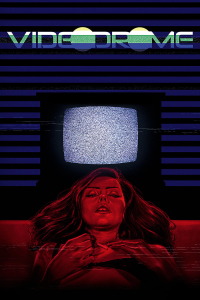
David Cronenberg's understanding that conceptual emotions are disconcertingly influential when visually and atmospherically represented in illustrative, sensory ways has brought him gradual steps closer to producing high-brow art-house cinema, and one of those steps on the way was Videodrome.
In a genre in which death ultimately defines its content and attraction, Cronenberg transcends it by ignoring death as a trigger of fear. In a Cronenberg film, conditions and processes of disease is never an extrinsic cause. It doesn't come from aliens, zombies, vampires or natural predators. In a Cronenberg film, genuine affliction and contamination are usually identical to genuine aural comfort, and their mutual root is physiology, as we see here in James Woods's transfigured abdomen. The Canadian "veneral horror" director is radical enough to give off that disorder isn't automatically bad.
Cronenberg's images are bizarrely alluring, a correspondent of the unconscious, yet in Videodrome they're sometimes hilarious. As usual, this Howard Shore-scored Cronenberg outing is a deranged organic zone where mind and body, relentlessly traversing the mechanistic interpretation for assimilation, are so susceptible as to be easily adjoined by the technology produced by them. Cronenberg characterizes physicality as one immersed within savage association with the soul.
In Videodrome, Cronenberg familiarizes control networks that are virtually imperceptible. Cronenberg signifies that the body is an impermanent form between one's actuality and the generation of a "new flesh" in which the television screen is, not figuratively, the retina of the mind's eye. In the hypnotic dimension of this cult film, the sole means to counteract extinction is to convert into complete electronic force.
While I don't believe to entire comprehend Videodrome intellectually, Cronenberg radiates arresting imagery of how television revolutionizes the body. What's Videodrome about? S&M as a modified mode of being and the power of the image over society that more personally conducts our life than any politician. Very much like Network, what was in its time a sardonic composition of what in social morals deserves criticism turns out to be spookily precise in its prophecy of the TV panorama now, with its reality shows that subliminally infer that life on TV is more certain than life in one's own skin.
Essentially, this surrealist biopunk film is about those who would command entrée to all broadcasting. It applauds technology as it vilifies its power, amassing a predictive visualization of squalor and oppression. Cronenberg reflects what tends to be intuitively suppressed and makes apparent those structures of control unseen by the tangible barren eye.
Videodrome exudes another facet to Cronenberg's need to understand how the existence carried by the media influences us metaphorically. Videocassettes ascribe human form. TV reaches out to touch you: One's body becomes its machine rather than the other way around. Cronenberg films incline all-consuming introspection, esoteric and abstract, where sensation-fueled dreams, underlying theoretical principles, evolution, mental processes, and technology converge. Videodrome may belong to his schlockier era, it is no exception but in fact a quintessential example.
This review of Videodrome (1983) was written by Simon L on 02 Feb 2009.
Videodrome has generally received positive reviews.
Was this review helpful?