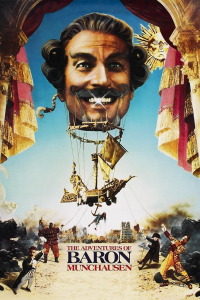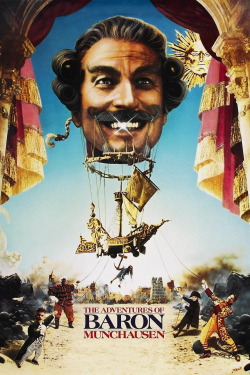
Review of The Adventures of Baron Munchausen (1988) by Spangle — 08 Mar 2017
The final entry into director Terry Gilliam's "Trilogy Imagination", The Adventures of Baron Munchausen pick up where the final two entries left. An imaginative tale that blurs the line between dreams and reality, the film is incredibly engaging and entertaining throughout with phenomenal performances from the entire cast. As with the previous two films, the film is more of an ode to storytelling as an escape from reality, more than a straight film that can be defined between dreams and the real world. A film about the mysterious Baron Munchausen (John Neville) and his band of odd helpers (Eric Idle, Charles McKeown, Winston Dennis, and Jack Purvis), the Baron crashes a performance of his life story and informs the audience and actors that they are true stories. Though extraordinary, his adventures are not mere legend and, even more, he is the reason why the Turkish sultan is bombing their beloved city because he stole the sultan's treasure. What ensues is a film that is magical and fantastical that reaches comedic and adventure heights like only Gilliam can reach.
In the first entry in this trilogy, Time Bandits, Gilliam focused on a child. Living in unhappy home with parents who are more concerned with their material goods than their own son, the boy goes to sleep one night and a small band of thieves pop up in his room. What ensues is an imaginative experience that, though it sets it up as occurring in a dream world, drops a few hints that maybe everything was real. In Brazil, the second installment, Gilliam created a 1984-esque dystopian world that is incredibly real, except for the middle aged protagonist's frequent dreams about a different world, culminating in a dream world breakout from prison that is shown to be anything but real. This film, picking up from there, has the Baron tell his story to the crowd as he simultaneously saves the city from the sultan in a dream world. Only it appears to be a dream world, as by the end, the sultan is gone and the city has been saved. Yet, while all of these films show the stories escaping the dream world and jumping into reality, the line between the two hardly matters.
Rather, Gilliam's tales are about the necessity of storytelling and imagination. Objectively, regardless of what the endings show, we all know that dreams are not real. They may reflect reality - as shown in the films by characters in the dreams sharing resemblances with real people, such as Uma Thurman's dual role as city girl Rose and, in the dream, the goddess Venus - but they are simply not real. Gilliam's films, however, suspend this disbelief via storytelling and/or imagination. He fashions his films as an escape from a horrific reality - neglectful parents, dystopian world, a city under siege - with the stories and collective imaginations of the characters being a blissful departure from their traumatic real lives. Thus, the film's finales do not hint at them being real or having actually occurred. Instead, it depicts that it hardly matters. The dream world is objectively better, even if it is not real, than the lives these people lead. Collectively, everybody in these films opt for these falsehoods to enter a state of bliss. In Brazil, the protagonist is declared insane for this, but regardless of his sanity, he has escaped his prison. The boy in Time Bandits escapes in the end via his dreams and the town is saved in this film because they opted to ignore reality and instead enter the world of their imaginations, in which the city is still standing and safe from the sultan.
In crafting this world of imagination, Gilliam continuously finds new antics and ideas to introduce. For instance, the moon brings some of the film's comedic heights with a terrific supporting appearance from Robin Williams as The King of the Moon. A floating head trying to escape the carnal tyranny of his body, the King is a higher being who can create Spring by whistling. His wife Queen Ariadne (Valentina Cortese) is similarly able to separate her head from her body and reach a higher state of being. The two not only exist as a statement on the possibilities of the mind without physical limitations, but are also hysterical entries into the film. No matter where the Baron and his child helper Sally Salt (Sarah Polley) wind up, Gilliam's film is imbued with a sense of adventure that capitalizes on the film's naturally whimsical state of being.
An uproariously funny and thoroughly engaging film, The Adventures of Baron Munchausen is a film with a lot of moving parts and demonstrates Gilliam's tremendous ability to create fun and smart films for audiences of all ages. Not limited by the PG-rating, the film explores important themes such as honesty, while creating a tale about embracing the oddities of life. No matter where you wind up, there is a way out of it (even death) if you are willing to take chances and embrace possibilities that were previously inconceivable.
This review of The Adventures of Baron Munchausen (1988) was written by Spangle on 08 Mar 2017.
The Adventures of Baron Munchausen has generally received positive reviews.
Was this review helpful?