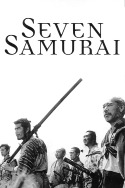
Review of Seven Samurai (1954) by Brooks C — 23 Nov 2012
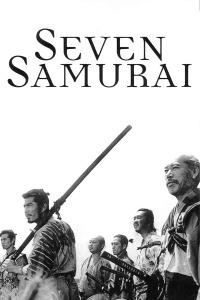
In 1954, maverick director Akira Kurosawa took his homeland of Japan, and the world by storm by making many classic movies. Many films he's made range from Ran, High and Low, Kagemusha, The Throne of Blood, The Bad Sleep Well, Rashomon, and Yojimbo. The Seven Samurai is a film that is not only flawless in execution, but is also one that is one of the most important films ever created.
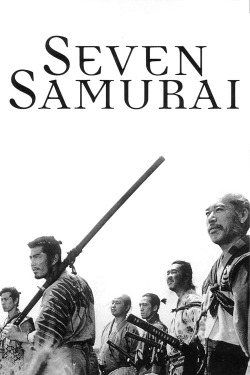
Set in the backdrop of Japan's feudal class warfare a village of farmers is constantly being raided and plundered by bandits. Left defenseless and poor a select few of villagers decide to go to the metropolitan areas of Japan to search for a group of willing samurai to help them defend their village during harvest season. The warriors they select are expertly skilled in many specific areas of warfare. One is an expert marksman with a bow, another is great with reflexes, one is perceptive, one is great with interactions, one is skilled with strength, one is a young rookie samurai who desires to learn his ways and finds love with Manzo's beautiful daughter Shino, and another is a hot-tempered drunk, yet gruffly humorous and understanding of the circumstances. Each samurai help to train the villagers in the art of war and help to defend their village against the ensuing attack.
The plot to The Seven Samurai is about as flawless as this movie. The cast of actors is perfect in every role and each is acted wonderfully. Toshiro Mifune's character, Kikuchiyo is more like a voice of reason and is of society's lower class. His character is revealed to have been a farmer in his early life and he gives one of the more memorable speeches about class warfare and corruption in Japan's society. This was one of the many occasions Toshiro Mifune had worked with Kurosawa and one that helped to launch his successful acting career.
Another noteworthy subject is the cinematography. For a movie shot in black and white and made in the time where Technicolor was too expensive the movie pushes the boundaries of its technical limitations. Every shot is wonderfully rendered and the backgrounds look massive. While operating within its limitations The Seven Samurai pushes the boundaries into many different areas that many filmmakers have probably never thought it would go.
The Seven Samurai is regarded in Japan as one of the most important movies of their homeland. The movie helped to launch a new era of moviemaking and also helped launch many other classic forms of media in later generations. The Seven Samurai was later remade as a classic western The Magnificent Seven and an excellent, yet loose anime series adaptation Samurai 7.
I must confess how fascinating it is how much different cultures can learn about one another and discover each other's similarities. There are many differences in perception in terms of philosophical motives concerning code of conduct, but each other's means of achieving goals remains the same. The Seven Samurai is a very culturally oriented movie. While a work of fiction, it perfectly captures the emotional outlook of feudal Japan and peoples' attitudes of class warfare.
Many directors worldwide have hailed Kurosawa and his work. Some notable ones who have done so include Sergio Leone, Frederico Fellini, John Milius, and George Lucas who also would derive influence from Kurosawa's classic The Hidden Fortress in order to make his classic Star Wars franchise. Sergio Leone would also derive influence from Yojimbo to create A Fistful of Dollars, the film that not only is the first in The Dollars Trilogy, but also the film to popularize the Spaghetti Western genre. Kurosawa's legacy was one that inspired a whole new era in the world of filmmaking.
The Seven Samurai is a wonderfully crafted movie that deserves its place in international cinema. Everything from the music, acting, cinematography, action choreography, and the story is perfect. This movie belongs in the rare category of films that are nothing but the embodiment of absolute perfection. For a movie that is three hours and thirty minutes long there are no scenes that feel wasted, or pointless. The Seven Samurai may not be my No.1 favorite movie of all time, but rest assured that it's in the top 5. Despite that The Seven Samurai is one of those films that I will cherish watching until my dying day.
This review of Seven Samurai (1954) was written by Brooks C on 23 Nov 2012.
Seven Samurai has generally received very positive reviews.
Was this review helpful?