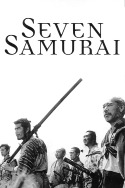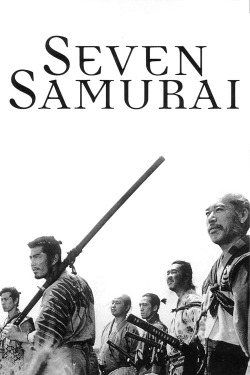
Review of Seven Samurai (1954) by Cameron H — 31 May 2016
"What are we fighting for?" Shut up, you hippie. Okay, hippies weren't as strong of a rage back then, but anti-war sentiments certainly exist. So, what went wrong in those past three sentences? There was an assumption made about the initial question, interpreting it as an anti-war sentiment. Seven Samurai is, so far, the only film I can think of that depicts a war in an encouraging manner, yet ultimately destroys the motives of every soldier in focus.
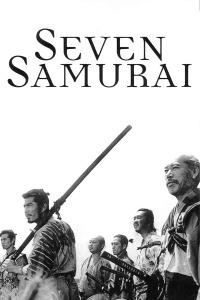
Seven samurai and a village of farmers VERSUS an army of forty thieves. That's the ideal situation for the village, when they must face another year of thieves robbing everything that was harvested. What choice is left, but to hire samurai willing to fight for that cause with no reward other than a bowl of rice a day? Trouble is, not many samurai would fight for that reason. After several days of searching for willing fighters, seven are found. They each choose to fight for their individual, but not independent reasons. Kambei (Takashi Shimura) is the first to join, and acts as the primary war strategist. He has fought many wars and is no longer interested in gaining reputation. He loves to fight for greater balance and justice in the world. His adoring fan Katsushiro (K.O.), a new samurai, is eager to learn about what fighting in a war is like. Shichiroji (Daisuke Kato), friend and fellow fighter to Kambei, is simply happy to fight alongside great companions, old and new. Gorobei (Yoshio Inaba) is so intrigued by Kambei's mindset that he feels like he can put wisdom and faith into Kambei's leadership. Heihachi (Minoru Chiaki) is a woodcutter in need of any meal on the table, and, for such, is happy to help others in any way that he can. Kyuzo (Seiji Miyaguchi) is a master of the sword who longs to continue practicing his skills in whatever situation may call for a master. Lastly, there is Kikuchiyo (Toshiro Mifune). Before explaining his motive, I must note that, while the ensemble acting is already stellar, Mifune still happens to steal the show. Kikuchiyo is both the primary comic relief and holds the most dramatic monologues and backstories, and Mifune commits to every action with such fun and passion. His motive is to avenge the lives of farmers who lost their lives to bandits, and annihilate every single thief in sight.
SPOILER: If Japanese martial arts cinema weren't so obscure to Americans at its time of release, I bet that the final quote of the movie, "The farmers have won. We have lost," would have resonated with common viewers. Truly, every single samurai lost. No one lived up to their motive. Heihachi died in the attempt to save a farmer from sacrificing his life. Gorobei died because of his faith in the mission, granted under the control of a great militaristic strategist. Kyuzo died by distant gunshot, thus not allowing him any means of proving his mastery. Kikuchiyo died under the pretense that he has slain the final thief, which only we, the viewers, see is false. The other three samurai live. Katsushiro discovers that with war comes love, and even after surviving war, that love can die. Seeing the rejection in his eyes in the epilogue is rather painful. Shichiroji cannot conjure enthusiasm for their victory, when staring at the four graves of befallen samurai. And Kambei, throughout the entire movie, uncovers injustices on all sides of the fight, and concludes that there is no way he can ever fix the world. In the meantime, however, the farmers saved their village. I do not mean to disregard a good chunk of this three-and-a-half-hours long movie. Trust me, every second is worth your time. However, the final hour is the ultimate Kurosawa achievement, shooting remarkable, exciting and horrifying war scenes and splicing them with provocative dialogue to spark discussion at any second.
You might be surprised to hear that such a long movie stands out for its pacing, but I thought it moved at a good pace. This sprawling war movie does not sell itself as action-packed, so we are free to involve ourselves with the desperate affairs of the farmers. This doesn't just regard thieves. They fear the samurai as well, on account of their reputation for looting, pillaging, even killing innocent bystanders. Under-the-surface tension between two characters can be strong, and Kurosawa shows that so can such tension between two crowds. The farmers take it out on themselves before the samurai, yet their fears all come from outside influence. By the end, it's clear that the farmers only love each other. Once there is cooperation, I found myself quite interested in the preparation for war. Viewers are welcome to familiarizing with the whole map of the area -- on one end are empty, flat fields, surrounded by a moat; on the other end is a forest pathway leading up a mountain. Meanwhile, we learn a greater deal about what "unity" means to individual farmers, as each procedural step reveals something new about particular village members. This is best signified by the choice of Grandaddy (Kuninori Kodo), the all-purpose guru of the town, to die in his inevitably unprotected mill. At the last minute, his family members leave the protected village to join him, only to have to evacuate because of a raid. The samurai do what they feel they have to do in that situation, but are constantly at risk of completely reshaping their motives because of the foreign motives of the farmers.
"What are we fighting for?" Each character must ask themselves this again and again and again. There is no consistent answer, and even when they thought they understood why, every action somehow led to failure. The victory of the farmers did not matter. At the declaration of the last thief (ahem) being dead, all that we see and hear is Katsushiro hysterically crying, unable to feel relieved by such news. It's not like Kambei's plans failed. They were quite successful, and happened to act as classic cinematic action. Katsushiro learns what war is like: inevitable despair. Kurosawa twists that despair into tension, between like characters and between opposing groups. Scenes and conversations are held on for a perfect amount of time to let that tension pull you around. Why resist?
This review of Seven Samurai (1954) was written by Cameron H on 31 May 2016.
Seven Samurai has generally received very positive reviews.
Was this review helpful?