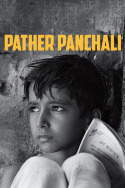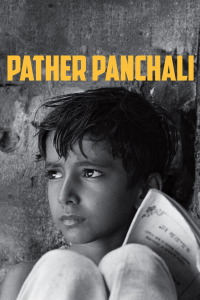
Review of Pather Panchali (1955) by Kevin M — 29 Jan 2009
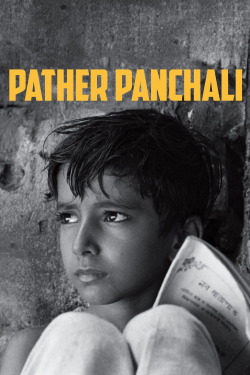
Stands right alongside "The 400 Blows" as one of the best coming of age stories ever filmed. Although Satyajit Ray was born into a position of privilege and doesn't have the benefit of directing his own life story, unlike Truffaut. The opposing directorial styles could not be more different. Making his debut here, Ray shows impressive natural talent. His style echoes Renoir, De Sica, and Ozu, yet he does not consider himself above altering classical dramatic structures. "Pather Panchali" is surprisingly accessible for an unflinching, authentic look at rural Indian life.
We slide into the daily rhythms and inner conflicts of the Roy clan through the casual fruit theft of Durga, the daughter of Harihar and Sarbojaya, and her warm relationship with her ancient Auntie. Ray brilliantly shows the old regressing back to (mentally) young, the hardships of extreme poverty, the tension between husband and wife, the disillusionment of unfulfilled dreams, conflict between opposing classes within the same family, and the pressure of raising children--within the first ten minutes or so. In these picturesque jungle settings, a hellish yet fully believable world is fleshed out. It is into this world that baby Apu is borne.
Six years pass by thanks to a jump cut. The boy is full of boundless energy, optimism and the refreshing perspective that only youth can give. The distant train noises will become an extremely important motif that will repeat through the subsequent two films in the trilogy of his life.
Despite a harsh climate (or perhaps because of it), Apu learns to read and write and begins to crave foreign stimulus, a visit to a festival awakens his full-fledged lust for culture. There is plenty of mirth and jocularity in capturing the foolishness of childhood, and there's also an over-the-top swordfighting play (with the worst fight choreography EVER) that feels like something Bergman or Ozu would throw in.
Not to go into spoiler territory, the story takes several turns for the melodramatic, but its realistic, earthy pace and authentic feel make it the stuff of life, rather than literary invention. Throughout, the Ravi Shenkar sitar and tabla score injects further weight to the painterly images, and gives energy to some of the more listless scenes.
Interesting how the pacing of each installment picks up as Apu ages. Don't you remember childhood lasting forever? Did it ever occur to you that someday, you'd be looking back on your early naivete as a kind of idyllic period, before life's brutality began to edge its way in? Not only are the child actors impeccably good, Ray's masterly touch captures even the "time warp" of childhood; also the Roy clan itself seems to be in a time warp, as the reveal of power lines beside the train tracks in one scene comes as a genuine surprise. Most of "Panchali" is so timeless it could be taking place anytime in the last 1000 years. Not until "Aparajito" do we learn the story takes place in the 1920s.
Masterful stuff. Try to acquire all three parts at once and watch them back to back. It will be one of the most rewarding experiences of your life. Unless you'd rather be watching something in English, in color with lots of explosions, in which case you can kindly fuck off and watch "Transformers".
This review of Pather Panchali (1955) was written by Kevin M on 29 Jan 2009.
Pather Panchali has generally received very positive reviews.
Was this review helpful?