Review of Harlan County U.S.A. (1977) by Square E — 30 Oct 2013
"Organize the unorganized, with organization you had the aid of your fellowman; without organization you are a lone individual, without influence and without recognition of any kind."-John Lewis, Pres. UMW.
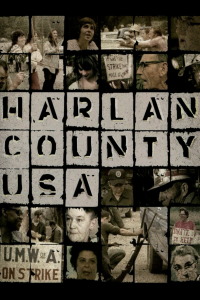
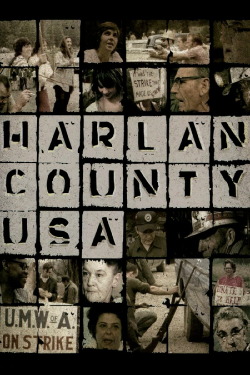
Harlan County, USA is a fantastic 1976 documentary directed by Barbara Kopple revealing the Brookside strike against Duke Power Company in Harlan County, Kentucky. The film recorded the struggle of the protagonists-miners who had been harshly exploited in Brookside mines and the reaction from different sectors of society.
In the summer of 1972, miners in Brookside mine started striking as the Duke Power Company rejected their request to sign the union contract to join the United Mine Workers of America (UMWA). By signing the contract and joining the union, the workers would gain guarantee in their salary and welfare. During this period, workers in Brookside mine suffered from poverty, abuse and diseases such as dark lung. Therefore, self-organized miners went out to form a picket line to prevent scabs entering the mine and forced the company to sign the contract. Later on when conflict became fierce, women-daughters, wives, mothers of the miners stood out to assist in raising fund and forming the picket line. Harlan County, USA was filmed with extreme closeness to the striking miners, "much of its success derives from the fact that filmmakers covered events in and around the coal fields for a period over four year"1. Barbara Kopple and her group was dedicated enough that they "could wait for months on end, shooting very little, just wait for the story to evolve, patiently recording it."2 Therefore audience are fortunate to see first-hand video recording significant moments in the strike.
Having abundant materials to edit and organize, the director utilized several cinematic techniques to better present those materials. The sound in Harlan County, USA was very impressive and effective in coordinate with the topic of the film. The folks that appeared as non-diegetic or diegetic sound strengthened the audience background knowledge and also highlighted the theme. For example, at the beginning of the film when the title was introduced, the director used a voice-over of a folk sung by an old miner while giving an extreme long shot showing the Brookside community. "Down in a deep hole, where the bright light did glow; back in a dark room, and spading up coal." The old miner's voice had a hoarse timbre, implying his long-term misery he experienced under coal mine. The lyrics directly reflexed miners' severe working environment: while hearing this song, it is facile to imagine miners working down in a mine underground, with no shine or wind, surrounded by polluted air, and bearing abuse of monitors. At the same time the film was shooting the desolate land, dusty sky, ramshackle houses and off-paint jeep in confirmation of what the lyric described. By giving multisensory stimulation to audience, the film successfully set an overall image of the hard life of miners in Harlan County. Similar tactics could also be found in other parts of the film. When the group of women finally achieved their goal and forced the police officer Sheriff to arrest Basil, one of the scabs, they were repeatedly singing "Just like a tree that's standing by the water, we shall not be moved". The repeating of this sentence their solidarity, optimism and determination in fighting with the scabs. The folks helped a lot in integrating the film while also enhanced the attraction of the film, making it much easier to for the audience to accept than some early observational films.
Another notable achievement of Harlan County, USA is how it effectively conveyed characters' emotion-sorrow, desperation, and wrath of miners. There were uses of medium-close up and close-up shots which focused on facial expression of the character nearly everywhere in the film. The facial expression as a branch of mise-en-scene helped to convey the emotion and thoughts of those characters to audience. Near the end of the film, after Lawrence Jones was shot in head and lying in the ward in hospital, the director interviewed his wife utilizing a medium close-up shot focusing on her facial expression. The young women, sixteen-years old, knowing the possibility of losing her husband, frowned her brows, had tears in her eyes, and half-covered her mouth with her hand. It is easy to tell that this poor young woman was in overwhelming anxiety. When asked about "Are you proud of your husband?" the women smiled but bitterly, still frowning her brows and answered in a really light voice "yes". The facial expression of the women revealed her internal conflict-the pursuing for constitutional rights finally led to a loss of her beloved person. This scene, in coordinate with later scenes in which people, even a male adult, wept for Lawrence Jones's death, created a sorrowful and helpless atmosphere which led the film to an emotional climax and became the most impressive part of the film.
The film was in great sympathy with miners who were exploited but never gave up fighting against the repression. It also implied the idea of feminism by observing the strike from the women's perspective. They gathered together to raise fund for the strike, to encourage their husbands, and finally choose to "fight in the frontier to 'man' the picket line by themselves"3. At the end of the film, Brookside miners finally got the contract signed by Duke Power Company, but soon after that they went on join another much more prevailing strike to search for better terms. By leaving such an open ending, the film stressed that the pursing for human rights will never cease, no matter what the cost will be.
Harlan County, USA impressed me with the strong spirit of the miners fighting against unfairness showed in the film. It was a documentary film with many dramatic traits, the plot of the whole story is about how good fight against evil, and though chronologically in general, the film was very suspenseful, therefore engaging and thought provoking. As the film was shot in extreme closeness to the miners, I was able to feel the sorrow, the determination and the helplessness of those miners as I was experiencing the strike with the miners and Barbara Kopple. Although the filmmakers' affection towards miners seemed lead to a one-sided view, ignoring the idea of scabs who may prefer compromise to gain an income and sustain their lives, Harlan County, USA is a valuable film to watch which not only records a remarkable event in history but also reveals an existing social conflicts remaining to be solved even nowadays.
References:
1. Harlan County, USA, Gray Crowdus, Pg2.
2. Filming in Harlan County, Gray Crowdus, Pg1.
3. Harlan County, USA, Gray Crowdus, Pg1.
This review of Harlan County U.S.A. (1977) was written by Square E on 30 Oct 2013.
Harlan County U.S.A. has generally received very positive reviews.
Was this review helpful?