Review of Harlan County U.S.A. (1977) by Mackenzie M — 11 Nov 2013
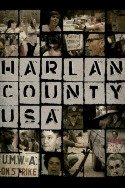
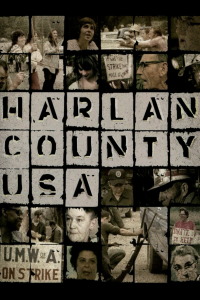
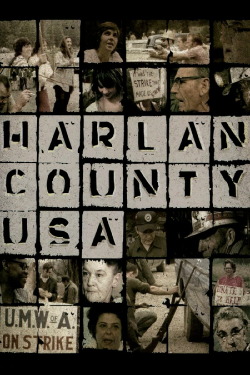
Directed by Barbara Kopple, Harlan County USA is a documentary that covers the struggle of coal miners' families for their memberships of the United Mine Workers of America (UMWA) and their union contracts in Harlan County, Kentucky, in 1973. The prominent characters in the strike not only include the coal miners, but also their wives and daughters who played crucial roles in the movement. Film critic Crowdus claims Kopple's work to be "one of the most significant documentary films on the labor movement ever produced in this country". Combining sound and cinematography, the director effectively presents the audience with a vivid picture of coal miners' working conditions and their determination to improve their rights.
As the director of the documentary film, Kopple chooses to take a stand with the coal miners and uncovers the story of the strike from their perspectives. The 13-month campaign started with the workers' initiatives to demand for the union contracts, whereas they immediately faced the opposition from Duke Power Company. The suppressed strikers initially made their voices heard by forming picket lines across the major road in Harlan County. In response to the campaign, Duke Power hired strike breakers and provided them with guns. Violence broke up occasionally and as a result, some strikers, both men and women, were arrested. Harlan County's effort towards the union contracts was further impeded by the inevitable politics within the union. One major malign political battle was the election for the president of the union. The competition between former president Tony Boyce and challenger Joseph Yablonski became so corrupted that the latter was eventually murdered. Having overcome the political differences, the movement reached its peak when Lawrence Jones, a young miner, was shot fatally. The death of Jones united the mining families unprecedentedly towards their goals for the contracts.
Throughout the documentary, sound is used as a powerful tool to express the intangible sufferings of the miners. In order to address the severe issues of black lungs and other diseases due to mining activities, Kopple tactically utilizes both diegetic sounds and non-diegetic sound. At the beginning of the film, we hear a non-diegetic plain singing of an old man. The revealing power of the sound is partially due to the absence of instruments. Without any background music, the extraordinarily rough timbre of the voice stands out. Meanwhile, the breathing can barely catch up with the lyrics. Upon hearing that, we can instantly imagine the tough life the old man has gone through and the sacrifice he has made. The folksy lyrics further reinforce the rough impression as the non-diegetic sound becomes diegetic: "My bones, they did ache me. My kneecaps got bad... I got sand in my hair. Both lungs were broke down from breathing bad air". The various physical sicknesses described in the lyrics, ranging from aching bones to broken lungs, are all results of working in coal mining without proper protection and necessary health care. Without displaying any medical images or making any technical arguments, Kopple succinctly utilizes the voice of a retired coal worker to bring live an artistic and persuasive revelation of miners' health damage due to poor working environment.
Apart from sound, cinematography is another technique heavily used in the film to demonstrate the evil nature of Duke Power Company. At about two thirds of the film, we see a scene where coal miners are attacked by Basil, the strike breaker, firing bullets from his car. Throughout the film, this is the only scene where Kopple decides to display the image in slow motion. The director tries to portray Basil as a representative of Duke Power. Because of the slow motion, we are able to have a clearer view of Basil pulling his gun out and pointing directly at the camera. The devil characteristic of Basil, and thus Duke Power, is deliberately magnified via the slow motion. The low camera angle also helps to establish Basil to be even more threatening. After the slow motion, the camera tracks in to the window of the car. In the close-up frame, we see Basil's mouth tightly closed and down. He also frowns his eyebrows. After the shooting, he only glimpses at the screaming group once, then turns his head away from the camera and simply drives away. The close-up shot and slow motion combine to emphasize the cold blooded hostility of Basil and Duke Power.
Using sound and cinematography, the director unapologetically stands with the coal miners and advocates for their rights. Kopple's bias become obvious as she spends the majority of the time focusing on the hardship of the miners and the apathy of Duke Power. The director believes that the cause of the strike - to obtain the union contract - is justified and that the human rights for the miners' families are undeniable. While black lungs and other physical damage caused by coal mining can be prevented, Duke Power Company are depicted to be reluctant to recognize the possibility for improvement or to take any action. The documentary mainly blames Duke Power for the current situation and conveys the message that the strike for the union contracts is the last resort for the miners.
If you are looking for an accurate and objective recount of a historical union movement, Harlan County USA may disappoint you. However, if you have a passion for activism and sympathy for hard working Americans, Kopple's documentary may resonates with your ideal. For me, the film maker masters the technique for sound and cinematography to justify the cause of the strike and promote a better working condition for the coal miners. Despite the possibility that the struggle for a better future may be far from an end, the courage to take on this journey and the persistence to continue are nonetheless precious.
This review of Harlan County U.S.A. (1977) was written by Mackenzie M on 11 Nov 2013.
Harlan County U.S.A. has generally received very positive reviews.
Was this review helpful?