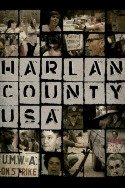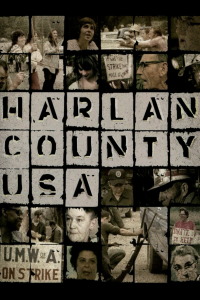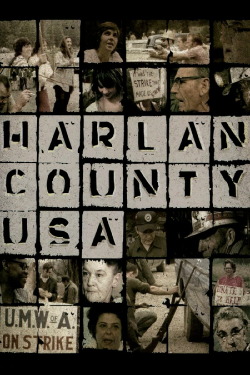
Review of Harlan County U.S.A. (1977) by Scott S — 30 Oct 2013
Harlan County USA: The Strikers' View.
"The unions are destroying the whole country" Basil Collins, Harlan County USA.
This may be the view of many people in the United States. Labor unions certainly play a big role in today's political and economic structure from settling agreements with companies to lobbying politicians. Though labor unions are targeted as some economists and the media as a cause of inflation and increased labor prices, Harlan County USA gives a new perspective on the people such unions support. The result is a shockingly new perspective on mine workers, their families, and their living conditions. Harlan County USA approaches the strikers' lives on the human level, creating compassion and pity to advocate their cause.
The film mainly focuses on the strikes in Brookside mines that started in June 1972. The main story revolves around the miners and their wives against the "scabs" and mining companies. The miners started the strike with picketing in roads and try to stop "scabs" or temporary workers from going to the mines to work. Car after car, the state police come in to "keep the roads open." The strikers tease the officers and the officers respond with laughs, having friendly conversation. When the scabs come through the roads, the strikers try to block the cars from going through. At first the officers try to pull the strikers off with their hand but soon enough they got frustrated and brought out long wooden sticks they use to grapple and pull the strikers by their necks and shove them into the police cars. Even their peaceful efforts to resist against their employers are being hindered by the state government.
As the picket line grew and the strikers became more organized in their efforts against the coal company. The strikebreakers bring in machine guns as the numbers of the picketers grew. The strikers are overpowered and scatter away as the heavy gunfire of the machine guns fire above their heads. Many in the confusion were beaten up and even the film camera was knocked out of the hands of the camera man giving a "frighteningly 'subjective' experience of a bodily assault by a strikebreaker." Scenes like this gave the idea of what it is like being in a strike: the horrors of gunshots and being knocked out.
After the violent one-way gunfight between the strikebreakers and the strikers, the wives of the strikers take a stand far away from the machine guns. The local sheriff comes to break the ladies up and get them out of the road. Then one of the ladies brings a warrant to arrest Basil Collins, the head of the strikebreakers. The sheriff reluctantly goes to Basil Collins and tells him to come to the Sheriff's office. Basil says that he will go when he gets his workers to work. When the sheriff allows this, the women protest saying that that's not fair and that he was not there when the gunfight happened and the strikers were fired at. Her argument is understandable and shows the frustration the strikers face while striking with the state level government and the local level police.
Harlan County USA excels in its use of music to describe the pitiful state the miners are in. The diegetic music -music that is directly done within the film not as a background- helps the audience understand parts of the story, introduces matters the film will be discussing and adds credibility to the lyrics. The opening scene which shows miners working smoothly transitions into an interview with an old retired miner. The lyrics "for 42 years I labored and toiled," "My bones did ache me", and "lungs broke down" describes the hard labor the miners go through and the medical consequences of their jobs. Another reason such music is effective is because an actual miner is shown singing it. The wrinkles all over his face, husky and croaky voice, and a crooked back instantly ensures that he is an ex-coal miner and creates a belief that the song was his story. Many scenes are connected in such manner adding credibility to the story of the lyrics and making the audience believe them, thus persuading the audience of the film's cause.
The film also uses creates great contrast when portraying mine executives and miners. The film constantly uses low angle takes, which the camera is stationed below the height of the object, when filming mining officials. This is comparable to where mass meetings of the miners are always filmed from a high angle. The low angle creates the subconscious feeling that the object being portrayed is powerful and strong while it does the opposite for the high angle. Also the scenes of the antagonists, except the ones for those portraying "scabs" and "gun thugs", are all in low angle. For example, when Carl Horn of Duke Power Co. explains the issues of the Harlan County strike to the shareholders the camera is low angle and zoomed to medium close range, only showing his chest and up as if a roman general's bust. He also shows signs of lack of interest and a general sense of apathy to the issue: he leans into the podium resting his weight on it, reads a script, his gestures are incoherent and random, showing no signs of preparation whatsoever. All composed with the low camera angle creates an apathetic authoritarian of a tyrant.
The director, Barbara Kopple, is clearly advocating the rights welfare of the mining. She never once says "this is this" or "that is that" but successfully creates an image that the large corporations are creating an economic unbalance and that they are also abusing their power and money by hiring "gun thugs" and "scabs" to intimidate the workers and hinder the labor union. She also mocks Duke Power officials and the corrupt labor union official Tony Boyle. She does this through presenting the facts first and then showing the corporate's side of the view. For example, when the film touches the issue of black lung or pneumoconiosis, she first shows the state of which the miners are with medical staff stating that coal mining is resulting in black lung and then shows an attorney stating that according to the "best informed medical opinion" coal mining does not necessarily cause black lung. By informing the reality first, the director discredits the words of the latter and creates his words of "we want to do the right thing." into words of a hypocrite. The next scene a man shocks his audience with black dust like material in his hand saying "this is one of your brother's lung's, this is preventable" further discrediting the attorney and his words of "doing the right thing.".
Overall the film is a shockingly accurate description of what the mine workers of 1970s and before went through. It represents the coal miners in a pitiful and compassionate way. It is a fine documentary where it is possible to understand the views and the reality of the coal miners instead of hearing it from the media. It approaches in the human level most media failed in. By portraying the miners as common people not glorifying them in such a way that they are godlike saints, the director clearly makes relatable factors about them, such as not being able to get up at 4 in the morning or having fights with your neighbor. All combined with the effective use of music and great cinematography- the angles and the zooms- Barbara Kopple has created a true piece of art that advocates the rights of miners.
Scott Skirata.
This review of Harlan County U.S.A. (1977) was written by Scott S on 30 Oct 2013.
Harlan County U.S.A. has generally received very positive reviews.
Was this review helpful?