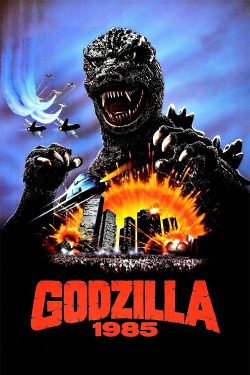
Review of Godzilla 1985 (1985) by Phillip C — 12 Apr 2013
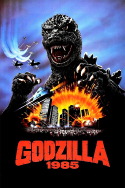
As an expositor of a dissenting opinion, I may invite great scorn and ridicule with this review. Nevertheless, I feel that Godzilla 1985 is an unfairly maligned classic. Derided by both American critics and genre purists, the stateside version of the film has been derisively characterized as either B-movie fodder or a bastardization of an otherwise good Japanese monster film. I submit to you that it qualifies as neither. I shall articulate this contention with a point-by-point address of the criticisms.
Criticism #1: "Raymond Burr's appearance in this film is both superfluous and unnecessary." While it is true that Burr's character does little more than stand around and opine about Godzilla as the embodiment of man's destructive propensities, one could argue that the Greek convention of the Chorus is equally as inconsequential. For instance, the Chorus in Sophocles' Antigone and Oedipus Rex really does nothing more than describe action that transpires offstage and restate the obvious concerning action that has occurred onstage. Yet, they also perform an ancillary function, facilitating the audience's catharsis with highly emotive commentary. Likewise, I feel that Burr's character serves a similar purpose. The character of newspaper journalist Steve Martin helps American audiences relate to Godzilla as the metaphorical incarnation of atomic destruction, albeit from a Western vantage point. Heretofore, the Japanese are the only people who can lay claim to intimate experiential knowledge concerning the tangible horrors of nuclear devastation. To a certain extent, Burr's soliloquies provide audiences with a crude verbal approximation of the Japanese sentiments concerning nuclear anxiety. Certainly, Burr's monologues don't thoroughly capture this fear, but at least they supply a fragmentary glimpse of this distinctly Japanese angst. Moreover, the inclusion of the character of Steve Martin instills the stateside version of the series with a sense of continuity. Apart from Emiko Yamane and Professor Shin'ichi Chujo, Steve Martin is the only character in the genre to make such a reappearance. Lastly, Burr's performance is not without its merit, bringing a nice somber and stoic tone to the film.
Criticism #2: "The American version is right-wing propaganda that vilifies the Soviets." This criticism is not without validity. It is true that New World edited certain portions of the narrative to reinforce the Manichean binary opposition that was endemic to Cold War epistemology (i.e., the dialectic of a "good" West against Reagan's so-called "Evil Empire"). I am by no means justifying these inherently jingoistic revisions. However, contrary to the opinions of many purists, the original version of the film is no more flattering to the Soviets than the American version. As a matter of fact, the original meeting between the Japanese prime minister and the Russian and American ambassadors underscores some core dialectical commonalities between the Cold war opponents. Both are proverbial "hawks," favoring the reactionary employment of nuclear weapons against Godzilla. In fact, the Russian and American ambassadors even come into agreement at one juncture, somewhat crudely reiterating Kissinger's pragmatic idealism by voicing a mutual derision for Japan's anti-nuclear principles. The point is that, while the American version is guilty of bleaching out the complexities of Cold war politics, it would be erroneous to conclude that the original Japanese version is any more sympathetic to the Soviets. So, the jingoistic revisions of the American version should not automatically undermine the film's legitimacy. If nothing else, they provide a fascinating study in how cinema can reflect the cultural prejudices of a nation.
Criticism #3: "The special effects are poor." This criticism is only partially valid. Yes, some of the effects are less-than-convincing, but others are actually quite good and attest to the resilience of Japanese filmmaking. This is not merely a textbook exercise in having an actor in a rubber suit trample cardboard buildings. Arguably, it never was. Such a characterization is an oversimplification. The miniatures are quite elaborate and the Godzilla suit has a wonderfully organic appearance. In addition, the film makes use of a larger mechanical Godzilla for shots that require more monster articulation. There are colorful and vibrant opticals throughout the film (e.g., lightening, lasers, atomic breath, etc.). The sets are especially detailed. From the dazzling lights of the Tokyo business district to the fiery cauldron of Mt. Mihara, the various environs of Godzilla 1985 induce a sense of wonder. Arguably, when combined with actual scenery and human subjects in colorful optical composites, even the more overtly synthetic visual elements still manage to create an alternate reality of sorts. Moreover, the fabrication of objectively realistic special effects in cinema seems to be a perennially elusive pursuit. In some cases, CGI produces images that are no more convincing than the miniatures and rubber suits of Japanese monster films. And, what exactly qualifies as objectively realistic special effects in the world of cinema? By and large, movies thrive on illusion. Seldom do they ever fully approximate the visual elements of reality. Even in the context of the actual world, what qualifies as visually realistic is problematic. For instance, some witnesses of the 1989 San Francisco earthquake drew upon scenes from Godzilla movies for visual analogues of their own experiences. In short, the special effects of Godzilla 1985 are a mixed bag, with even the less-than-convincing effects still being visually compelling. Thus, the derisive assessments of critics such as Roger Ebert and Vincent Canby are really unfair.
Criticism #4: "The dialogue is bad." This is one of the criticisms of Roger Ebert, who writes, "It is so consistently bad that the entire screenplay could be submitted as an example. My favorite moment occurs when the hero and heroine are clutching each other on a top floor of a skyscraper being torn apart by Godzilla and the professor leaps into the shot, says 'What has happened here?' and leaps out again without waiting for an answer." First of all, I have watched the film several times and have yet to see this alleged scene. Simply stated, it never occurs. It is basically Ebert's truncated account of what was actually a longer and more coherent scene. In all honesty, I don't think Ebert really paid attention while he was watching the movie. I think he entered with the presupposition that Godzilla 1985 automatically qualified as a bad film, thereby tainting the interpretative lens through which he would formulate his review. Secondly, there are several instances where the dialogue is actually better than the original Japanese script, which tends to be a wee bit clunky. True, some of the American dialogue is laced with clichés, but no more than the original.
Criticism #5: "The edits diminish the quality of the original film." Again, this criticism is not without validity. It is true that some of the thematic depth of the original film is lost, but the narrative thrust is improved considerably. In the original version, kinetic action sequences tend to lose momentum very quickly, unceremoniously staggering into moments of narrative inertia. Moreover, the original is replete with abortive music and sound cues. Portions of the score and certain sound effects end abruptly, thereby weakening the continuity and dramatic impact of some scenes. In fact, some scenes of destruction are conspicuously bereft of the cacophony one would associate with such carnage. These awkward instances are camouflaged rather smoothly by some of the American edits.
Of course, I don't expect this review to win over the hardcore detractors. Besides, converting the "unbeliever" is not really my objective. My point is that not all of the criticisms are necessarily fair ones. One could compellingly argue that, given the fact that I am an avid Godzilla fan, I am critically predisposed to automatically embrace Godzilla 1985 as a misunderstood cinematic gem. In response, I would argue that I have enjoyed very few of the Millennium-era Godzilla films. Thus, being a Godzilla fan does not mean that I will uncritically receive Godzilla 1985. I, myself, acknowledge the fact that it is by no means a perfect film. Yet, I would contest the assertion that Godzilla 1985 is devoid of any redeemable qualities. Ultimately, modern audiences of cult monster classics will have to decide for themselves. As for me, I believe Godzilla 1985 should occupy its own space on the shelf reserved for classic monster movies.
Oh, and it is vastly superior to Roland Emmerich's 1998 abomination. But then, what avid Godzilla hasn't expressed that sentiment? At any rate, I enjoyed Godzilla 1985 and, hopefully, so will you.
This review of Godzilla 1985 (1985) was written by Phillip C on 12 Apr 2013.
Godzilla 1985 has generally received mixed reviews.
Was this review helpful?