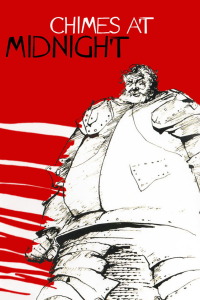
Review of Chimes at Midnight (1965) by Justin B — 18 Dec 2007
Hmmm. I've always held to the belief that film adaptations of books or plays can rewrite the stories however they want, so long as they do it better than the original. Alas, with Shakespeare, it is impossible to do anything better than in the original; the only option open to one is to completely reinvent the plays before filming them (like Van Sant did for My Own Private Idaho, which, incidentally, rips off this movie on more than one occasion). In the end, Shakespeare, as he exists on the page, just doesn't translate that well to the screen--or to the stage. The only way to fully appreciate him is to READ him, and repeatedly; one can stage all the possible versions of the plays in one's own mind, simultaneously, which is a richness no single adaptation can match.
Welles, though he greatly condenses the material, sticks closely to it, and more's the pity, for the reasons I stated above. Welles was, I think, one of the four or five absolute geniuses that the cinema has had so far, but even he cannot match the boundless invention of Shakespeare on his own terms; the movie often stumbles, and either the acting or visual elements fail the text in nearly every scene. Even Welles's usual brilliant direction just doesn't match his material, as there really is no comic timing to speak of; I dare say that Shakespeare doesn't work so well under Welles's hyper-editing, and might be better suited to the long-take style of someone like Rivette (now there's an idea...) Those moments which work best are those that are purely cinematic and not to be found in Shakespeare; for instance, the battle scene, which plays like Potemkin in overdrive, and unlike Eisenstein actually conveys a real sense of horror and disgust. But much of the rest of the film falls flat; Welles plays Falstaff as a dreadfully weary old man, which is a perfectly legitimate interpretation, I suppose, but the rest of the cast seems uncertain whether they're in a Shakespeare film or a Welles film--the weirdly theatrical behavior exhibited by most of the rest of the actors, that manages to be both deeply impassioned and emotionless at the same time, would certainly be ill-suited for either.
At this rate, I'm making this film sound like an utter failure, which it is not. The tragedy of it is that Welles set out once more to do the impossible, and for once he failed to achieve it. A much better example of his late genius, which was in many ways as powerful as that of his early works, can be found in the freewheeling "F for Fake," a mad, internal documentary that is happily untethered to both text and reality, or even "The Immortal Story," in which Welles embraces the various "New Waves" of the 60's (French, Italian, Czech) with open arms, and melds their innovations with his unique vision, though admittedly with some losses to the strengths of both. However, the brilliant Welles of "Kane" and "Ambersons" is not to be found here, and there's precious little of Shakespeare, either. That which does actually work in this movie (the battle scene, the dress rehearsal for Hal's meeting with his father, the renunciation scene) is pure gold; would there were more of it, impossible though that may be!
This review of Chimes at Midnight (1965) was written by Justin B on 18 Dec 2007.
Chimes at Midnight has generally received very positive reviews.
Was this review helpful?