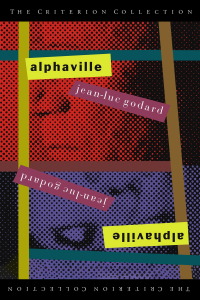
Review of Alphaville (1965) by Mark D — 22 Apr 2011
This is a film that will seem like a bunch of artsty-fartsy junk, until (if) the sharp knife-edge of the concept ('concept' is a bad word, 'awarness' might be better) that this all points to suddenly clicks. Then it all makes perfect sense, and if you go back and watch it again, it's smooth and simple, and all the distractions of what seemed cheap, pointlessly weird, messed up, whatever, either just don't matter or even add to the whole thing.
But then I would say that point is a philosophical and/or 'poetic' one and I'm not sure how much it's really evoked, forced to seep into our direct perceptions, by the film, by what we actually see and experience. It becomes a text shown via a narrative with voices, scenes, etc., but ultimately a text about the 'human condition', leaving me unsure what all the filmed content adds to it. The dialogue could be read alone and perhaps give as much, and not intensely focusing on the words in the film will leave the viewer lost and with nothing gained, it seems to me. But maybe I'm wrong.
But then there are all those odd elements (like the setting, where what we see is just the Paris of the time, and all sorts of obviously non-future society things, as well as plainly no intergalactic travel, though this is supposedly what's going on (it's kind of like when you see a theatre performance, with no props and costumes, and none of the places and distances in the story, and you just have to imagine those things (or as in 'Dogville')) or the strange b-movie detective element of it, where the main character is actually from other detective movies, and Dick Tracy is mentioned, etc., and he is a coarse, macho, mac wearing American, from 'Nueva York' and drives a Ford Galaxy, etc., etc.), and all these elements are hard for me to fathom clearly, but I think are deliberately intended to involve us in a specific way, maybe bringing us 'closer to home', or maybe seeing those aspects as mere 'details' and irrelevant. They might seem crazy, cheap, unimaginative, but I think they're deliberate, and then, perhaps, they do something to us. I'm not sure. But yeah, again, this is all full of poetry and riddles and philosophical ideas (a lot, it seems, from Eluard and Borges), and ultimately, to me, comes down to a sharp point of view about reality, life and death and meaning that is simply conveyed mainly by the words, presented in this odd context and by the cinematic medium. Perhaps beyond the words it's as simple as that it's set in the present day to show how the main point of this is 'here and now' and at any time, and the detective simply is an example of passion, a giving of control to something beyond pure logic. That would be quite banal, but maybe fair enough, but the ideas put across are nonetheless powerful.
And, of course, I know people will say they hate those who watch'pretentious crap' and who say that those who call it that 'don't get it', and that those people will say that actually they do 'get it', but it just is 'pretentious crap', but I'm sorry to say that that people 'don't get it' is true, and there's nothing unnatural about that or offensive in saying it. it's just true, and so it should be for any film, or anything else, that hopes to broaden or deepen our perceptions. This film is about that very 'split' in perception that might make people unable to 'get this'. Alpha 60 doesn't get it, but then seemingly later does, or has an inkling of it that his logic can't deal with, because to 'pure logic' it's meaningless, because that's not where meaning really lies.
People can say that it's a banal idea about how 'love' and 'poetry' are above 'logic', etc. and how that's either crap, or just simplistic, but if they think that, they just still don't get it, I'm sorry; they've only scraped the surface of what's being expressed. Only if the final words of Alpha 60 make crystal clear sense to you, and all the other 'riddles' in here, like from Eluard's poetry and much else, do I think you could claim you might 'get it' - "Time is a river that carries me along, but I am time. It's a tiger, tearing me apart, but I am the tiger. It is our misfortune that the world is reality and I, it is my misfortune that I am myself, Alpha 60." Why people should be offended by the idea that a film (or anything else) should present anything that they might need to really work on to 'get', I don't know, seeing as otherwise it means that it's simply not offering you something new. No one gets something that teaches you something until they've pondered on it hard, worked at it, whatever, so we're all people who didn't 'get it' at first, and not 'pretentious snobs'. He made this film to help things be seen, but the very nature of what he's exposing means it can't be said plainly to you. If you say 'why not?', then, well, sorry, but you still don't 'get it'. It's in the words, in the poetry, and it's what's being pointed at by those words but can never actually be said in words, and only giving yourself up to them can that awareness be awakened, and perhaps that's the same of everything else we experience in this film. Until it clicks it doesn't fit in our logical view of things, and is 'junk', but when it clicks it sits very nicely with that awareness, and suddenly becomes a gem.
This review of Alphaville (1965) was written by Mark D on 22 Apr 2011.
Alphaville has generally received positive reviews.
Was this review helpful?