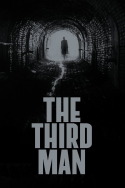
Review of The Third Man (1949) by Cole P — 15 Oct 2011
Never before have I seen a film noir executed in such a masterfully done style, pinpointing everything vital about the sub-genre whilst captivating my general attitude towards film noirs to an unfathomable level. This film was brilliant; sheer brilliance from start to finish. It's astounding. There's a little of Casablanca in there. There's a little of Double Indemnity in there. There's things that foreshadowed Polanski's Chinatown. The Third Man is the cosmopolitan center of the universe in this style of film, in which all other film noirs orbit around.
It's hard to divulge into the story without giving away spoilers, but I'll say that it follows an American man named Holly Martins who has entered Vienna to seek employment under his friend, Harry Lime. Lime, in turn, is the subject to many mutual friends and enemies. The vexatious revelation is equally as mysterious as it is perilous for Martins , who determines to uncover the many secrets of his elusive friend. Joseph Cottens plays Holly Martins like the archetypal American cowboy. It's amusing to watch him go rogue, as he mingles and meshes with the Viennese society. Perhaps he's reeling in the sappy fiction of his Western cowboy books. Whatever the reason, his antics and parochial English make him the perfect candidate for getting (so to speak) lost in translation. He doesn't understand the Russian police, he avoids the Viennese locals, he's at odds with the Austrians, and he fences with the snooty Brits. Because of this, it makes cooperation difficult and progression with his case (on any level) exceedingly difficult.
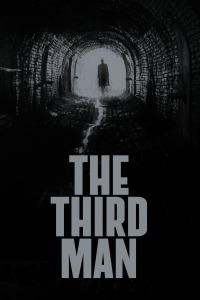
Carol Reed helms this richly enigmatic movie. His direction is astounding. The streets of Vienna post-World War II have never looked more cadaverous, opaque, and yet stunningly alive. To start, the city is a character in itself. It's filled with endless alleyways, subdivisions, concrete tenements, and Anglo-Saxon Renaissance architecture. Accentuating its geography are several divided districts, ruled by British, Americans, Italians, Dutch, German, Russians (aka, the setting of a James Bond movie's wet dream). The multilingual level of the city is also richly layered by these different ethnic groups. But beneath the surface is an entirely different Vienna, characterized by a labyrinthine sewage system and a cavernous, murky grotto. In essence, the dichotomy of the city is contrasted perfectly--so perfectly in fact, that I have never before seen a city better portrayed on film.
Besides its metaphorical structure of tangible shadows and entangling tunnels, it is also paramount to recognize the film's notable camera angles. Reed frequently has the frames at a slight tilt--as if to suggest that something totally wrong is about to capsize. I'm fairly sure this was intentional, or femme fatale Anna Schmidt's line about "everything is upside down" wouldn't have meant anything. And indeed, by the finale, this declaration rings true.
The Third Man is a near perfect movie. It's highly original on its take of the film noir style, and it delivered something refreshing and new to the usual atmospheric dramas. Because of this, I still see its legacy carrying on for an unpredictable length of time. Its direction, juxtaposed music, cinematography, story, and acting will maintain a longstanding effect for...well, ever.
PS.
Let me also talk about Orson Welles, because it's seemingly impossible to see this review to fruition without doing so. Welles steals the show in the same way that Marlon Brando devoured Apocalypse Now (no pun intended). And like Brando's Kurtz, Welles disappeared right into the shadows.
This review of The Third Man (1949) was written by Cole P on 15 Oct 2011.
The Third Man has generally received very positive reviews.
Was this review helpful?