Review of The Ten Commandments (1956) by Lisa M — 25 Sep 2012
Elizabeth Moss.
REL-110-FON01.
Movie Review Extra Credit.
"The Ten Commandments".
Judaism.
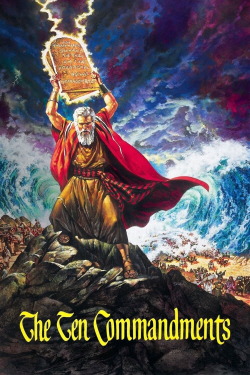
During the rule of Rameses I in Ancient Egypt, the pharaoh is informed that the Hebrew slaves believe that a recently seen star portends the arrival of a deliverer who will free them. Wanting to subvert the deliverer, yet unwilling to kill all the Hebrew slaves, Rameses I theorizes that the deliverer must be newly born and so orders the death of every male, Hebrew infant. To escape the edict of Egypt's Pharoah, Rameses I, condemning all first-born Hebrew males, the infant Moses is set on the Nile in a basket. Saved by the pharaoh's daughter Bithiah, he is adopted by her and brought up in the court of her brother, Pharaoh Seti. Moses gains Seti's favor. Years later, Bithiah's brother Sethi is pharaoh, and Moses is much loved by the Egyptians, even more than Sethi's own son, Rameses II. Rameses is deeply jealous of Moses, who has returned from Ethiopia after conquering it in Sethi's name. Sethi chides Rameses for not completing the treasure city for his upcoming jubilee, and Rameses blames his failure on the stubbornness of the Hebrew slaves. At Rameses' urging, Sethi sends Moses to oversee the new city's construction, much to the dismay of Nefretiri, the princess who must marry Sethi's heir. Nefretiri is in love with Moses, who shares her passion, even though Sethi has not announced whether Moses or Rameses will succeed him. When his Hebrew heritage is revealed, Moses is cast out of Egypt, and makes his way across the desert where he marries, has a son and is commanded by God to return to Egypt to free the Hebrews from slavery. One day, Moses sees a burning bush on Mt. Sinai, the holy mountain of God. Climbing up the mountain, upon which no mortal man has set foot before, Moses finds the burning bush and hears the voice of God, who orders him to return to Egypt and lead the Israelites to Sinai, where they will receive God's laws. Although he still doubts his ability to serve God, Moses is touched by the "light of the eternal mind," and Joshua, who escaped from Egypt, accompanies him, as does Sephora.Upon reaching Egypt, Moses confronts Rameses, demanding that his people be freed. Rameses laughs at Moses' proclamation that he brings the word of God, although Nefretiri is thrilled to see that Moses is alive. When Moses turns his staff into a serpent that swallows up the serpents produced by the Egyptian priests, Rameses dismisses his actions as a magician's tricks, then continues to ignore Moses' pleas to free his people, even though God sets loose nine plagues upon Egypt. Finally, after Moses turns the Nile into blood for seven days, Rameses' advisors urge him to acquiesce, but the pharaoh insists that there must be a natural explanation for the phenomenon. When Rameses again denies Moses, Moses asserts that one final, terrible plague will be brought upon the Egyptians by Rameses' own words. Rameses declares that the next day, his soldiers will kill all the firstborn Hebrew children. Rameses' words are turned back upon him, however, when the Hebrews protect their children by painting their doors with lambs' blood, and a spreading pestilence kills every other firstborn child, including Rameses' own son. Grief-stricken, Rameses grants the slaves their freedom. The vengeful Nefretiri taunts Rameses until he orders his charioteers to chase the freed slaves. Soon the Egyptian forces find the Hebrews by the Red Sea. To demonstrate the power of the Lord, Moses uses his staff to part the Red Sea and clear a path for the Hebrews, while God's pillar of fire holds back the chariots. When the fire dissipates, Rameses orders his soldiers to cross the Red Sea, but before they can reach the Hebrews, Moses restores the sea and the Egyptians are drowned. Defeated, Rameses returns to the palace and there declares to Nefretiri that the god of Moses cannot be defied. Soon after, Moses leads his people to the base of Mt. Sinai and ascends the mountain to receive God's laws. As forty days pass, the people grow anxious, with Dathan proclaiming that because Moses must be dead, the people should return to Egypt, where at least they can find food. Dathan assures the people that if they follow an Egyptian idol, they will be safe from the pharaoh's wrath, and Aaron is ordered to craft a large, golden calf. Meanwhile, on the mountain, Moses witnesses God's finger carve His ten commandments on two stone tablets. When Moses comes down from the mountain to share the laws, he is horrified to see the people worshipping the calf. Dathan attempts to defy Moses, but Moses throws the tablets on the ground, causing an immense earthquake that swallows the nonbelievers. Although they are forced by God's anger to wander the wilderness for forty years, Moses and his people remain strong in their faith, until one day, they come to the River Jordan, across which lays their promised land. Moses informs his family that God has told him that he shall not pass the river. He gives his staff and robe to Joshua, thereby appointing him the new leader.
This review of The Ten Commandments (1956) was written by Lisa M on 25 Sep 2012.
The Ten Commandments has generally received positive reviews.
Was this review helpful?