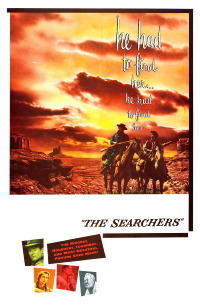
Review of The Searchers (1956) by Jennifer D — 21 May 2009
The Searchers is John Wayne's finest performance. For the first time in any Western, his laconic style, drawling speech and crooked grin are appropriate as the anti hero Ethan Edwards. He returns to his brother's farm 3 years after the Civil War. Little is known of his whereabouts during that time except references that he was on the wrong side of the law. Edwards is a bitter loner who hates people in general but especially hates Indians. After his brother's farm is destroyed by a Comanche raid and his nieces are captured he vows to hunt the raiding party and find his nieces. Throughout the film the focus is on Edwards who is dealing with his hatred of Indians, his uncompromising nature and his willingness to use violence and intimidation to meet his objective. His hatred for Indians is so intense that he is prepared to kill his niece when he discovers that she is married to one of the Comanche leaders, Scar. There is an interesting relationship between Scar and Edwards. Like Edwards, Scar has a vengeful hatred of Texicans. Both men are driven by that obsession. This is the central theme of the film - racism. Ford made an effort in this movie to examine the issues of racism and genocide towards Native Americans. Ford's was not the first film to attempt this, nor the most polished as regards the effort, but it was startling (particularly for later generations) in the harshness of its approach toward that racism. Ford's examination of racism starts with the racism of his hero. (That "hero" is hardly conventional.)John Ford, as his interviews give evidence, unquestionably felt strongly about the plight of the Native Americans, and the way that white society had smashed their culture and thrown them aside. His landmark work The Searchers was an attempt to examine how this plight had come to pass, and how racism had turned into genocide. The theme of miscegenation also runs through this movie. Ethan says repeatedly that he will kill his niece rather than have her living with a buck. He says "living with the Comanche ain't living." Even one of the movie's gentler characters, Vera Miles's Laurie, tells Martin when he explains he must protect his adoptive sister, that "Ethan will put a bullet in her brain. I tell you Martha would want him to." This outburst made clear that even the supposedly gentler characters were thoroughly tainted by racism and the fear of miscegenation.
Ultimately, supported by the Texas rangers, Edwards and Charlie (adopted by Edward's family) are able to successfully raid Scar's camp and rescue his niece. However, it is Charlie who saves the girl and it is he who prevents Edwards from killing her in the first place. In one of film historys' most dramatic moments when Ethan has cornered Debbie he raises her in his huge arms as he did when he first saw her as a child and tells her "lets go home Debbie." The scene has been interpretated by many as Ethan's redemption. Perhaps it is but it leaves the question hanging - does one decent act compensate for all of Ethan's past crimes, racism and killings. Why Ethan turns against his instincts and spares his niece is not clear. It is difficult to understand what drives Ethan and his emotions. Notice at the destruction of his brother's farmhouse he calls out for Martha and the girls. He does not look for or mourn his brother and nephew and makes no reference about them during the rest of the film.
John Ford's landscape shots of Monument Valley are wonderful and truly captivating as they emphasise the harshness of the landscape which produces men like Edwards who excels in its roughness and find more comfort in the desert and the mountains, than in the comforts of home. This is presented to us in the final five minutes of the film. Edwards and Charlie bring Debbie home and as everyone enters, only Edwards is left on the porch. He briefly contemplates before walking into the wilderness, rejecting the household and family which he could never be a part of. Here Ford is emphasising that Edwards represents the type of men that helped create America: harsh, brutal, uncompromising, stoic yet necessary. A testimony to the hardy frontiersmen, who will never be forgotten.
This review of The Searchers (1956) was written by Jennifer D on 21 May 2009.
The Searchers has generally received very positive reviews.
Was this review helpful?