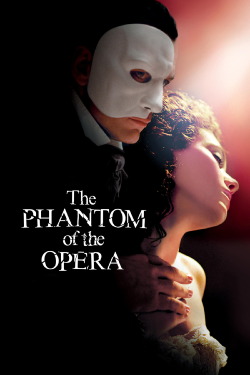
Review of The Phantom of the Opera (2004) by Spangle — 11 May 2017
A film with the music and lyrics provided by Andrew Lloyd Webber could hardly go wrong and Joel Schumacher's The Phantom of the Opera certainly does not take many missteps. While his sense of spectacle can be a bit too flamboyantly gaudy at times, it is hard to deny the visual stimuli on display that Schumacher presents, opting for a bombastic musical akin to Baz Luhrmann's Moulin Rouge!. With raucous crowds, gorgeous production design, and extravagant costume design, The Phantom of the Opera is a lively and inspired musical with excellent performances, solid direction, and phenomenal music that always manages to lift the film up if it ever slacks off. Putting this all into one finished product results in a good musical that is tragic, beautiful, and infused with excellent style.
Opening with a black-and-white sequence set in 1919 Paris, the film shows an auction taking place with memorabilia from the opera house being sold. One such item is the infamous chandelier from the night of the disaster, which is sold as item #666. As it is lifted up to be demonstrated, the film beautifully transitions to color with every inch of the frame being absorbed by vibrant golds and reds as the opera house is brought back to glorious life. An inspirational moment from Schumacher to open the film, it may be the creative peak of the film on his part, but it is an undeniably high one and sets the tone from the very beginning: this is a spectacle. The scene immediately following features the first song as delivered by Minnie Driver's Carlotta Giudicelli, who is the prima donna and diva of the opera. Living up to those titles, she is self-absorbed and unafraid to demonstrate how in love with herself she is at every turn. In this opening number, the sensually extravagant choreography and vibrant use of color provide the film with a fittingly loud and wondrous opener. With a lot of visual conflict, Schumacher plays all the right notes from the very beginning of this film creating beautiful chaos in the film's presentation and sea of color. Accompanying this opening number is an introduction to Christine Daae (Emmy Rossum). A beautiful, but unknown, dancer, Christine was raised in the opera house and has been taught to sing by the mysterious Phantom of the Opera (Gerard Butler). Ogled by the male gaze of the camera and of the opera houses new owners, Christine's peril is forcefully thrust into focus as we see her introduced as a talented girl, but one at the behest of dangerous men around every corner. With the Phantom trying to possess her and keep her for his own pleasure as a wife, Christine has her back against the wall. The men of the opera house still do view Carlotta as their lottery ticket, but are certainly taken by Christine's beauty. Meanwhile, the Phantom orchestrates productions to ensure she is the lead singer and tries to keep other men such as Raoul (Patrick Wilson) out of her life. She is a woman left with very little choice as to where to go and what to do in order to live the life she desires. In essence, she continuously finds herself being past the "point of no return" as a result of letting the mysterious Phantom into her life.
Her only savior is Raoul. Reigniting a romance with Raoul over the course of the film, the film finds great fire and passion in their love throughout, but the writing certainly does it a disservice at times. The dialogue can be awkwardly presented, especially whenever Raoul comes to save Christine from her lovesick and deeply obsessed Phantom admirer. Fortunately, the music greatly elevates their love scenes with the duets between Emmy Rossum and Patrick Wilson being extraordinary. With snow falling on the roof of the opera as the two serenade one another with "All I Ask of You", Schumacher finds similar glamour in this small, intimate moment. The two's vivacious and impassioned performances creates beautiful harmony that ensures the performance is the best one in the film. The two play off of one another beautifully and both deliver pitch perfect notes. In staging the scene, Schumacher also finds an opportunity to further demonstrate the Phantom's looming presence. Hiding behind a statue and watching the couple sing and dance, the camera often racks focus between the couple and the voyeuristic Phantom. Highlighting the joy of Christine when in the arms of Raoul and the loneliness and isolation experienced by the Phantom, the scene is not just beautifully sung and written, but also terrifically staged and framed.
With the death of Christine's father being the event that brought her together with the Phantom as a child, it is only natural that one of the best moments of the film comes with Christine visiting her father's tomb in the cemetery. A gray and blue sequence with mist rising off of the ground as Christine walks to the tomb and sings "Wishing You Were Somehow Here Again", the song is beautifully sung by Rossum.
This review of The Phantom of the Opera (2004) was written by Spangle on 11 May 2017.
The Phantom of the Opera has generally received positive reviews.
Was this review helpful?