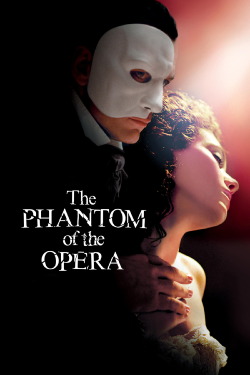
Review of The Phantom of the Opera (2004) by Peter A — 03 Jan 2014
I'm biased. I really like the story and the music so it would take a lot for me to dislike a Phantom of the Opera production. So I think this movie is decent, even despite its flaws.
I normally like Gerard Butler, but he wasn't right for the role as the Phantom. His singing was off, discordant. It just didn't sound right. His Phantom wasn't very menacing either. This is a demented person, a homicidal pedophile who stalks a girl for years while also extorting the theatre owners. Butler brings the intensity to the role, but I never get creeped out or afraid of what he might do next. Seems like he needed to channel a little of what Christian Bale did for American Psycho to get at the kind of monstrous soul the Phantom has. Butler also didn't give us a very sympathetic character. We learn the guy was tormented and abused as a child which helps explain the anti-social behavior. That abuse, though, should help us connect with the Phantom and give us a queer feeling, like I hate & fear him, but I can't help feeling sorry for him too.
Emmy Rossum and Patrick Wilson are okay as Christine & Raoul. They sing well, but there is so little focus on their romance that it's hard to believe they're actually in love. It just happens as they sing through a scene. Instead, the movie tends to focus more on the woes of the Opera House's new owners as they deal with their Phantom problems.
That is an interesting focus, though, on the theatre's owners. They're new money who made their fortune off the Industrial Revolution. They buy this Opera House as both investment and as their entry point into high society thanks to patronage from Raoul, who represents the Old Money of aristocracy. There's a social commentary here about the way business interferes with art, with how money influences celebrity, as depicted by how Minnie Driver's La Carlotta is flattered then set aside, and with how wealth can influence superstition. The owners at first refuse to believe in the Phantom and rebuff his demands for money and a box seat. When he murders a stagehand, the owners react in fright then later find a way to capitalize on the scandal. It's an interesting commentary. Too bad it takes away from what audiences wanted to see: a melodramatic romance, a monster movie and a lavish Broadway production.
The production itself isn't bad. I like the transition from the prologue in 1919 to the story in 1870 as the Opera House was brought back to life. The large-scale music numbers were pretty good, but I think they could've been bigger, given what a movie can be capable of. The direction and the editing were off on many of those scenes. Moments that should've had a big emotional punch instead dealt a glancing blow. You can see it in how what shots were chosen and used.
This is an okay movie if you like musicals, including those based on Broadway productions. It has some heart and intensity. The music is still good even if what's on the screen is mediocre. But wouldn't it be great if we could get a version of Phantom of the Opera that didn't involve a teenage girl, too naive for her own good, being stalked by a homicidal pedophile who she actually believes is an angel? It might be cool instead to mix Phantom with Friday the 13th. Y'know, instead of a disfigured man, it turns out Christine became a seriously disturbed child after he father died and she was orphaned. So as she got older, she took theater superstitions and fanned them into this legend of a phantom where she extorted money and arranged the occasional murder to keep fear alive. And, like Jason Voorhee's mother, we don't find out she's the Phantom until the end or something. I dunno. I'm just brainstorming.
This review of The Phantom of the Opera (2004) was written by Peter A on 03 Jan 2014.
The Phantom of the Opera has generally received positive reviews.
Was this review helpful?