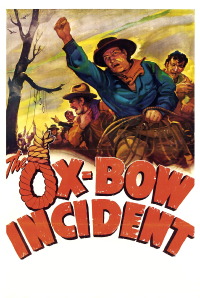
Review of The Ox-Bow Incident (1943) by Anders H — 12 Oct 2010
This is my second Western review and I thought long and hard about which one I should talk about. As you can see from my Searchers review, I am a Western fan. I grew up watching them along with my older Brother Adam. As we have got older we have collected many westerns that we never saw when we were kids and are love for westerns and as well as films has got bigger. I got this film for my birthday along with two Spaghetti Westerns called Django and The Great Silence. This film, The Ox Bow Incident, I saw on a sunny September day before I had a driverâ??s lesson. I was very close to finishing this film when my driving instructor arrived and I was a little pissed off due to the fact I was really enjoying this film and wanted to carry on watching the movie. During the film I felt really involved with the events of the film as well the characters and I just felt at the end of the film feeling sad and a little bit depressed. This is the first western that I have seen that has ever made me feel sad at the end of it.
William A Wellman directed the movie. He was a famous director of films such as The High and The Mighty, Yellow Sky, Buffalo Bill, The Story of GI Joe and Island in the Sky. Two of these films star John Wayne. The film was released during World War 2 in the year 1943 and the themes of the film fit well with the troubling times as I think it still does today. The film stars Veteran actors Henry Fonda (The Grapes of Wrath, My Darling Clementine, Young Mr Lincoln and On Golden Pond) and Harry Morgan (TV Series of MASH, Bend of The River, The Far Country, Backlash and The Shootist) who play two drifters who come into a deserted town, which Henry Fonda describes as â??deader than a Payuteâ??s graveâ??. They go to the Saloon to have a drink and Henry Fonda asks about a girl who is in the portrait on the wall of the saloon posing with a guy watching her from behind. This starts the film off and then turns into darker territory as a man comes rushing in and tells everyone that a well-known Rancher Larry Kincaid has been murdered and his cattle have been stolen. This stirs everyone up and the town forms a posse led by Major Tetley played by Frank Conroy who dresses in a confederate uniform. The posse consists of many blood thirsty men who want to see their own brand of justice, which means that they are going to lynch the men who they think are responsible. Henry Fonda and Harry Morgan tag along to see what happens and hope they can do something to straighten things out and be a voice of reason, which Henry Fonda usually is along with Screen legend Gary Cooper (Who was going to play Fondaâ??s character). They hear of three men who have the cattle with the brand of the dead Rancher and go after them despite peopleâ??s reasoning. The lynch mob are so blinded by prejudice and hate that they believe this three men did it and go off to lynch them. They come across the three men played by Dana Andrews, Anthony Quinn and Francis Ford (John Fordâ??s brother). These three men try to prove their innocence without any proof except their word that they bought the cattle. They are given till the next morning to prove their innocence otherwise they will be hung. During this the group is split and seven men who believe the men should be taken back for trial, which includes Henry Fonda and Harry Morgan as well as Major Tetleyâ??s cowardly and possibly homosexual son Gerald Tetley played by William Eythe. His father is ashamed of him and refers to him as a woman and not worthy of his blood, which I found very sad and made me hate Major Tetley more. This is the basic plot of the film all fitted in to a mere 75 minutes and a lot happens in that space of time.
Henry Fondaâ??s character is very interesting and I believe is one of his best performances along with 12 Angry Men, Young Mr Lincoln, Once Upon a Time in the West and My Darling Clementine. Like 12 Angry Men, Henry Fonda plays the voice of reason and is horrified by the lynch mobs horrible bloodlust and their plans to go on lynching the three men. They wonâ??t listen to the men and the facts due to lack of evidence that they bought the cattle. Some of them want to hang the three men who believe that it is justice that they are doing. One of them was a worker and a friend of the rancher killed and wants to see justice served. Some of them want to see a good hanging and some want to see a hanging to fuel their cruel sadistic nature, which embodies the fake sadistic southern Major Tetley who Fonda calls a man who â??never even saw the South until after the warâ??. Thereâ??s not really much mystery in Fondaâ??s character because he has come to the town looking for a girl who he finds out is married and her husband says he can call on them but he tells him she is his wife. This scene I found very random and I felt didnâ??t need to be in it because it didnâ??t drive the story and we donâ??t see her again after this scene. The rest of the cast play their characters brilliantly and as this is an ensemble cast everyone supports each other skilfully under Wellmanâ??s direction.
The main bulk of the film happens in the place where they find the accused, called the Ox Bow. This part of the film I found very moving and hard to watch because of the way the townsfolk are towards the accused. This part of the film shows what human beings are capable of. When there are no laws people can influence their own kind of justice over others and do what they think are the right thing. This part of the film is where I felt emotionally involved and I was like listen to these people, they didnâ??t do it and where is the sheriff when you need him. You as the audience want the men to listen to the accused but their prejudice and sadistic nature has blinded them and there is no sense of humanity in them. The seven men seem to show some sympathy but seem powerless to stop what is going to happen. This might be the darkest western next to The Searchers I have ever seen. The Lynching scene in the film is one of the saddest and most heart breaking scenes I have ever seen and is so beautifully shot and the music accompanies it makes it powerful. This is why I nearly broke out in tears during this film. Others who read this and find out I nearly cried at the end of a western may refer to me as being wimpy, female or in a really Bryanston Public Boarding school manner, GAY. But the people who think that can just shut up and go to hell. People feel some emotion when watching movies and its either happiness, shock or sadness. Countless women have cried at the end of Steel Magnolias and many kids cried when Bambiâ??s mum gets killed. Thereâ??s nothing wrong with it. It means that this movie has had an effect on you and these sorts of things in movies stick with you and you remember that effect as well as the movie and you enjoy it more.
The film is in black and white and adds to the dark atmosphere. Its like a Film Noir Western much like John Fords The Man Who Shot Liberty Valance. Gone are the great landscapes of monument valley and gone are dusty trails. The setting does change to the dusty trails but you feel that they have all been taking place on a set. This is a good thing because it shows the theatricality of the drama. The main thing that is important in this film is the atmosphere of the town as it makes the audience understand the behaviour of the male inhabitants. The first time we see the town it is deserted and all that inhabits the streets is a wandering dog, which appears at the end. The other sign of life is in the saloon where Fonda and Harry Morgan go in and come across the locals. The dialogue is well written in the first scene. This is where we get to know the characters and the concerns and situations of the main protagonists. The ending scene also takes place in the saloon where all the men gather around and sit and sulk in silence about the films events. This scene is very emotional and poignant because Henry Fonda reads out the letter that one of the accused had wrote and we find that he understood what true justice was and â??Itâ??s the very conscience of humanityâ??. Family values have since long gone with the men and have been absent from their lives.
This is a film I think everyone should see because I think it is relevant today as it was back in 1943 when it came out. People should take in the moral message of the film and it will move you as it did me. People who are Western fans should have this in their collection and people who are die-hard Western fans should see it. Thank you and Goodbye. Hope to bring you more Western reviews and many other reviews on other types of film soon.
A.H.
This review of The Ox-Bow Incident (1943) was written by Anders H on 12 Oct 2010.
The Ox-Bow Incident has generally received very positive reviews.
Was this review helpful?