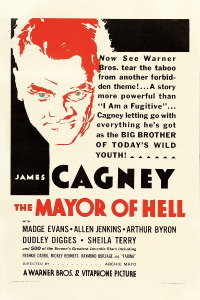
Review of The Mayor of Hell (1933) by Morris N — 28 Jun 2011
Reform Comes to the Reform School.
I think this movie may be a little overdone. The trailer goes on about how "fearless" and "dramatic" it is, and of course there is the title. You would think we would see constant beatings, deaths covered up, boys living in squalor--at least a prison riot or two. And while I suppose there is technically one, there at the end, it's a pretty tame riot. There are a couple of deaths in the movie, but there is very little violence. In point of fact, one of them is probably from the effects sleeping in a shack on a cold night have on tuberculosis, and there's no way to be sure that the kid wouldn't have died by the end of the picture of just general lack of proper treatment anyway. What's more, while it's quite clear that these kids have a hard life, and while the reform school is mismanaged and probably in the long run at least as bad for the kids as being on the street, the kids would be pretty shocked by how much worse state prison would be.
Our story starts with an integrated, or at least somewhat integrated, band of hoodlum kids led by Jimmy Smith (Frankie Darro). They end up getting sent off to reform school for robbing a candy store and injuring the owner. It turns out the reform school is run by the corrupt Mr. Thompson (Dudley Digges), who is not so much interested in the "reform" end of things so much as making sure the boys do what they're told. What's more, he's skimming off the state funds, and the boys are ill-fed, ill-clothed, and just generally ill-treated. Nurse Dorothy Griffith (Madge Evans) wants things to be run better, more in tune with modern principles, but Thompson doesn't care. However, in comes Patsy Gargan (James Cagney), who has gotten the position as a stopover on the way to a slightly higher patronage job, and Patsy wants to impress Dorothy, so he decides to run the place her way, including making Jimmy "mayor" and appointing other boys to other positions of "authority." And all goes well until Patsy shoots a guy and ends up on the lam.
The interesting thing is that it's called a "reform school" even though the original uses of the place do not seem to include reform in any meaningful way. I'm not a hundred percent sure what they actually are doing with the boys, but it never really seems to come up that they might want something to do with the "school" part of the name. The only time they ever have books is what is probably hymnals or something. Anyway, it's specifically stated to be church. The point is, even the most hardened anti-reform advocate must surely acknowledge that the point of sending someone to prison is to prevent them from harming society, and these boys are going to get out sooner rather than later. One boy's mother says that one of her sons went into reform school and came out a murderer, and I can't see that these boys were being taught much of anything else. No problems were being solved here for anyone.
It is true that the black and Jewish people in the movie are crude ethnic stereotypes, but they're in the movie to be stereotypes at all. And while Mr. Hemingway (Fred Toones) is just there to be laughed at, his son, "Smoke" (Allen Hoskins) is not. Mostly, he's part of the gang. It's roughly the same with Mr. Horowitz (William H. Strauss), who is admittedly not as funny. However, Izzy (Sidney Miller), while admittedly doing a bit Borscht Belt, is also taken relatively seriously. One might even expect that he'll convince Patsy that he should maybe consider serving kosher meals. When he is incapable of trading his bacon for someone else's eggs, he just gives up and gives the guy the bacon, which is showing him to have dignity of a sort. Yes, it's a bit of a stereotype that he ends up as a storekeeper and presumably the treasurer, but he is considered for such a relatively important role among the boys. He is shown early on to have an eye for beauty. This is better than nothing.
Really, Cagney doesn't much register here. It feels as though the casting people weren't sure whether they wanted a movie about Cagney or the kids, and they weren't sure Cagney was the right guy to cast. James Cagney the man was actually a softy, I've read; James Cagney the character, not so much. I'm not sure exactly what the plan was when he took the job at the reform school, but it was clearly supposed to lead somewhere. He was supposed to be working his way up the chain of government. The reform school was supposed to be a step on that. That doesn't really work for me. The idea that one look at a girl would convince him to do right by a bunch of hard-up boys? Not working. Yes, all right, he came from the same place as these boys, but that didn't exactly mean he was working for them before he met Dorothy. He almost seems to be stopping in on his way to another movie. The whole thing is a little disjointed, and the title is certainly extreme. But hey, it was 1933, and there was money to be had in this kind of thing.
This review of The Mayor of Hell (1933) was written by Morris N on 28 Jun 2011.
The Mayor of Hell has generally received positive reviews.
Was this review helpful?