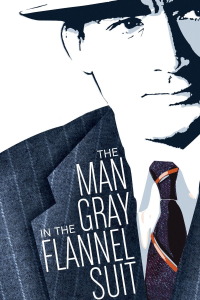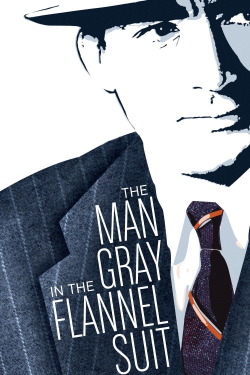
Review of The Man in the Gray Flannel Suit (1956) by Lecritique I — 15 Jan 2017
It is difficult to see how the film adaption of Sloan Wilson's immensely popular and deservedly-acclaimed 1955 novel The Man in The Gray Flannel Suit (20th Century Fox, 1956; directed and screenplay adaptation by Nunnally Johnson) could have turned out as anything other than a tepid, slightly-better-than-mediocre domestic melodrama with unrealized-yet-noble aims.
The film tells the story of thirty-something Tom Rath (Gregory Peck), a man from a privileged upper-class background who must balance the demands of domestic responsibilities (including parenting three young children and serious but not life-changing financial problems) with professional imperatives. In order to satisfy the demands of his rapaciously ambitious wife, Betsy (Jennifer Jones, in what may well be the worst performance of her career), Tom pursues and obtains a much more lucrative position as special assistant to Ralph Hopkins (Frederic March), the president of a national television network, on a project to launch a national mental health campaign.
Mental health-or, more accurately, mental illness-is a subject toward which Rath might well feel a passionate identification. An unmemorable but competently directed series of flashbacks (which begins with the tired device of Rath focusing on a man wearing a jacket with a fur-trimmed collar similar to that of a German solider he'd killed with his bare hands) attempt to persuade the audience, unsuccessfully, that here is a man suffering from post-traumatic stress disorder. Wartime flashbacks also reveal the distinct possibility that Rath fathered a child with an Italian girl (Maria, played ably but not notably by Marisa Pavan) during a week-long affair in Rome in 1945.
Hopkins' toadying assistant Bill Ogden (Henry Daniell, in one of the few good performances in the piece), gifted at the dubious craft of the Madison Avenue "yes-man," immediately sets expectations for Rath's first assignment-a speech to doctors in Atlantic City-impossibly high by giving him the brief: "And if the speech is right, it will not even mention a national mental health campaign-but at the end of it the entire audience will rise as one man and demand not only that such a campaign be launched at once, but that Mr. Hopkins should head it.".
On the home front, pressures both severe and minor begin piling up. The estate Rath's grandmother left him has at last been exhausted, save for an aging mansion and the land on which it sits. Betsy whines, incessantly, melodramatically and with a great deal of manipulation, about all matters domestic. Early in the film, she complains that their house (rather spacious by post-war standards, if a bit shabby) isn't good enough, and is in the wrong neighborhood:
I'm sorry, Tommy, but I hate this house, you just don't know how much . . . . Its ugliness, its depression, its defeat. It's a graveyard, Tommy, a graveyard of everything we used to talk about-happiness, fun, ambition-and I want to get out of it.
She then goes on to tell Rath that she doesn't know what has happened to him since the war, but she's ashamed of him. Ultimately she sells the house without Rath's knowledge or consent, telling him on the drive home from the commuter rail station one evening that the family will be moving into his grandmother's mansion that week and at another point in the film outlining a get-rich-quick scheme to turn the acreage on which the mansion sits into a subdivision.
Meanwhile, Rath's grandmother's servant, Edward (Joseph Sweeney, in another of the film's fine performances) lays claim to the mansion and the land on which it sits through the submission of a mimeographed letter (purportedly written by the deceased Mrs. Rath) to probate judge Bernstein (in a wonderfully nuanced performance by Lee J. Cobb). In one of the piece's few memorable scenes (and one of its best), Judge Bernstein somewhat gently but relentlessly and remorselessly demolishes both Edward's character and his claim. Mr. Peck sits woodenly through this scene, contributing little-and it must be said that the scene is the better for it.
At work, Rath becomes increasingly close to Hopkins despite having his work suppressed by Ogden (who ultimately pulls him off the project without Hopkins's knowledge). As the film unfolds, we learn the terrible toll Hopkins's addiction to work and immense success have taken on his personal life: A marriage which has disintegrated into an arrangement of social convenience; an estranged, spoiled, rebellious daughter involved (tellingly) with two men her father's age, both of whom her parents deem inappropriate (quite probably because of their age); and perhaps most touchingly, a son lost in the war about whom Hopkins's wife Helen (wonderfully played in a quiet, unpretentious but heart wrenching performance by Ann Harding) says, "You never really knew Bobby-not really." In the same scene we learn that at least part of Hopkins's growing fondness for Rath is his resemblance to this son, who enlisted rather than accepting a commission his father could easily have arranged because Bobby thought it the right thing to do.
On the professional front, Ogden has rejected all five of Rath's drafts of the Atlantic City speech, writing instead what he thinks Hopkins wants to hear. Betsy-in the habit of wheedling every scrap of information about Rath's professional life that she can get out of him-in a bizarre about-face, suddenly a highly-principled-and urges Rath to do the right thing by telling truth to power and presenting his original ideas to Hopkins. Rath meets with Hopkins in his sumptuous Manhattan apartment and does exactly that.
In what is unquestionably the film's best scene, Hopkins's meeting with Rath is interrupted by a telephone call from an AP reporter informing him that his daughter has just married and asking for a quote. Hopkins says all the right things to the reporter, then phones Helen, who asks that he never call her again. As played by Frederic March and Ann Harding, the scene rips one's heart out with a quiet, resigned, understated dignity and grief.
One day Rath meets Caesar (Keenan Wynn), a sergeant with whom he'd served in the war, now an elevator operator at the network's headquarters. Over drinks Caesar tells Rath that his wartime lover, Maria, did in fact give birth to his child and is in dire straits. In the film's worst, most melodramatic scenes-scenes in which Jennifer Jones chews up all the scenery there is to digest-Rath returns home to Betsy to reveal both the affair and the child's existence. After some additional melodrama (Betsy driving recklessly off into the night) and an even-more-bizarre and out-of-character about-face by Betsy, Rath and she appear in Judge Bernstein's office the following morning to make arrangements for monthly support payments to Maria and Rath's illegitimate child. The film ends with Rath and Betsy embracing in the front seat of their car and driving away from Judge Bernstein's office.
Upon its release, the film received widespread (and, in this observer's opinion, utterly unwarranted) critical praise. Bosley Crowther (then the cinema critic for The New York Times) called it "a mature, fascinating and often quite tender and touching film." In his April 1956 review, Mr. Crowther goes on to say "It was not a simple, easy story that Mr. Wilson wrote, and it is not a simple, easy drama that Mr. Johnson has translated to the screen . . . . He has, in short, a full, well-rounded film.".
Where to begin?
The novel was a runaway critical and commercial hit-the kind of material mainstream Hollywood snaps up in hopes of replicating such success. 20th Century Fox (or perhaps more accurately, the film's producer, Darryl F. Zanuck) apparently felt that translating such a work to the screen necessitated treating the project as a big-budget, star-studded "prestige picture.".
He couldn't have been more wrong.
Mr. Johnson's rather florid-yet-lukewarm, overly earnest but at the same time really rather lazy realization of the film begins with the-well, one is tempted to use the word "unfortunate," but this critic finds the phrase "wildly inappropriate" more apt-choice to film in CinemaScope and in color. The use of both is jarringly inappropriate for the piece. Rath's existential dilemma and alone-ness, the always-gray world of corporate politics, his fundamental abstruseness and (as Mr. Peck plays it-although not necessarily intentionally or appropriately) ambivalence, the new and strange moral ambiguity of the postwar world and its new and strange anxieties-all these leitmotifs scream for black-and-white treatment. Additionally, CinemaScope robs the film's few great scenes of the intimacy their subject matter deserves. Cases in point include the scene in which Helen begs Hopkins to intercede with their daughter, telling him "If you don't, Ralph, if you don't make this effort, I'll never want to see you again" and the wonderful scene in which Judge Bernstein utterly destroys Edward's character and claim to the Rath estate. The former scene calls for an intimacy and the latter an immediacy which both CinemaScope and the really quite garish color process used rob the scenes of utterly.
An overly-sentimental score by Bernard Hermann trivializes the film's subject matter throughout. Additionally, Mr. Johnson's choice of shots and framing offers nothing new, much less innovative, and frequently diminishes scenes which might have been great. While many shots are well-composed, there's more to mise-en-scène than composition. Realization of the film's goals-or, perhaps more accurately, what should have been the film's goals-is seriously compromised by poor and frequently garish set design, bad (and certainly not subtle) lighting, and other poor aesthetic choices.
The director's cinematic vocabulary seems limited, relying heavily on medium and long shots in scenes which call for close-ups or deep focus (which appears not to have been in Mr. Johnson's vocabulary) or perhaps other innovative camera work. A prime example is the scene in which Susan Hopkins (Gigi Perreau, who pulls off the dubious achievement of being simultaneously both overwrought and tepid) accuses her father of caring for nothing but money, telling him "You don't love me and you don't love mother. To tell you the truth I don't think you love anybody," an intimate moment shot entirely in medium shots with no close-ups (also an example of the staggering misuse of CinemaScope).
One wonders whether Mr. Johnson's cinematic hand wasn't rather forced into over reliance on medium and long shots by the really quite terrible performances handed in by Mr. Peck and Ms. Jones (Mrs. David O. Selznick at the time). Mr. Peck's Rath is a leaden performance with little or no depth, making it difficult to relate to his character (which is why this reviewer refers to the character as "Rath" rather than "Tom"). Jennifer Jones's Betsy veers from annoying shrillness to high melodrama to a barely-passable attempt at quiet dignity (in the piece's final scene).
Some mercy can be shown Ms. Jones (Mrs. David O. Selznick at the time) for what is a TRULY awful performance. Mr. Johnson's overly earnest adapted screenplay fails to develop the characters in any meaningful or interesting ways; hence Jones's Betsy veers wildly from avaricious shrew to indifferent mother to ambitious schemer to the aforementioned attempt at quiet dignity. The screenplay attempts to convince us, unsuccessfully, that Rath is a man suffering the pain, confusion and alienation of mental illness (specifically, PTSD) while perversely treating Rath's relationship to the mental health project which comprises his work with (at best) indifference or (at worst) mindless ambition. Additionally, while the screenplay achieves some success at showing us the terrible price Hopkins has paid for success on a grand scale, it does little or nothing to explore the psychic price exacted-for that we must rely on yet another outstanding, understated performance by Frederic March.
One of the film's most interesting aspects seems entirely accidental as it is never fully explored or elucidated: The treatment of the Rath children. Early in the film, prior to and during the scene in which Betsy tells Tom she is ashamed of him, there is a touching scene between Rath and his son Pete (convincingly but not spectacularly played by Mickey Maga). Pete wants to bring the family dog indoors to sleep with him. Betsy denies him; Pete dresses up in a pirate costume and threatens to run away. After Betsy tells Rath she is ashamed of him, Rath goes outside, retrieves the family dog and carries it upstairs to Pete's room.
It is the only truly tender, memorable scene between parents and children in the film. While there is the occasional nod to parental responsibility (e.g., Rath-checking in on one of his daughters who have chicken pox, Rath insisting the children turn the television off and go to bed), both the Raths more or less abandon their responsibility as parents, Betsy "outsourcing" child care to a shrill, cold drill sergeant of a nanny (Mrs. Manter, in a competent if obvious performance by Connie Gilchrist). The childrens' obsession with television, and with death, is touched upon only briefly and obliquely. The adult Raths' relationship to their children-or rather, the increasing lack of one-is not explored in any depth, and makes Rath's ultimate decision to choose family over professional advancement seem inexplicable given a parental indifference bordering on neglect.
The Man in the Gray Flannel Suit is a good novel (not a great one) which explores some of the psychic and social issues which arose in and dominated the existential landscape of postwar America. In giving the book "the full treatment," i.e., in treating it as a big-budget, star-studded "prestige" film, Hollywood took an important, sensitive work and turned it into mediocre media fodder.
Note to mainstream Hollywood (or a plea, if you will): Learn from your mistakes.
This review of The Man in the Gray Flannel Suit (1956) was written by Lecritique I on 15 Jan 2017.
The Man in the Gray Flannel Suit has generally received positive reviews.
Was this review helpful?