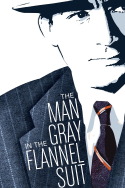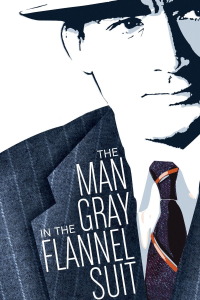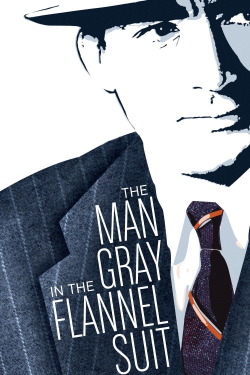
Review of The Man in the Gray Flannel Suit (1956) by Edith N — 05 May 2011
A Fine Piece of Work About Which There Is Not Much to Say.
I have just, as I sat down to write this, started watching [i]Mad Men[/i]. It's set a few years later, which means that few of the executives in the show have the experiences the executives in the movie had. At the heart of this movie is what happened during World War II, ten years earlier. Gregory Peck was young enough and more importantly seemed young enough so that he'd still be a Leading Man for another decade or better, and I mean the kind of leading man who Gets the Girl. However, it was also recent enough so that you believe he was an officer during World War II. I think that generational difference was probably important, and I suspect it caused a lot of conflict as time went by. I don't know if I'd say that the world changed faster in those ten years than it ever had before, but I think possibly the changes have become more obvious with every recent decade. The life these characters lived permitted the one the characters in [i]Mad Men[/i] lead, and that would not have been comfortable.
Tom Rath (Peck) lives in Connecticut and works in The City, just like thousands of men leading similar lives. He has a young, pretty wife, Betsy (Jennifer Jones), and three kids (Portland Mason, Sandy Descher, and Mickey Maga). He makes seven thousand dollars a year, which works out to roughly fifty-six thousand today. He's applying for a new job, which will work out to about eighty thousand a year. In public relations. His grandmother died recently, but her estate turns out to be mostly worthless except for the house, which they may not be able to keep after all. He also had an experience in the war which he won't discuss with his wife. It's said that he was a lot more ambitious ten years ago, before he got back, and we certainly learn things about him that his wife did not know. It all comes back in the person of Sergeant Caesar Gardella (Keenan Wynn), who had been in his unit.
The problem I had with the movie was that it seemed to be doing too much. I was reasonably sure that Gregory Peck was headed for a nervous breakdown, because that was where the beginning of the movie seemed to be taking us, but nothing seemed to come of the trauma he experienced. It didn't really seem to have much to do with anything. I think the whole thing with Ralph Hopkins (Fredric March) and his daughter's elopement was to show the destructive effect too much work can have on a family, but it bothered me how much was shown from his perspective. The main character would have had no way of knowing what was going on, and it didn't really have anything to do with him anyway. Drinking with his boss at that pivotal moment probably improved his career, but that's about all there is to it. It's as though the movie (I haven't read the book) is trying to make at least three important points, and it gets too hung up in that to really even make one.
In fact, if I were to choose, I'd want a full movie out of the mental health plotline and one of the Italian plotline. Not mixed, mind. Separate movies. I find it intriguing that a man could go from the start of a case of PTSD to a normal life, only it turns out that it's a normal life wherein he has to write a speech which would get his boss a job as head of a commission in charge of mental health activism. Arguably, Tom Rath was ideally placed to advise his boss, but of course he could never mention that. Look how hesitant Betsy is when she has to mention the word "nerve" to him. And of course, there's no way a movie from 1956 would condemn that; movies today are ill inclined toward condemning that attitude. But taking someone like Gregory Peck and giving him that problem would have maybe meant people would have thought about it as a problem that real people have. Gregory Peck was the kind of man we could all take seriously. We trusted him and always would. He might have been the best chance for that kind of story.
And the Italian thing . . . okay. I don't want to give away spoilers on this, though of course after over fifty years, it's not as though you'd have no way of knowing what was going on. But I understand Tom's actions during the war. He really did think he was going to die. He grabbed onto life in the way people have been grabbing onto it as long as there have been people. He made a move he wouldn't have in any other circumstances, and he walked away. Was flown away by the US military. But what I really find interesting is how Betsy responds. She's angry, and she has a right to be. Her initial reactions all make perfect sense to me. What's interesting, though, is her final decision on what should happen. No, they don't exactly go spreading around to everyone what happened to Tom in Italy. Indeed, they're quite intentionally keeping quiet about it. But it's a marriage where they're willing to work through their problems, and for once, it's believable.
This review of The Man in the Gray Flannel Suit (1956) was written by Edith N on 05 May 2011.
The Man in the Gray Flannel Suit has generally received positive reviews.
Was this review helpful?