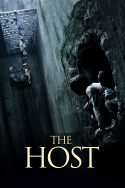
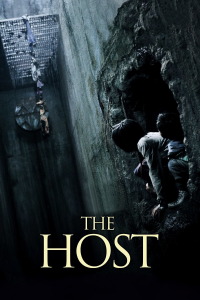
Review of The Host (2006) by Stephen M — 26 Apr 2010
Well, as a skeptic of the critics, I'm never surprised when they get something completely wrong. The new movie Kick-Ass I'd say is a prime example. However, some times they get it right when the general viewing audience is split, and "The Host" is one of those movies.
Born from a long line of monster movies, mostly American and Japanese, "The Host", like all great monster movies focuses on the people affected by the creatures presence rather than the creature itself and the destruction it causes, something Roland Emmerich's "Godzilla" absolutely did not get right. Having said that, there are many monster movies more in the vein of horror films that focus on the destruction and have the social commentary take second fold, such as the original "Gojira"/"Godzilla" or even films like "Dawn of the Dead". "The Host" falls more into the category of "Cloverfield" which deals with the personal effects of terrorism or "The Blob" which adapts a "Rebel Without A Cause"-like thematic basis of "adults as detriments to progress".
The family dynamic is important in "The Host" but only plays the backdrop to the larger political issue at the film's core; the history of modern Korea. Now I know the feeling of reprehension when watching a film set in a non-American country and automatically assuming it must be about the grand political issues of the nation. It's the same painfully obvious trick used in "District 9" when addressing the practically defunct issue of South African Apartheid. However, consider the fact that in the past ten years or so South Korean cinema has really matured into a powerful force of great films that the entire world is beginning to enjoy. I believe the very American/East Asian genre of monster movies to be a perfect platform for expressing grand political events in the country's past and insightful guidance as to what must be done. Also Bong Joon-ho is an intelligent filmmaker who simply would not create a big dumb monster movie with nothing to say.
This is a theory I picked up on and having rewatched the film I see a great deal of merit for it, so I'll run with it for the sake of argument. At the basis of the film we have the Park family. Gang-du is played by Korean superstar Song Kang-ho who you may or may not have seen in some of the films of Park Chan-wook or Kim Ji-woon. Gang-du plays son, brother and father to the other members of the Park family and is somewhat intangible in his lifestyle and manner. He may be dopey but he loves his family, even his old geezer of a father, Hee-bong. Gang-du's brother Nam-il is an unemployed college graduate and alcoholic and his sister Nam-joo is a bronze medal winning archer who struggles with speed (not the drug, the thing). There is also his daughter Hyun-seo. Now, consider the Park family as split into two groups, divided by gender where the females represent North Korea and the males represent the South. I believe these characters all conform with the idea Bong is trying to put forth for the individual countries.
However, these characters only represent the people, not the government or the authorities. The South Korean authorities are self-represented. They are inept, useless and tools. In the opening scene we see the American scientist (and Americans obviously play a huge role in the film too) who convinces the spineless Korean assistant to poison his own country's river with fermaldehyde. Neither characters here are shown in a sympathetic light. Naturally, this senseless agression from the American, who didn't like the dust on the bottles, and the cowardice of the Korean assistant lead to the birth of a monster; North Korea.
When Hyun-seo is kidnapped by the monster, the Park family (or the people of Korea) must work together to rescue her. Of course the inept and spineless South Korean authorities - police, doctors, emergency services - offer only a detriment to the Park family's attempts to the save the girl. They would much rather blindly follow the Americans and their misguided attempts at fighting the creature. As the film progresses Hee-bong is killed when he confronts the monster head-on, Nam-il is sold out by his friend for money (which is another motif to look for in the film) and Nam-joo is knocked out by the monster for being unable to actually fire a shot against it.
The final few scenes in the film are excellent as they give almost implicit instructions of how to unify Korea and free them from the monster that has split them apart. As Hyun-seo tries to escape the monster's confines she is killed for her attempts at escaping the monster's tyranny. The Americans release their toxic "Agent Yellow" a gas which supposedly neutralises all biological agents within a space of several kilometres. This is certainly a reference to "Agent Orange" which was widely used by American forces in Vietnam. It caused serious damage to the environment and affected generations of people born afterwards. The Wikipedia page has further details on this that I won't go into here. Anyway, to continue with the final scene, Nam-il gets help from a homeless man (money motif present again here) who helps him fight the creature with petrol and molotov cocktails. And in a genuinely great moment, when Nam-il clumsily drops his last molotov cocktail, his sister is there to pick up the the pieces and ignite the monster herself. We see that humans are flawed, not powerful rock solid creatures who never falter. The story isn't about individual heroism, but about collectivity in the face of injustice.
The final scene shows Gang-du caring for the boy Se-joo who was also trapped in the monster's lair with Hyun-seo. Gang-du is still paranoid that the monster will return, but wants only to take care of his new son. He turns off the TV and distances himself from the politicians' lies, focusing only on his meal.
Obviously, there is a lot more to say about the film, but I thought the dynamic between North and South Korea was a very interesting topic in the film and so decided to address it. The film itself is quite funny at times, such as when a drunken Nam-il explodes into to tears at the shelter and the Park family begin to role on the floor as photographer come to snap up shots. Also, the character all have great depth. They generally make sly allusions to each other's past, unlocking a whole world of meaning and complexity to the film.
The greatest strength of this film is how it seperates a government and a people. This is important as it is difficult to criticise US goverments sometimes without offending roughly half the nation's population. I fee many countries are as bitter towards United States foreign involvement as South Korea is. I even feel my own country is merely a stepping stone for the US, one that it treats more like a young dopey cousin than a brother. Of course, much like the South Korean authorities in "The Host", my government is entirely inept. The film's advocation of unity for the people as opposed to the false democracies that actually run the world is something that truly resonates with me.
This review of The Host (2006) was written by Stephen M on 26 Apr 2010.
The Host has generally received positive reviews.
Was this review helpful?