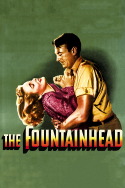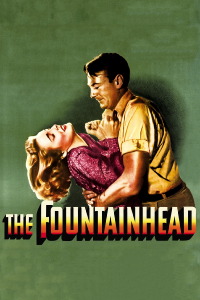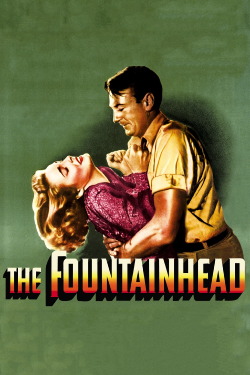
Review of The Fountainhead (1949) by Cameron J — 19 Jul 2014
I heard that this guy is a passionate architect, but he must really love his job if he built a fountain for his head. Man, that sounds stupidly surrealistic, but no, this isn't exactly what I was expecting from David Lynch's first film, although I don't guess you can ever predict what kind of film a three-year-old will make. Yeah, this is too old to be as trippy "Eraserhead", which is bogus, because you're going to need some audacity if you're going to be adapting an Ayn Rand novel. Granted, I haven't read any of her books, because, you know, contrary to what many may believe based on my watching so many blasted movies, I have a life to get to eventually, but she did know how to push the envelope further than they were capable of doing in Hollyweird, circa 1949. ...Mind you, she actually wrote this screenplay, but she went on to do the critically panned, yet oddly commercially triumphant "Atlas Shrugged", so maybe her dramatic competence was beginning to slip by the end of the '40s. Yeah, people, I think we can all agree on what is truly the most satisfying adaptation of Rand's "The Fountainhead": Rush's "2112" album. I don't exactly know how this novel relates to that album which Neil Peart says was largely inspired by Rand's works, or rather, "genius" (He must have found something better to do than read "Atlas Shrugged"), but I'll take it, because this film isn't exactly doing anything for me, though not for a lack of trying.
This film offers a good bit of style and a great deal of limitations, and heights in both go reflected within Robert Burks' cinematography, which both held back by and thrives on a black-and-white color palette, which falls over crisp definition and occasionally ingenious plays on lighting in order to establish an almost noirish flavor that is handsome, if not captivating throughout the drama. This visual style, in addition to such other artistic touches as nifty visuals, supplement the aesthetic value which is decidedly as impressive, if not more impressive than anything else in this narratively sloppy affair of respectable style. Of course, if inspiration stands so firm in directorial style, then King Vidor can go only so far with his shortcomings in directorial storytelling before hitting highlights, and sure enough, when Vidor hits, entertainment value is sustained, occasionally augmented by genuine dramatic tension. Make no mistake, much more often than not, Vidor falls flat, and about as often as he hits highlights, he just about embarrasses with his dated, if not outright incompetent missteps, yet the fact of the matter is that highlights stand, helping you in seeing the potential here. Although I have not read any of Ayn Rand's classic material, I don't suppose her dramatic competence was ever even close to the level of her thematic competence, for even in concept, this story is a hopelessly melodramatic affair whose sloppiness will be touched more upon later, and whose genuinely worthy aspects are very much worthy, in their establishing some biting histrionic intrigue, and plenty of intriguing themes regarding business' and society's interpretation of questionable innovation, and how innovators interpret the critical. While more limited than fans of the original, ostensibly non-cinematic like to think, potential stands, and it's hard to deny that when it comes in glimpses through commendable style and heights in substance. Still, on the whole, the final product is surprisingly mediocre, being a misguided take on a misguided story which isn't even sharp enough to be as thorough as it ought to be with its characterization.
Over-celebratory of its themes and shamelessly manufactured with its dramatics, this film needs more than just adequate flesh-out in order to thrive as a character study, and the characterization here, with its lack of immediate development and shortage on gradual exposition, simply isn't up to the task of getting you invested in contrived and thin characters. Nonetheless, as undercooked as the film is, it, at just shy of two hours, still has plenty of time to drag its feet, not just through cold spells in King Vidor's direction, but through meanderings in Ayn Rand's script, whose bloating in plot layering doesn't exactly gel with all of the aforementioned expository bumblings. Rand's over 700-page epic is adapted into a two-hour melodrama which is all over the place with its pacing and structure, with enough of the source material's dynamicity retained for the messy structuring to lead to some serious focal inconsistencies which make the final product almost exhaustingly convoluted. Still, there is something consistent throughout the storytelling, and that is conventions, because even though there is a potential for uniqueness, the execution of a promising story is so riddled with tropes that the final product stands as just plain trite, with nothing new, - despite its following themes of rejecting conformity to artistry - and most everything questionable about Hollywood formulas of this time. I don't know if it's simply the test of time doing a number on the filmmaking abilities of this drama, or sheer incompetence which modern critics disregard, but I'm just not comfortable with this film's very Hollywood lack of subtlety, which draws thin roles for too many of the performers - save decent leading man Gary Cooper - to portray questionably, and too many embarrassingly shoddy dialogue pieces and obvious visuals and set pieces for you to get past the contrivances which are even found in concept. Again, Rand's dramatic writing seems to have always been beneath her thematic writing, and this film reflects that through a layered, but startlingly melodramatic and occasionally unfocused plot that thematic value could make up for, and perhaps would have made up for if it wasn't for all of the incompetent miscalculations in structuring and subtlety which betray thematic value, and further stress the blandness and misguidance of this story, until the final product is barely ever truly engaging. Sure, there are compelling moments found here and there throughout the film, and there's enough of them for the final product to all but achieve a decency which is ultimately lost by utterly erroneous filmmaking that make the final product yet another misfire of an overrated classic.
Overall, handsome visual style and other attractive stylistic touches to direction which hits a few dramatic highlights to do a degree of justice to intriguing subject matter, thus, the final product borders on a decent state that is ultimately lost amidst the thin characterization, bland dragging, exhaustingly convoluted unevenness, genericisms, and dramatic incompetence which, behind a hopelessly melodramatic and overwrought story, make King Vidor's "The Fountainhead" a mediocre piece of dated, melodramatic filmmaking.
2.25/5 - Mediocre.
This review of The Fountainhead (1949) was written by Cameron J on 19 Jul 2014.
The Fountainhead has generally received positive reviews.
Was this review helpful?