Review of The Conformist (1971) by Pleasebury D — 16 May 2009
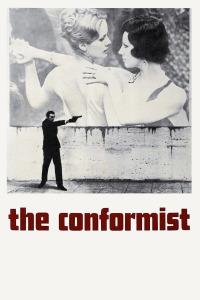
In 1970, Bernardo Bertolucci, famous for films like Last Tango In Paris and 1900, and later more popular works like The Last Emperor and Little Buddha, adapted a 1950s novel about 1930s fascist Italy to the big screen. Mostly forgotten until the 2005 rerelease, Il Conformista to me still nonetheless retains a lot of its lurid impact and historicity.
Bertolucci wrote and directed, however I also wanted to credit the fine cinematography of Vittorio Storaro, another film giant. Storaro collaborated with Bertolucci on all the movies mentioned prior, as well as working on films like Apocalypse Now and Ladyhawke. It might also be interesting in comparing his work here and in 1990s Dick Tracy, for which he won an Oscar.
The following is not so much a review, as it is a study of the film sans an undesrstanding of WWII era fascism.
Doctor Marcello Clerici is a stiff but weak willed character, outwardly an active member of the Fascist party, scarred as a child when he was sexually molested by their chauffeur Lino. Marcello is assigned to assassinate his old philosophy professor, a Prof. Quadri, but hesitating to take his chance, he meets Quadri in Paris, in the pretense of his honeymoon. He gets lost in hesitation, unwilling to do the job itself, but also unwilling to intervene when Quadri and his wife Anna (Marcello's lover) are eventually killed. Later, he discovers Lino in the street and denounces him as a fascist, but finds he is not accepted by the growing anti-fascist mob.
On the surface, the story is shocking in itself. The movie is liberally peppered with sex throughout, from Marcello' s brief flirtations with his young bride Giulia, and Anna's seductions of both Marcello and Giulia, and of course, Marcello's chldhood memories. As was common then, the sex in this movie is not very titillating, but works to advance the plot, and further our understanding of Marcello. Still, it hints at the kind of grahic context Bertolucci would bring to Last Tango in Paris. Violence, implied throughout the film, only comes once, but it is a stark & powerful 10-15 minutes.
Popular depictions of WWII nowadays evoke images of the American war effort (Band of Brothers, Pearl Harbor, Saving Private Ryan) or Nazism (The Reader, The Pianist, Schindler's List). In the same time period, Italy was swept up by Mussolini's Fascist movement, and would not be freed from it until the wars' end. In this context, Bertolucci wanted to criticize Fascism's suppressive tendencies, but truly a lot of the meaning he, or the original novelist Alberto Moravia meant to evoke, is simply lost to obsolescence. The movie still works as an indictment of state' s repression of the individual, but that's about it.
So, mostly what we do get from the film is an intese psychological study of Marcello. Marcello is not the typical Hollywood protagonist; a difficult personality, morally irredeemable, sensual but incapable of love. If not for our foreknowledge of his sexual molestation, we should hate him. In the confessional he admits many sins and his lack of guilt towards them. Throughout the film he acts to achieve what he defines as 'normalcy'. Externally he defines this as a middle class life with a woman of the same age, but by his willingness to commit morally repugnant acts he reveals his lack of understanding fof what normal is.
Presumably, as pointed out by his blind friend Italo, he is different from most people, like Italo himself. Italo perceives Marcello's character and his deviance from other people, although there is no indication he even suspects Marcello was sexually molested as a child. His interactions with his wife Giulia, in turn, show his detachment to people, and how he struggles to connect with her, with a lot of sensuality, but ultimately fails.
He is also well remembered by Prof. Quadri as a brilliant student, and Marcello demonstrates his intellectualism throughout the film, with references to poems by Emperor Hadrian and Gabriele D'Annunzio as well as Plato's Myth of the Cave. Of the former, it's notable that he enjoys poems made by Italian political figures. This and other scenes imply that he has redefined his intellectualization to support his fascist beliefs. However, in private conversation with Quadri, he reveals that he still sees himself as lost in Plato's cave, one who does not see things as they are, only by their reflection.
His hesitation in killing Quadri does not seem to depend on any moral compulsion, or a particular fondness for his professor, but again due to a general sense of confusion. His many sexual dalliances with Quadri's wife Anna seem to have brought this about; in a short scene in her ballet class he offers to run away with her, implying their relationship may have been so good that he was willing to drop his search for normalcy to be with her. Or perhaps he thought she could give him this normalcy?
Whatever the case, he stares at her blankly, as she begs for help from him, to spare her after the death of her husband. He could have intervened for her, or he could have killed her quickly, but he just stares out of his car, the state-issued gun untouched and thrown a car seat in front of him. His bodyguard gets out of the car and mutters his disgust, as Anna is eventually, slowly, painfully downed with bullets.
As visually powerful as the assassination scene is, I think the pivotal scene which the whole movie hinges upon is the sexual molestation, recalled in its entirety by Marcello in context of the flashback. The flashback actually begins earlier in the day, where a young Marcello is being bullied by classmates. He refuses to go into the limousine, although Lino follows him slowly to the road. Suddenly he gets in, only so that he can scoff at the other children off the road. Endeared to Lino by this little conspiracy, Marcello agrees to follow Lino to his run so that he can play with his gun (uhm, a real gun). Inside the room. Marcello is so entranced by the pistol he does not notice Lino starting to undress to play an entirely different game.
Relax. Bertolucci doesn't actually go there, we presumably get some brief cuts where they kiss, and skip to the part where Marcello figures out how to fire and starts shooting around the room. Apparently he hits Lino (not seen onscreen) and tries to get out but finds the door is locked, finally a gust of wind miraculously forces the windows open and he runs off.
The gun becomes loaded with meanings for Marcello, none of which point to its true function. When he first picks up the gun from his superiors he plays with it, but during Quadri's assassination he does not dare pick it up. Perhaps out of an unwillingness to relive the associated trauma, he fails to see the gun for what it is, only its reflection.
So in summation, Marcello's quest for normalcy is doomed by his inherent lack of understanding. As in the myth of the cave, he can't get beyond the first level of the cave, unable to see things as they are.
This review of The Conformist (1971) was written by Pleasebury D on 16 May 2009.
The Conformist has generally received very positive reviews.
Was this review helpful?