Review of The Big Clock (1948) by Lewis P — 03 Apr 2010
The Big Clock keeps ticking despite the implausibilities.
*** This review may contain spoilers ***.
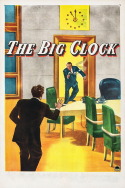
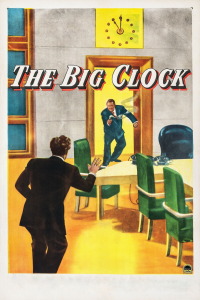
'The Big Clock' features Ray Milland, as George Stroud, an editor/investigator of a crime magazine. Stroud's boss is mega-publisher Earl Janoth, played by Charles Laughton, who hams it up as the arrogant mover and shaker of a publishing empire. Janoth is obsessed with time and has a giant clock installed at company headquarters, a modern high-rise, where the big clock controls all the other clocks in the building. Most critics will agree that 'The Big Clock' starts off quite slowly in its first thirty minutes. During the slow-moving exposition scenes, we learn that Stroud is Janoth's best employee, solving various crimes with the aid of his staff?they rely on a bulletin board which Stroud utilizes to organize various clues garnered during the course of their investigations. We also learn that Stroud is on the verge of quitting his job since Janoth will not give him the time to take the honeymoon he never had with his wife.
The story begins to shift into high gear when George finally tenders his resignation but misses his train to meet his wife for the honeymoon. Instead he gets drunk with Janoth's mistress, Pauline York, and ends up at her apartment. Janoth shows up and George makes a quick exit; neither of the men can identify one another. Janoth and Pauline argue and Janoth kills her with the sundial which George purchased earlier at a bar. Janoth then enlists his right-hand man, Steve Hagen, to help him cover up the crime by ordering his staff to investigate the illusory 'Jefferson Randolph' (the name Pauline concocted and the person who Janoth ended up believing left her apartment right before he killed her). Janoth then orders George to return to work and find Randolph. George has no choice to comply with Janoth's order after realizing he may be implicated in the murder (Janoth mentions the inscription on the base of the sundial is from the bar where George purchased it).
The tension in the plot grows exponentially as George must prevent his staff from believing that Randolph might be him. George locates a cabdriver who gives him information about another cabdriver who drove Janoth to Pauline's apartment the night of the murder. But Janoth finds the cabbie first (offscreen) and pays him off. After an antique dealer (who sold George a painting during his drunken night out on the town with Pauline) spots him in the Janoth Publication's Building, George must do everything he can to prevent himself from being identified by this man. To make matters worse, it just so happens that the artist, Louise Patterson (Elsa Lanchester), who painted the painting George bought at the antique store, was at the store that night and haggled with George over its purchase. She shows up at Janoth company headquarters and tells Janoth she is willing to draw a picture of the man who bought the painting at the antique store for a price. It turns out that George gets to her first and promises to compensate her for the painting. As the comic relief, Louise does draw the man's portrait for Janoth but it's in the style of an abstract Picasso!
The climax of the story finds George in Hagen's office along with his wife and one of his pals from the bar where George lifted the sundial (later used as the murder weapon). A handkerchief which Pauline took from the bar is found in Hagen's cigar box so George accuses Hagen of the murder. Hagen manages to concoct various alibis until George's associate mentions that he saw Hagen return the murder weapon to the bar. Hagen no longer is willing to take the rap for Janoth and informs his boss that he'll turn him into the police. Janoth shoots Hagen and then tries to escape via the elevator but falls down an empty shaft (George kept the elevator cab on a lower floor after climbing out of the shaft and fiddling with the controls, preventing the cab from moving).
Some have referred to The Big Clock as a 'film noir'. Certainly the film has noirish elements (dig some of the dark cinematography), but really shouldn't be classified as a true film noir. While Pauline York can be viewed sort of as a 'femme fatale' (her numerous affairs are alluded to), she doesn't lead the protagonist to his doom (George is more responsible for getting himself in trouble during his drunken foray on the night of the murder). More importantly, the protagonist, ends up prospering at the end. Think of a classic noir such as 'Double Indemnity' in which the protagonist (Fred MacMurray), the hapless insurance agent, ends up dead after committing a murder with the help of Barbara Stanwyck's quintessential femme fatale.
Some have argued that the big clock is a powerful image as it symbolizes Janoth's megalomania. To me it's a rather obvious symbol and an awkward one at that. The big clock itself really doesn't figure directly in the plot. Contrast that with the 'The Stranger', where the clock is integral to the narrative (Orson Welles, who plays a Nazi war criminal, ends up impaled by a statue's protruding sword, which moves as a result of a clock striking at the appointed hour).
After the slow-moving introduction, the Big Clock picks up and holds your interest for the rest of the film. Despite the good entertainment, the story hinges on the police not finding the body. You would think that one of the victim's friends would have attempted to contact her since she was missing for such a long period of time. Had the police found the body, all the machinations back at the office could not have occurred.
The Big Clock is also worth watching for the trivia: watch for Noel Neal (TV's Lois Lane in the 50s) as an uncredited elevator operator. And Director John Farrow was Mia Farrow's father! There are other stories about the cast of this film well worth investigating.
This review of The Big Clock (1948) was written by Lewis P on 03 Apr 2010.
The Big Clock has generally received very positive reviews.
Was this review helpful?