Review of The Age of Innocence (1993) by Blake P — 12 Apr 2014
No matter the 1800s set period piece, there is always one thing in common that can't be ignored - the characters, putting reputations aside, always manage to talk in a certain eloquence in which even the cruelest of insults can sound like a compliment; they don't make decisions based on their own feelings, but rather, on the society around them's terms. "The Age of Innocence" could be looked at as an archetype of the conversations of the genre, but it also diverts from the usual aspects we've come to expect, all done by Martin Scorsese, a director that no one would ever believe could deliver a period piece so elegant while so subtle.
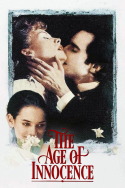
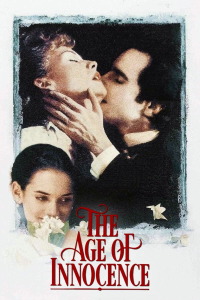
At the center of the aristocratic world of the 19th century upper class of New York is Newland Archer (Daniel Day-Lewis), an intelligent (perhaps, too intelligent for the 1800s) man who is engaged to the sugar sweet but also quite empty May Welland (Winona Ryder). The two come from high society families that have the respect of everyone around them, and while Newland has a quiet adoration for May, there is something about her that leaves him hungry for something a little more hearty.
When he is reacquainted with May's cousin, the Countess Ellen Olenska (Michelle Pfeiffer), he is instantly in awe of her. She comes from a scandalous background and is in the midst of a divorce, but Newland finds her entrancing because she doesn't let the judgement of the cultural norms mare her ideas. Ellen is aware, however, that if she gets in the way of the up-and-coming marriage of Newland and May, her reputation could be tarnished much more than her liking, in a way that rings more unbearable than it already is. But Newland is on the verge of throwing everything he has away.
"The Age of Innocence" is narrated by Joanne Woodward, whose astute and slithering voice gives the film a knowing background that gives the viewer an idea of just how easy it is for upper class society to shun you out of the spotlight. But it also reminds us how trapped Newland is in his situation, a situation in which most modern movies would end rather quickly because it wouldn't take long for him to realize his desire for Ellen. This is the 1800s, however, and we're reminded that time and time again. Around the Victorian designs and posh lifestyles of its wealthy patrons there is an iron cage, in which anyone who does something "immoral" is shot dead on sight (figuratively).
Lewis' performance is astonishing in its distinction - on the outside, we could view him as being stiff, bland, but quite good at presenting himself. But if you look deep into his eyes, you can see his inner turmoil. He wants Ellen, but not enough to incinerate his esteemed past and take away the opportunity that could come by marrying into a similarly successful family. It's as if there are monitors watching his every move, and one false step could land a red dot on his forehead - and he knows it. There are layers and layers of Newland, and Lewis makes them accessible but not over-the-top.
Pfeiffer and Ryder provide ample support as Newland's women, both giving exquisite performances that match the depth that Lewis shows us. Pfeiffer gives us a reason to understand Newland's lust for Ellen, with her beautiful looks and knowing attitude, and Ryder is often times fragile as May, a young woman so caught up in what her peers might think that she is completely incapable of having ideas of her own.
One wouldn't ever think of Scorsese as a director capable of making such a lavish piece, but he does it wonderfully, in the same sort of determined passion that he showed through 1977's "New York, New York", where he tried to recreate the look of a 1940s Technicolor musical. He does a similar thing with "The Age of Innocence", presenting us with vivid imagery and sets that are sumptuous and melodramatic, which contrasts with the simple war of feelings the characters within the walls of the story are experiencing.
Nowadays, if we had a burning desire, we'd chase it without too much hesitation. "The Age of Innocence" shows us a time where that simply could not happen if it meant throwing dirt over the world's opinion of us. The ending, which is surreally heartbreaking in showing the restraint people of the 19th century could hold, proves that, even if they were much to self-aware for their own good, their thoughtfulness is something all of us should think about.
This review of The Age of Innocence (1993) was written by Blake P on 12 Apr 2014.
The Age of Innocence has generally received very positive reviews.
Was this review helpful?