Review of Seven Samurai (1954) by Chiang L — 22 Nov 2011
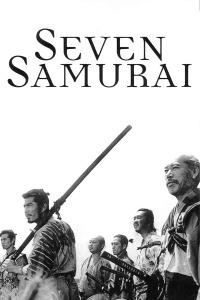
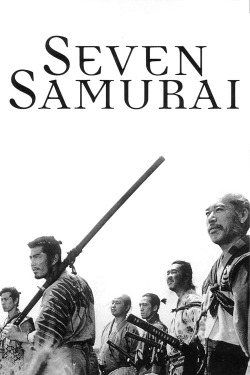
The Seven Samurai is about as flawless as filmmaking gets. It is Akira Kurosawa's epic masterpiece about a poor village hiring seven samurai to help defend themselves against ruthless, post-civil war bandits. Although, I couldn't help but feel a wave of deja vu as I watched it; this is because there were elements from George Lucas's Star Wars, Steven Spielberg's Saving Private Ryan, and notably Pixar's A Bug's Life. I think I know from which dead director they've been stealing from...
Timeless in its story and memorably filmed, Seven Samurai is utterly absorbing. The booming, hell-bent rhythms of the drums in the opening credits instantly captures our attention. We are brought into a recreated Feudal Japan, circa 1588, where proud ronins perambulate the country and slipshod peasants squirm at the bottom of the hierarchy. What Kurosawa accomplishes here is an effective setting that becomes a compelling period piece. The isolated village on the brink of a mountainous forest and surrounded by crop fields is, in itself, a character for it cradles much of the film's action and plot. It is here that battles are won, lives are lost, and farmers scourge on a day to day basis. The black and white is also effectively tangible. The shadows, the effulgent sun, and the hazy dirt seem three dimensional. Feudal Japan has been expertly recreated.
Leading the large cast is Takashi Shimura as the wise guru of the samurai. His presence, diction, and disposition are all noteworthy. Every samurai character is memorable, although it is Toshiro Mifune's Kikuchiyo (in an Oscar worthy role) who manages to steal every scene as a baleful, vehement ronin, agitated by the effrontery of the peasants.
Of the many successes this film hails, Kurosawa's direction is perhaps the most commendable. There is a visceral reality to all of the violence, but Kurosawa also knows where to place an artistic edge to these scenes of graphic battle. The film also benefits from Kurosawa's eminent sense of humor; for the many jests, jokes, and idiosyncrasies of these characters (spoken in Japanese) cannot be emulated by any other film. It is a film and a story that is entirely Kurosawan--but Hollywood has sought to imitate it time and time again.
The Seven Samurai is just a brilliant film, leaving me almost speechless and regurgitating only redundant fluff in place of well-versed words. Its timeless tale illustrates the lives of the hierarchy in Japan and resonates strongly with the universal samurai code of death and honor. The reason I love movies to begin with ranges from genre to story to narrative. The Seven Samurai has just become another one of those distinctions.
This review of Seven Samurai (1954) was written by Chiang L on 22 Nov 2011.
Seven Samurai has generally received very positive reviews.
Was this review helpful?