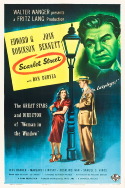
Review of Scarlet Street (1945) by Blake P — 10 Aug 2016
To want to escape within the romanticized walls of a movie is a desire I find myself hungering for as frequently as a sitcom child actress announces that her posing for Playboy is the only way the world will ever see her as a woman. I instantaneously respond to methodical optimism and I thus crave it in my reality. Dozens of films, musical or otherwise, are so seductive in their guises that I'd rather live my life surrounded by their artifice than by the all-too-real pains of the everyday.
But not every movie is so intent on creating a world whereby everyone's wildest dreams come true -some are more delighted at the thought of making everyone's nightmares come true. Such is the case in Fritz Lang's "Scarlet Street," a miserable psychological film noir so misanthropic I'd like to think of it as a more pessimistic piece than Billy Wilder's "Double Indemnity" - and that's saying something. It's a product of contorted despair, a bad dream without the nonsensicality necessary to prove that a pinch to the arm will make all anguish disappear. Every room seems to be caving in. And yet in "Scarlet Street," the gloom and the doom presented are fascinating features. How rare it is to be made doleful by a movie interested in harsh realities, rotten people, and wretched motivation. Most movies are too meek to explore the darker depths of humanity.
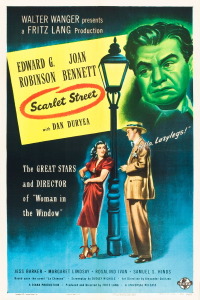
The film is the second and final teaming up of director Lang and the dubious acing trio of Edward G. Robinson, Joan Bennett, and Dan Duryea, last seen together in the previous year's (and more accessible) "The Woman in the Window." Like the latter, widely regarded as a masterpiece by film noir devotees, "Scarlet Street" is a salty martini of sinister black and white and twisted morality, torment brought on by a woman our hero will never be able to have for himself.
Robinson is the man thirsting after her; Bennett is the girl who has him tied around her perfectly manicured finger. In "Scarlet Street," Robinson is Christopher Cross (or, as his pals playfully call him, Chris Cross), a mild-mannered lonelyheart with a slight stutter. All curves and no edges - he's compliant to his very core - Chris has had the same job for twenty-five years (an anniversary celebrated at the film's introduction), has been married to a shrill woman that emasculates him for far too long, and is treated not as a friend by his closest workmates but as a kindly acquaintance without much of a personality. He'd lose his mind over his bland existence if not for painting, a hobby that he's good at that makes his tiresome week worth suffering for.
Chris has gotten used to going through the motions and has therefore made peace with the fact that he'll always be the clerk that will be forgotten and the artist that never was. A sad truth, but one that many, in no doubt, have felt themselves. But a chance encounter with a black haired beaut named Kitty (Bennett) gives his life new meaning. It's love at first sight, even if that first sight is of her volatile boyfriend, Johnny (Duryea), beating her up during the blackest hours of the night.
We, and Chris, would like it if the story turned out be a love story, one in which Chris saves Kitty from a downcast fate and they live, unlikely as it may seem, happily ever after. But Kitty is a crass schemer who likes to be hit; she's a femme fatale that seems as if she's trying to be one, all cheap toothsomeness that seems just plain cheap before long. She doesn't have a genuine bone in her body, and she's proud of her serpentine nefariousness. She looks at Chris with a condescending smirk, feeling sorry for him even though he wears the fragility of an underfed mutt over his tattered, blue-collared coat. If he noticed her cattiness, he'd probably die from the rejection.
But he remains infatuated with her. Kitty herself doesn't plan on seeing the man again after he "rescues" her that fateful night, but after her abusive boy toy catches wind of Chris's talent, he sees monetary potential. The guy's paintings are eye-catching, but if it were presented as though Kitty, a sexy dame, were the artist, likeliness of commercial success would dramatically increase. And through some machinations that involve Chris being kept in the dark and Kitty pretending that she loves him, Johnny'd be right - the pieces start bringing in dough rather quickly. But get rich quick schemes, especially ones as dirty as this, are always prone to catching a bad karma virus.
Bad karma, though, seems to afflict every character in "Scarlet Street" one way or another; no one is safe from screenwriter Dudley Nichols's wrath, who's unafraid to push his characters to their individual brinks of cool keeping. His biggest target, of course, is Chris, a classically tragic average Joe. Robinson is gut-wrenching in the role. Ordinarily typecast as loud-mouths ("Double Indemnity") and pug-faced villains ("Little Caesar," "Key Largo"), his Chris is so unassuming and hopeful that his spiraling down to self-hatred is positively ruthless. Here is a man worn down by a sexless marriage, by a job that doesn't fulfill him, by a life that seems to remind him tirelessly that he doesn't matter. A woman steps in and makes his doubts in himself disappear. An excitement to wake up in the morning no longer eludes him. But "Scarlet Street" would rather continue pushing him down than allow for him to catch a break, and its ending, thoroughly spine-chilling, is as disturbing as it is necessary.
But I cannot decide how much I veritably like the film. I appreciate how unwilling it is to pretend that everything is okay when everything is actually in shambles, and I'm thrilled by Lang's treatment of it all, which contains hints of his famed expressionism without losing glimmers of film noir ideals. Robinson is affecting, Bennett a subversive femme fatale. Duryea, a being of Pepe Le Pew sleaziness and con man vulgarity, is the best thing about the film. But "Scarlet Street" is also an exercise in continual unhappiness, and its depressiveness is a lot to take.
This review of Scarlet Street (1945) was written by Blake P on 10 Aug 2016.
Scarlet Street has generally received very positive reviews.
Was this review helpful?