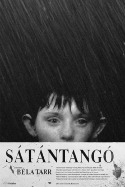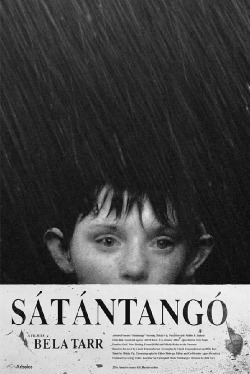
Review of Satantango (1994) by Christopher G — 07 Mar 2010
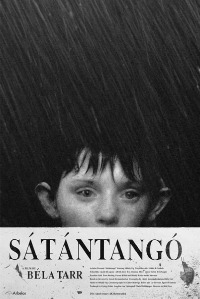
You know that feeling when you just finished a marathon? You finished in the 10th percentile, but you don?t give a damn, you finished damn it, so screw your ex-girlfriend who said you?d never amount to anything. Well, I don?t know that feeling either, but I think that?s the feeling I?d have after completing Sátántangó. Seven long ? but highly gratifying ? hours were spent on the couch, eyes glued to the picture mover (but not in succession, I had to keep my sanity somehow.).
Sátántangó is comprised of 12 chapters (to call them vignettes would be an understatement). The first six moving forward story wise, but following taking on another person?s POV. Until doubling back, and following the same people only in reverse. The structure borrows from (OMG!) the tango: six moves forward, six moves back. It?s very interesting, can only be taken true advantage of in a film of this length. It?s the only way you really get to know the characters.
One such chapter in particular really struck a cord with me. Felfesl?k (Those Coming Unstitched) follows Estike (Erika Bók) around on a short tale of betrayal and death. Being coerced by one, who we can only assume is her older brother, she?s lead to believe planting money underground and watering will grow the money tree. She returns a few days later and discovers the money was taken, and used by aforementioned older person. Her face to discover the betrayal, without reason might I add, truly saddened me. Of course she can?t fight back, so her only way to cope is to inflict pain on a poor cat. And that?s a key issue in the film: bullying. The bigger powers take advantage of the little, for no reason whatsoever, only because they can. It?s quite reminiscent to the Bush Doctrine, except America always has a ?reason.? I?d never go as far to say that America?s evil goes as far as the Soviet Union?s, but it sure as hell gets close. I?d hate to digress into some rant about America and our perverse concept of American Exceptionalism, but I can?t help but to find some allegorical similarity whenever a film takes on politics. It kills me just to think of Dragan Marinkovic?s satire The Bizarre Country (1988, Yugoslavia). If you can manage to find a copy, I highly suggest that film. Anyway?
It?s hard to be coherent when writing about a film you?re still digesting, but I do know this: Sátántangó is a film experience that can?t be matched. There are moments of boredom, do not get me wrong, but that?s more to do with Tarr?s need to stay stagnant on a particular shot, and all I want is for him to move on. I know why he does it, and frankly, commend his bravery, but after five hours, sometimes all you want is for things to progress. Save for that little complaint, this is a damn fine film, and deserves all it?s deification.
This review of Satantango (1994) was written by Christopher G on 07 Mar 2010.
Satantango has generally received very positive reviews.
Was this review helpful?