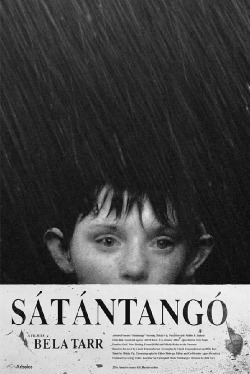
Review of Satantango (1994) by Brian E — 28 Apr 2010
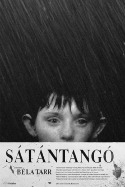
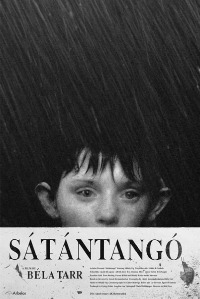
'Satantango' is one of the very most notorious film titles ever uttered from the mouths (or online message boards) of cinephiles and film afficionados, clocking in at an ambitious 7.5 hours in length (let's also recognize other well-regarded films in the "Running Time Olympics": Rainer Werner Fassbinder's 'Berlin Alexanderplatz' at 15 hours; Jaques Rivette's 'Out 1' at 12 hours; Sergei Bondarchuk's 'War and Peace' at 7 hours; Edgar Reitz's 'Die Zweite Heimat' at a baffling 25 hours; Masaki Kobayashi's 'The Human Condition' at 9.
5 hours'; and Bernardo Bertolucci's cut of '1900' at 5.5 hours). Bela Tarr uses this 7.5 hours to pay some obvious tribute to the Michaelangelo Antonioni school of cinematic thought - which is a gazing focus on everything outside of the actual story, while the story takes the backseat.
It is 1980's Hungary - once upon a small, impoverished village where time apparently stands still (not literally). As the townspeople receive their yearly pay in full, they organize a way out of the hopelessness and concretion of the dreary, lifeless landscape which they live.
Enter Irimias - seemingly who the title's 'Satan' may allude to - a clever, conniving, manipulative man who returns to the town. A young suicide within the community gives Irimias reason to initiate his artifice using guilt-driven, religious lecture in order to convince the people to give him their bundles of money, and stay in the town to keep the community as it was.
Bela Tarr has a pure objective of projecting his socially destructive themes of melancholia through a series of long tracking shots, and 5-10 minute takes of continuity. The exhaustion and repetition accommodate the character isolation, and how the community aimlessly wanders from one day to the next.
However, within this companionship of character and cinematic drag, I feel there is much undesired superfluousness; there is an aforementioned device in 5-10-minute takes emphasizing long walks in the mud and rain, drunken dancing, impressive continuity of philosophical dialogue, and voyeuristic close-ups of isolated behavior - but is it 7.
5 hours necessary? I lean more towards unnecessary and over-indulgent at times. Most of the emphasis is magnetic, especially those scenes during the film's middle which follow the final steps of a young, innocent girl - how she deals torture to an innocent cat (I'm assuming in brilliant reflection of the social torture inflicted on her by the upper class outsiders), and how she spends her final minutes of life staring into a pub watching the drunken dance of the hopeless townspeople, which would symbolize the pointlessness of living in such conditions; this subplot was the film's most paralyzingly effective minutes, and also shows Bela Tarr's disintegrated vision of reality.
While 'Satantango' invests its time patiently paying some tribute to Robert Bresson's realism, most of the characters speak philosophically in ways that intimidate the face of reality, as if Bela Tarr is speaking through his characters himself.
Andzrej Zulawski automatically comes to mind, yet less a venture in exaggerated theatrics. I see an obvious, recurring parallel between 'Satantango' and the only other two films of Bela Tarr's work that I've been fortunate to endure - 'Damnation' and 'Werckmeister Harmonies'.
With 'Damnation', we also deal with a piece of a small Hungarian community stuck in an environment with zero destiny or ambition, but maintaining some kind of concentrated hope towards leaving the rut which isolates them.
'Damnation' investigates more urban, more cultured souls, while 'Satantango' focuses strife in a rural land with more primal conditions (note, 'Satantango' takes place in the early 1980's; 'Damnation' being more present day).
Its companion to 'Werckmeister Harmonies' lies in dictating figures manipulating the small minds of a small town. Bela Tarr is a genius far beyond nearly anyone working behind the camera, but his ability to entertain may also be lost in time with his characters.
This review of Satantango (1994) was written by Brian E on 28 Apr 2010.
Satantango has generally received very positive reviews.
Was this review helpful?