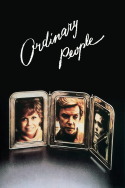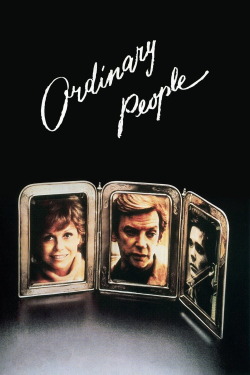
Review of Ordinary People (1980) by Mark A — 30 Aug 2014
"I've seen all ordinary people turn their heads each day! So satisfied, I'm on my way!" I'm not going to reference the John Legend song that is actually titled "Ordinary People", - because Legend is no ordinary black person - nor am I going to reference the more fitting song of the same name by "The Kinks", because I think everyone would kind of like to forget about the "Soap Opera" album. Man, as weird-looking as Mary Tyler Moore looks now, and as weird-looking as Donald Sutherland and Judd Hirsch have always been, I don't know how ordinary these people are. Not even the film's director looks like an ordinary person, although, outside of Hollywood, you might be more likely to find people who look as funny as the leads sooner than someone who looks as pretty as Robert Redford, which would explain why Redford chose to hide behind the camera with this film. Seriously though, I'd say that this was a pretty successful debut for Redford as a director, although, in all fairness, we are talking about Robert Redford, and in 1980, everyone was still on a high for films about brutal family dysfunction from "Kramer vs. Kramer", so of course the Oscars dug it. It helps that the film is actually good, at least about as much as it can be, even with its natural shortcomings.
Though plenty interesting, this film's subject matter is relatively simple, with certain major characters whose intrigue is not truly realized until they really find their place into a tale of dysfunction which has only so much momentum and extensive consequentiality, and isn't even unique. I joke about this being some sort of an answer to "Kramer vs. Kramer", but this film takes from a lot of distinguished dramatic properties in its vein and time frame, being almost hopelessly predictable, particularly when it goes so deep into formula that it loses subtlety. The subtlety lapses are rare, and hardly considerable once they do fall into play, but whether they be within some theatrical writing, or within obvious imagery, they stand overemphasizing ambitious themes, at least until Robert Redford's direction overcompensates for the dramatic missteps. As a matter of fact, I don't know if extremes to the directorial thoughtfulness so much overcompensate for the subtlety issues, as much as the subtlety issues break up overly subdued direction, whose consistency begets flat style and sober atmosphere that gets fairly dull upon find a point in storytelling in which material really falls out. I've already dealt with how simple this story is in a lot of ways, so, naturally, the runtime of over two hours is a little questionable achieved through a whole lot of inconsequential, or at least meandering material whose excessiveness is stressed by its getting to be just plain repetitious, if not monotonous after a while. The film takes so long to get its points, losing a sense of progression that more it circles around a formulaic and relatively simple path in a limp manner that wears you down, almost to the point of driving the final product into underwhelminginess. The film would have made that descent if all of the meanderings weren't punctuated so sharply by solid heights in storytelling which shine a light on just how worthy this drama's subject matter is.
The film's story concept is familiar and rather straightforward in its dramatic momentum, but the themes of this drama are of great importance, focusing on how terrible of an impact a tragic event can have on a family and its individual members, on an emotional and cerebral level that is by no means as ordinary as the victims of these personal turmoils supposedly are. Considering the subtlety and intimacy of this drama, a lot of the effectiveness rests on the shoulders of screenwriter Alvin Sargent, whose script is rather monotonous in its dramatic and structural excessiveness, but clever enough to carry respectable grace, and a degree of subtlety with it, which humanizes thorough characterization and dramatic scene structuring as genuine. Sargent's script is tasteful and obviously inspired, yet it, quite frankly, is not especially remarkable, with Robert Redford's direction seeming a bit more inspired, even if it's debatable whether or not it has more flare. There's not much style to Redford's debut directorial performance, hardly ever even utilizing a score to liven up the thoughtfulness which all too often dulls down momentum that cannot afford to fall too much, - considering the natural shortcomings of the story and the monotony of the written storytelling - but goes pretty deep when it does hit, breaking up a few obvious visuals with genuine subtlety that ranges from tenderly engrossing to piercing. Those subtlety touches go a long way, not simply in establishing powerful highlights in this audacious, brutally realist drama, but in transcending natural and consequential shortcomings enough to resonate with real, honest emotion, and tight intimacy that, as one can imagine, largely thrives on the performances. If nothing manages to save this film as compelling, then it is the cast, and even then, the thinness of the drama results in a thinness in acting material, made up for in the case of Donald Sutherland and Mary Tyler Moore through electric charisma and chemistry, punctuated by glowing dramatic highlights that are more recurrent in the lead performance of the then-up-and-coming Timothy Hutton, whose quiet, but powerfully convincing portrayal of a depressed young man seeking peace of mind over traumatic situations, and settle ground with loved ones, is the true heart and soul of this subdued drama. These gifted talents truly bring life to the impact of this film, whose subtlety could have meant its downfall, but is largely realized enough to make an adequately compelling and often powerful final product.
Bottom line, the simplicity of the story is stressed by clichés, a few lapses in subtlety, a number of bland spots in direction, and dragging to storytelling, thus, the final product runs a strong risk of collapsing into underwhelmingness, transcended through the important themes, extensive scripting, heartfelt direction, and strong performances - the strongest of which being by Timothy Hutton - which secure Robert Redford's "Ordinary People" as an ultimately rewardingly sound study on the struggles of dysfunction and facing harsh realities about what can happen to good people.
3/5 - Good.
This review of Ordinary People (1980) was written by Mark A on 30 Aug 2014.
Ordinary People has generally received very positive reviews.
Was this review helpful?