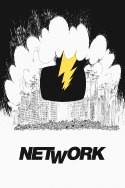
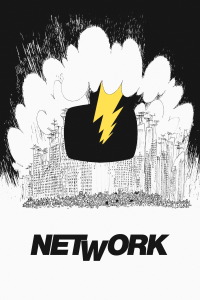
Review of Network (1976) by Vijay N — 21 Dec 2015
Howard Beale (Peter Finch) is about to lost his mind. He's (1) being sacked from his longtime job as the head anchor of UBS's evening news program, (2) threatened to kill himself on live TV, and, after being asked to publicly apologize for his outburst, (3) calls the world bullshit an irreparable number of times, the censors stunned.
But the network, it seems, is perfectly content letting Beale's mental breakdown fly free so long as it spikes their ratings - and, what do you do know?; the public likes watching a man throw his dignity into the trash heap and let go of what's left of a sound mind. On the first night of his network approved journey into madness, he immediately demands that the citizens of the United States of America stick their heads our their windows, gaze into the cold, cruel night, and scream "I'M MAD AS HELL, AND I'M NOT GOING TO TAKE THIS ANYMORE!".
How long Beale can keep up being a borderline insane public figure we don't know - but like the individuals who watch him, likening it to the trash TV they're only so rarely given the opportunity to devour, he could rip his hair out onscreen for all we care. As long as the popcorn's flowing and the content is one and the same with a trainwreck, uninterrupted entertainment is the first of our worries, a man's loss of stability a distant second. Execs tell him he's a spokesman for the 99% - a poor excuse for exploitation, if you ask me.
The best television satire ever made, "Network" gains relevance every year so steadily you'd swear screenwriter Paddy Chayefsky was, in actuality, a psychic who could see the direction television would head decades into the future. Did he know that illusionist David Blaine would later rise to prominence and risk his life in TV specials over and over again for our own enjoyment? Did he know that reality shows of the "Survivor" kind would pit vulnerable members of society against one another while placing them in dangerously wild areas of precisely picked jungles? Did he know that such a simple thing as finding love would become a game for the world to trivialize and mock?
No way in hell is "Network" a reflection of reality - it is, instead, a mirror Snow White's evil queen might be okay with if her self-confidence were higher, asking us just how much we sacrifice our morality, our ethical boundaries, for the sake of escapism, and how far entertainment providers are willing to go to fuel the cannibalistic hand that feeds them. In an Internet era where celebrities are more idealized than ever, where viral posts run amuck without considering humanity in the process, and where viewing human suffering can be a laugh-fest if the setting is right, "Network" is possibly even more audacious than it was in 1976. It deserves a thousand exclamation points following its closing credits, and then some. Some movies age badly over time - "Network" demolishes the notion.
Chayefsky, who died tragically in 1981, provides the film with one of the finest screenplays of all time, delivered in several enamoring tour-de-force monologues ambitious in their stature and razor sharp in their structuring and delivery. The writing is a game of cat-and-mouse, meant to be read as battles of words and linguistically crescendoed exchanges. He portrays the television industry, here depicted as the fictional Union Broadcasting System branch, as a cutthroat environment where monetary gain is so melodramatically important that even murder wouldn't be out of the equation if higher ratings arrived in return. The world it asks us to live in, callously lined in self-gain, is almost fantastical in the outrageous ways it scours for power, for financial leadership. And yet, Chayefsky's writing is so boisterous and so rooted in barely-there reality that we accept the film as non-fiction, even if it has less in common with the real world than a fantasy epic might.
Better yet, he writes people, not parts, and "Network" is fitted with an ensemble so in your face that even the smallest of a character sticks out in the memory (consider that Beatrice Straight, who plays William Holden's wife in the movie, is only on screen for about six minutes and still won the Oscar for Best Supporting Actress). Diana Christensen (Faye Dunaway), the person behind the spotlighting of Beale's breakdown, is the career woman who prefers the professional to the personal, willing to do anything to assert her dominance in the former; Max Schumacher (William Holden) is a days-past ideologist whose probable golden boy charm has been traded for cynicism in old age. Howard Beale is the product of a man who put off a mid-life crisis for years because he was too concerned with his job - and now that he's losing it, every regret, every doubt he's ever had about life, is hitting him like a truck.
The film is among the finest examples of a mainstream "acting" movie, too; its success and interest relies on the actors' handling of Chayefksy's screenplay. Not cast for their star power but for their memorization abilities and just how convincing they are at selling a long-winded monologue, they do not seem to be playing parts - it is as though they're subjects of an accidental documentary. Giving one of the finest performances by an actress ever, Dunaway smashingly makes Christensen a woman so keen on furthering her status that a doubt never crosses her mind as to if what she's doing is wrong; Holden, in his final great role, cements his legendary screen persona as something more than just a handsome face with a lot of talent. And who can forget about Peter Finch, hilariously angry and unstable, as a cinematic connoisseur of the art of the rant?
Everything about "Network" is dazzling: its satire is cold and sharp, ruthless and concise. We often forget that it is headed by Sidney Lumet, a dependable filmmaker whose influence spans decades, whose tight handling of the screenplay and the actors never gives us a chance to breathe. It is so original that anything even resembling an imitation would seem uncultured. It leaves you shaking, stunned, and maybe even wanting to watch it all over again, in order to appreciate Chayefsky's verbal luminosity and discover more gems embedded in the dialogue.
This review of Network (1976) was written by Vijay N on 21 Dec 2015.
Network has generally received very positive reviews.
Was this review helpful?