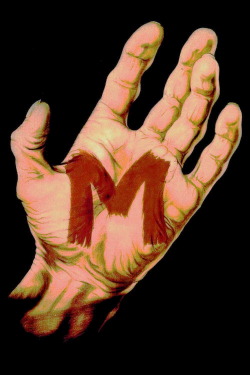
Review of M (1931) by Gregory S — 03 Sep 2009
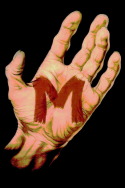
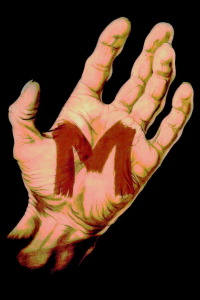
Fritz Lang's 'M' is not about a serial killer but one about the relationship society has with him. The film essentially has no main character but if it did it would be Lang himself. 1. because Lang would whistle the film's theme(Peter Lorre could not whistle and 2. because what he does with his camera in 'M' is creates a kind of unflinching nature of omnipresence (which was embodied by his characters in the early silents) for the viewer to survey seemingly all aspects of a society functioning in a way to bring something to the surface. The film functions unlike most serial killer or 'who done it' movies with a individual hunting down the killer but instead focuses on how a modern civilization comes to terms with making something invisible into something that is visible. At this point in his career Lang was not interested in dramatizing the exploits of a child killer but examining their role in the common unconscious.
Aside from being his first sound film 'M' is almost immediately in a league of its own among Lang's German period. Here there are no dragons, super villains, spies, robots of spirits. At the time of the film's released an article of his own where he more or less renounced the fantastic nature of his earlier films. He didn't talk towards his early stories but pointed out that all exploits in a story of Aladdin could be found in everyday life and decided that the film reflect phenomenons found in reality(as in the first scene where at the time of the first murder the victims mother receives her latest crime fiction). The prime phenomenon is here is that of that common subconscious in relation to the killer. This approach is evident in the very first shot where a circle a children recite a brutal nursery rhyme, or in a later scene where to eyewitnesses practically get in a fist fight over the color of a suspects hat on the scene in which an innocent man apprehended as the killer when a girl asks him what time it is. Another overlooked aspect is how the film adresses what were very modern views on serial murder when Lorre tries to justify his actions his argument is in line with Freud's theory of peace ego vs. war ego.
Lang's views of society covers one of collective fear to the point where we see many aspects of society being affected along with the common people, we see politicians, cops and criminals. What 'M" succeeds at is not only all these elements intertwining but how any individual who does not abide by any of these groups constraints will throw the whole balance into panic. This is the most evident when the criminals form their own effort to capture the killer juxtaposed with a police gathering on the same subject emphasizing the power of the killer, the two scenes are practically inseparable thanks to the excessive smoke (driving home the societies decay and nervous tension).
Many critics look at this film as a sort of prophecy to the paranoia the Nazi's would induce but Lang himself identified the film more with World War I. While the film does not directly reference the war Lang actually considered a scene in which Hans(the killer's name btw) was stationed in the trenches. Even without the obvious reference what we see is a world disillusioned and populated with a paranoia (and strangely seemingly absent of father figures) a country torn by the mass killing of war that can only breed more killers, Lang would call this 'mass murder complex' referring to society and the media's need for violence. The brilliance of the film is that the film dealt with what were at the time modern day issues, like I said its not as extravagant as his other films but it is his greatest testament as a film maker in that his observations I 1931 are perhaps even more relevent now as the more systematic a society becomes the more prone we are to be thrown out of balance and revert back a collective unconsious ruled by fear.
This review of M (1931) was written by Gregory S on 03 Sep 2009.
M has generally received very positive reviews.
Was this review helpful?