Review of M (1931) by Hayden G — 20 Apr 2016
Fritz Lang's 1931 film "M" opens up with kids playing a game and a little girl in the middle of a circle of kids imitating a clock and singing a song about a child murderer underlying the importance of time in the film and the character of Hans Beckert played masterfully by Peter Lorre. Little Elsie Beckmann is returning home as her mother prepares dinner. Elsie stops along the street playing with her ball against a reward poster for any knowledge on the murderer of kids in the city and just as the audience has finished reading the poster, a shadow appears over the poster telling Elsie what a beautiful ball she has and this is our introduction to Hans, he's a figure that has avoided detection for so long that even the audience isn't able to see him at first. Elsie's mother is starting to become frantic as Hans takes Elsie to buy balloons from a street vendor with his back to the audience. The presence of "Jaws" was always introduced by the omnious theme song, Hans is introduced by whistling the song "In the Hall of the Mountain King" allowing the audience to know whereabouts he is. Just as Elsie's mother receives the latest pulp fiction sensationalizing murders, Elsie is killed, her mother yells her name out the window and the film cuts to her ball rolling away and the balloon she had caught in telephone wires. This is how the film opens setting a pace for one of the creepiest films ever made.
The murder of Elsie leads to a police procedral film that looks more like a police training video. The police are bombarded with 1,500 leads where one police officer claims that "80 - 90% of them are false." The police bring in handwriting experts and pyschiatrists to help them track down the murderer causing panic among the criminal underworld with their constant raids on their bars. As Hans was introduced by shadow, so is Inspector Karl Lohmann (Otto Wernicke) as he descends down an arched staircase to a room full of criminals he has gotten to know so well over his years in the police force.
The countless police raids leads many heads of illegal business in the underworld to gather in a hotel room and discuss what they should do about the ongoing search for the murderer because it's cutting into their profits. A man known only as "The Safecracker" (Gustaf Grundgens in a role that would propell him to popularity during the Nazi Regime) suggests there will be no peace for them until the murderer is killed. This scene brilliantly transitions into a police meeting with city officials talking about how to catch the murderer. Lang uses this to show how criminals and police can put aside their differences when they have a common enemy. The film jumps back and force as the two meetings happen in tandem. Cigarette and cigar smoke slowly starts to build up in each room to the point where both rooms are consummed by it, indicating the nervousness of the characters in their search for the murderer. "The Safecracker" ultimately comes up with the plan to use beggars to watch children for the murderer.
The criminal organization starts to document where the beggars are located in the city by making sure no section of the city is not under surveillance. The criminals give them serial numbers marking the information in a ledger for their records. It omniously foreshadows actual events that will happen in Nazi Germany with Hitler's Secret Police and SS. Athough Lang never intended the film to be taken as an attack on Nazis, it's always been associated as such. As the beggars post throughout the city, the police are searching through mental institution records on any patient released within the last five years and ultimately that brings an officer to the apartment of Hans Beckert as the police put the crime together a little slower than the criminals and beggars.
Lorre's Hans toys with the press by writing letters demanding his notes be printed promising to kill again if they are not detailing mass murderers today who seek only recognition for their heinous acts. He's a mentally unstable person, no doubt, and Lorre plays that unstability to perfection. The role of Hans Beckert would unfortunately lead to Lorre's typecasting as villians in many films. It's no coincidence he would be casted in Alfred Hitchcock's "The Man Who Knew Too Much" before appearing in many classic Hollywood pictures. An unexplored element that is discussed among film scholars states that Hans may have been a World War I soldier whose killing in the war wasn't ultimately shut off in the civilian world as Lang refers to the act of killing in war as "serial murders." This was unexplored and ultimately less convincing as his targets are helpless children.
The newspaper plays an important part of the film, pitting one against another in attempt to locate the murderer with their overall looming presence over the city. Many scenes have the newspaper in the scene setting upon a table or in the hands of one of the characters. Altercations between citizens take place in the street where they accuse one another of being the murderer. What is absolutely amazing is that this film has relatively no location shots and the all scenes were shot on a studio set that impressively created a city in panic. The role of the media in today's society in causing panic and paranoia is shown in this film in a city with over 150 newspaper daily.
Hans becomes distracted as he passes a shop window looking at all the knives in the windows. He is framed by the knives in the display as he notices a small girl, also framed by knives. He starts to experience some intense feelings that he is having trouble controlling. He follows the girl whistling as the camera stalks her as if it were Hans, but immediately afterwards, Hans is stalked by the camera as he feels some omnious level of doom afoot. Perhaps after the girl meets her mother and he stops and realizes how close he was to being caught or the sickness in his ways prompted the feeling. Often times the camera swoons and moves more in this film by Lang than any other film I've seen from the early 1930's. Most films of the time period have the cameras stationary, but in "M," Lang seamlessly moves the camera from across a street through windows and finds his subjects among a crowd.
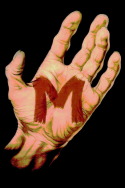
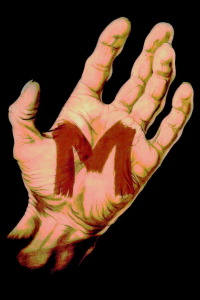
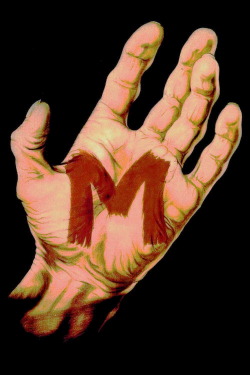
Sound was relatively a new technology at the time of the film's production. Sound was expensive and only 2/3 of the film has a soundtrack leaving many scenes devoid of sound. Lang experimented with sound and narrative on the film and would have sound coming from off-screen, intense silence disrupted by noise and sounds motivating the actions of the characters. It's ultimately ironic that the whistling that notifies the audience of Hans's presence would alert the suspicion and memory of a blind beggar who sold a balloon to Hans earlier in the film. A contrast that Hans goes unseen by the authorities and underworld but is ultimately caught by a blind beggar through the use of new technology in film, that of sound. As the police try to build evidence through visuals, the new technology of sound in film led the criminals to pursue Hans as if stating to the audience that the "silent film era" has ended and a new breed of film has begun. The beggar finds a young man to follow him and he uses white chalk and makes an "M" on his hand and walks past Hans and marks him as the murderer. This leads to a pursuit by the whole underworld of Hans ultimately leading to a memorable scene in seedy bars of the underworld.
"M" is supposedly based on Peter Kurten, who terrorized children from February to November 1929 and was known as the "Vampire of Dusseldorf," but Lang has always denied this. While researching the film though, Lang had spent time in a mental institution meeting with real child murderers including Kurten. But "M" isn't about the murderer, sure he plays a large part of the film, but the film is essentially about the panic and search for the murderer by all facets of city life. It's a very modern film despite it was made 85 years ago, with beautiful camera work and magnificent sets and lighting. Often times the camera swoons and moves more in this film by Lang than any other film I've seen from the early 1930's. Most films of the time period have the cameras stationary, but in "M," Lang seamlessly moves the camera from across a street through windows and finds his subjects among a crowd. The camera follows characters as they .
If this is considered a part of the canon of German Expressionist filmmaking that dominated German films in the Weimer Republic following the defeat in World War I to the rise of the Nazi Party, it may be the most accessible by today's audiences. But despite that, it may not be the greatest example of that film movement. F.W. Murnau, G.W. Pabst, Paul Leni and Robert Weine all made tremendously wonderful films, whether or not "M" matches these films is inconsequential in that it exceeds on its own merits without directly being an Expressionist film.
This review of M (1931) was written by Hayden G on 20 Apr 2016.
M has generally received very positive reviews.
Was this review helpful?