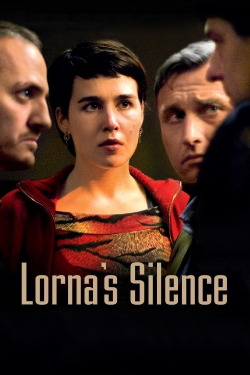
Review of Lorna's Silence (2008) by Daisy M — 05 Apr 2009
The Dardenne brothers are among the very few directors working today with the intention of delving into the darkest recesses of the soul. In a world obessesed with easy pay offs and enjoyable stories, they instead present ideas - about morality, and humanity. The pay off is effective, but never easy. Where most films are stories that can contain a purposeful idea, theirs are purposeful ideas that are told in story. Like Robert Bresson, they are artists presenting parables in the form of film.
They're latest is Le Silence de Lorna. It took home the prize for best screenplay at the 2008 Cannes Film Festival - the launching point for many of their films. The story this time centers around an Albanian immigrant in Belgium, Lorna (Arta Dobroshi). In a scheme orchastrated by an aspiring mobster, taxi driver Fabio, Lorna has married a junkie, Claudy (Dardenne favorite, Jeremie Renier). This will get her citizenship, and then she can marry a wealthy Russian, so as he may attain his citizenship. She has come to Belgium with her boyfriend, Sokol. He works away in Milan usually. Their time together is sparse. With the money they make from the scam marriages, they plan to open a snack bar. In the way is the issue of Claudy. As the film begins, Lorna has already married Claudy and lives with him. He's trying to kick drugs, and asks her to lock him inside while she works so he will not be able to get out if tempted. She refuses and treats him with scorn early on. The plan is that Claudy either 1) will give her the means for divorce, 2) die of an overdose, or 3) be overdosed by Fabio and his goons. Claudy only knows of option 1. As the film progresses, Lorna helps Claudy get sober, and she asks for the time to get a divorce. The rich Russian wants his Belgian card soon, so time is little. She gives herself bruises and claims Claudy beat her as grounds for divorce. The bruises are not evidence enough to say he caused them without witness. Lorna goes to him and asks him to hit her in public. He cannot go through with it - it's about his image, and he would never hit a woman. She goes to visit him in hospital and tries again. He complies with all he can muster - a weak slap. She hits her head off the wall instead so it bleeds and goes out into the hall crying. Now there are witnesses, and a wound. Her divorce is granted. She runs to Fabio, telling Claudy they will celebrate when she returns. She begs him to ask the Russian for the extra time to finalize the divorce. It's well established that she does not want Claudy dead, and in fact has come to care for him. He says the Russian agrees.
When she returns home, she finds a drug dealer there. She locks him out and throws away Claudy's key so he cannot get out. As he lays on the floor sobbing, she stares blankly elsewhere. Then, after a few moments, she begins taking her clothes off. Her look is one of hesitance, either because she is forcing herself to occupy Claudy with thoughts other than drugs, or because she is hesitant to accept the fact that this is what she wants.
The next day, Claudy is happy, she is happy. They get a new key made, and he buys a bicyle and she smiles and runs along side for a moment as he rides away. The series of events that follow would be spoilers to divulge. The Dardennes, so disregarding of conventional story-telling, often unwravel their secrets early. For example, in their brilliant masterpiece Le Fils, the big secret is revaled after the first act. The spoilers in this case they begin half way through. I orginally thought that revealing what happens at this point would not necessarily be spoiler, but to divulge it would mean everything else should be as well, and so I will not describe plot any further.
While Le Silence de Lorna is on the surface about the sinister intracacies of immigration in Europe, it goes much further. The story the brothers choose to tell is chosen for its timeliness and importance, no doubt, but it is simply a vehicle. In my opinion, like Bresson's L'Argent was about the evils of money, not simply a man who slowly becomes a criminal then murderer, Le Silence de Lorna is not essentially about underworld immigration, but about how money is the corrupter of our souls. I only slowly came to this realization near the end of the film when I began to contemplate the close shots of money being stuffed into envelopes, the transferring and talk of attainment of money. The Dardennes are too smart of filmmakers to shove something in your face, so subtlety is the key. Everything that occurs in the film is done because of money. At first only Claudy is the only one concerned about something other than money. Not only because he is concerned with saving himself from drugs. Lorna tells him to think of all the cash he will make through the divorce, but money is not the issue for him.
The brothers direct with their usual intimate camera work, but the film also seems to be shot with a bit more detachment. As usual, they make sparse use of music. What music we hear comes from onscreen for the most part (the final credits play with a piano piece by Beethoven). They also use some interesting editing with abrubt jumps in the storyline, as if a reel is missing. This is sure to confuse some, but I rather liked it, and thought it survived as a poignant symolic statement.
As usual, the Dardennes allow the power of their films to come from their actors. While all the performances are strong, one stands above. Arta Dobroshi's performance as Lorna is about as good as it can be. In particular, its the moments of silence that really shine. Her face expresses so much in a single glance. For me, the most affecting and brilliant moment of acting comes as Lorna answers a series of questions, all with "yes" or "no," as she realizes the magnitude of pain that comes with the success of the plan.
Some critics have taken issue with the direction the film goes in the second half, considering it somewhat conventional. It may be true that the plot becomes more conventional with a thriller, but the execution and purpose of it is anything but. And although Le Silence de Lorna may not necessarily be quite as good as Le Fils or L'Enfant, it's still a very, very strong film, and taken into context that means its still far superior to most standard dramatic fare that floats its way through our multiplexes.
This review of Lorna's Silence (2008) was written by Daisy M on 05 Apr 2009.
Lorna's Silence has generally received positive reviews.
Was this review helpful?