Review of Life Is Beautiful (1997) by Stefano C — 16 Apr 2018
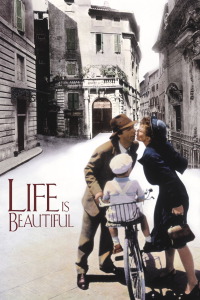
In his Italian Comedy/Drama film, Life is Beautiful (Italian: La vita è bella), Robert Benigni tells the story of a Jewish father, Guido, who protects his little child, Giosué, from the horrors of the Nazis with all that he has left: his wild yet colorful imagination. To protect his son from the harsh reality, Guido instead creates for him a false reality, in which the concentration camp they are in is instead a game. In the game Guido makes up, the rules are simple: Giosué has to do everything that helps him survive the camp. It is the combination of Guido's sense of humor, Giosué's fondness of tanks -the winner's alleged prize-, and most importantly, Giosué's innocence, that makes this "game" work, saving Giosué's life. Life is Beautiful is a film that uses comedy to symbolize parental love and devotion. Not only that, but it is also a film that works at both formal and contentual levels, transgressing boundaries of all sorts: temporal, mental, and ideological.
The brave but inevitably mortal Guido dies protecting his family, however, his sacrifice never dies, both in his son's memory of him -as long as he lives- and eternally in the film, which is a tool that transcends mortality. The film employs voice-over of the adult Giosué in the beginning and in the end of the film recalling his father's "gift" to him. This indeed shows that Guido's investment in his son made a lasting impact in his son's life that transcended his own existence. That is to say, the boundary of mortality, or more appropriately the architecture of death, is indeed transcended through the film, which is not something that could be done outside the frames of cinema. Another boundary that the film crosses is the architecture of confinement. Half of the film was shot in a concentration camp where elderly Jewish citizens and Jewish children get executed while allegedly taken to "shower" while men and women are separated, imprisoned and coerced to work for their enemies. Likewise, the film also operates at a formal level to further accentuate the oppression of the concentration camp. The form does this majorly with the aid of color transition. Scenes with dull and dark colors are seen in the camp, which is contrasting the bright and lively colors seen earlier in the film before the Jews' imprisonment, depicting the changing political climate in Italy. The use of color effectively highlights the film's message, showing life's beauty at the first half of the film and darkening as manipulation of power and discrimination increases in the second half. Indeed, this illustrates the negative impact of such actions and the poor quality of life when Georg Hegel's Master-slave dialectic comes into play, in which the Nazis become the masters of Jewish people. Also, the uniform pajamas worn by the Jews in the latter part of the film is contrasted with the military uniform of the Nazi soldiers, which accentuates an architecture of difference between the Nazis and the Jews, or perhaps more accurately, the masters and the slaves.
The Master-slave dialectic is reversed when Guido chooses to generate another reality for his son in which they are no slaves. Guido's game shatters the false unconsciousness Jews live in, in which it is one of the many rights of the hegemonic minority, the Nazis, to claim power over the subordinate class, the Jews. Having done so, Guido breaks free from the confinement they are in, even though not quite physically, at least mentally. Not only is false consciousness an obstacle in the film, it is likewise so in real life. Indeed, had the subordinate classes, always a majority, not been living in this false consciousness that obscures their sense of reality, they most probably would not allow of such manipulation of power to take place. False consciousness and ideologies are powerful tools that the authorities realize the value of and use to stay in control. However, Life is Beautiful subtly yet effectively challenges such ideologies as a means of transgressing boundaries to wake people up from their deep apathy.
Being of a comedian nature, Benigni uses comedy to subtly ridicule the Italian fascism and challenge Nazism ideology. In one of Guido's attempts to win Dora's heart over, he visits the school where she works when he knows they are expecting a visitor, an inspector from Rome. However, unlike the inspector, Guido does not believe in the superiority of the Italian race, or any other race for that matter, over the other races. When asked to lecture on that, Guido mocks the racial superiority argument by describing how perfect his ears and bellybutton are. Of course, it is ridiculous to base superiority on something as trivial as a bellybutton or an ear. Indeed, Guido left everyone in the room either laughing or angry at his "lecture". And yet, no one laughs or get mad when people assert that superiority is based on just another external and fixed trait, such as one's skin color. The form in this scene supports this arguments by the employment of irony, in which Guido is captured from low-angles while posing as one the "superior" people. Being a comedian by nature, Benigni never states his argument explicitly and neither did he attempt to. He just takes advantage of Guido's brilliant sense of humor to satirize Italian fascism and challenge views on false ideology. And just like that, the argument that Aryans are superior is ruptured and hence the film succeeds in profaning such common yet false ideology.
All in all, while Life is Beautiful might first be thought of as a film that is merely about a father and his son, it is much more than that. It is a film that gives meaning to life, even in the midst of life's harshest realities. Yes, Benigni knows how to make his viewers laugh, tear, and even smile through tears. But perhaps more importantly, Benigni knows how to brilliantly illustrate the power of films in transcending architectures of containment. In one film, the architecture of death, of confinement, and of false ideology were all transgressed.
This review of Life Is Beautiful (1997) was written by Stefano C on 16 Apr 2018.
Life Is Beautiful has generally received very positive reviews.
Was this review helpful?