Review of L'Eclisse (1962) by Ivan D — 06 Nov 2012
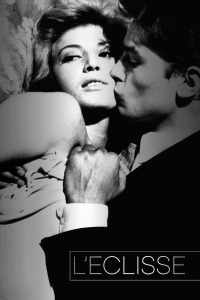
Deemed by Martin Scorsese as the 'boldest' film in Michelangelo Antonioni's trilogy of emotional isolation (the other two films being "L'Avventura" and "La Notte"), "L'Eclisse", especially in its final moments, has displayed just that and has also solidified, at least in my eyes, Antonioni's status as one of the greatest filmmakers of all time.
Enhanced by Monica Vitti's powerfully disillusioning and mercurial performance as Vittoria and Alain Delon's animated turn as her overly passionate (but I doubt that this is the right term for his character) stockbroker of a lover named Piero, "L'Eclisse" is an exemplary depiction of the qualms of leading an ennui-ridden life in a materialistic world. As highlighted by the film's almost nauseating visualization of the stock market, Antonioni is eager in exposing the chaotic repercussions of money. But more importantly, I think that, more or less, the film is truly an ambitious meditation on loneliness.
Throughout the film, we see Vittoria do all sorts of recreational things to alleviate her angst-ridden state of mind. From riding a plane, dancing in the tune of a native African music to chasing dogs, she has done it all. But still, empty she was. Along then came Piero, an aggressive, over-materialistic lad whose advances to Vittoria was first received with coldness, and then with passionate abandon. Both slightly cautious at first, they then began to have a series of brief romantic encounters that has neither meaning nor worth.
In many ways, "L'Eclisse" is a thoroughly pessimistic view on modern romance and how it's just impossible to maintain one in a money-driven world. In its majority, the film is exclusive in its observation of Vittoria's alienation. But by the end of the film, by way of a conclusive montage that has a certain power only a few scenes from a select number of films can muster, Antonioni suddenly transfers the alienation from Vittoria to us, the viewers.
By focusing mainly on a mundane street corner, its various trivialities and several 'alien' faces while completely removing Vittoria and even Piero from the whole picture, we ourselves are lost. 'Where have the characters gone?' 'Who are these people?' 'Where am I?' These are the questions that Antonioni has sparked within me as the montage kicks in. Through this striking sequence, Antonioni lets us feel that particular feeling of isolation and fear of not being able to perceive and interpret the things we're seeing. The resulting feeling, at least for me, is truly transcendent and somehow spine-chilling.
As those final minutes play out, I was literally lost for words; I can't decipher the holistic meaning of the images because the scene, I believe, is really meant to be 'incommunicable'. Bar none, "L'Eclisse" is certainly one of the most emotionally and perceptively unique cinematic experiences of my life. 50 years after its creation, its themes are still supremely relevant. At the end of the day, I think it's either "L'Eclisse" is truly a timeless masterwork or our everyday living hasn't really changed that much after all. For me, I think it's a great combination of both. Despite of "L'Eclisse's" esoteric quality, it has an emotional and reflective appeal that transcends cinematic barriers. This is auteurism at its best.
This review of L'Eclisse (1962) was written by Ivan D on 06 Nov 2012.
L'Eclisse has generally received very positive reviews.
Was this review helpful?