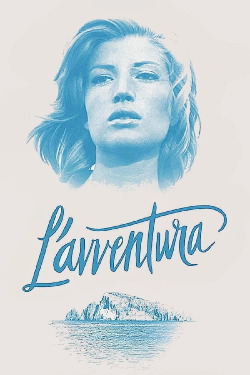
Review of L'Avventura (1960) by Jamison K — 23 Oct 2008
The Story.
The importance of Antonioniâ??s and Lâ??avventuraâ??s contribution to the craft of filmmaking aside for a moment, I think the real key to this story is the prostitute. The scene at the newspaper headquarters is just too overdone and out of context from the rest of the movie for it not to have been something important. Sandro could have made out on the couch with any random woman and it would have had the same impact on the plot, so why put that scene in the movie? (On a side note, who hooks up with a high priced call girl all night and never makes it past necking on the couch in the hotel lobby?).
Throughout the film Antonioni contrasts the prudishness towards female sexuality in public with the behavior of men. For example, the scene about how they locals ran the French and their bikiniâ??s out of town, and another scene where men surround Claudia while she waits outside the hotel allowing them to ogle Claudia while at the same time forcing her into feeling guilty/ashamed about what she is doing/who she is illustrate this dichotomy. This contrasts starkly with the near riot the men cause when they catch a glimpse of the hookerâ??s garter belt. There is also a contrast between these public situations where men are free to ogle and French ladies wearing bikinis are run out of town, and the private lives where sexuality seems to be relatively out in the open and equally acceptable coming from either gender. Antonioni may be trying to highlight the difference between male and female sexuality or public and private sexuality or both, its hard to tell.
There is also the strange situation of there being almost no female extras in the film, and those that are shown, like the ones at the ball are paired with men when they are shown at all.
Then youâ??ve also got the contrasting attitudes of the women where they all represent a different archetype of female sexuality. Itâ??s a similar approach to the one Eastwood used in Unforgiven except his characters represented different archetypes of violence rather than sexuality.
Claudia: Represents the contradictions of traditional female sexuality, understands what she wants but feels bad about wanting it, and would never dare admit any of it in public. (There was also that weird lesbian tension on the boat with Anna that Iâ??m not sure what to make of.).
Giulia: Essentially she represents the fully liberated sexuality albeit slightly constrained by her marriage, especially later in the film in the scene with the painter. Eventually, She knows what she wants from both her husband and from her young friend, will keep them apart as long as it benefits her, and if push comes to shove she will do whatever the hell she feels like regardless of the social implications.
Patrizia: She figured it out, sheâ??s got a PhD in Vaginomics and understands that men are simple simple monkeys easily manipulated to serve her interests.
Anna: Anna may simply be a plot device, or she may be a predesssor of the modern liberated woman who is trying to establish an identity outside of the men in her life.
The Prostitute: The reaction of Sandro and the men at the newspaper office to the prosititute are meant to show the power of female sexuality. Well, that and what simple simple monkeys we really are.
The Film.
In respect to the film and its influence on the craft of filmmaking, I got the same feeling I get when I watch the old Kirosawa/Mifune samurai movies. Iâ??ve been watching George Lucas rip him off for so long that I canâ??t really appreciate his true contribution to the art form. Itâ??s the same reason that people who grew up after the Beatles will never appreciate them the same way as people who were there when the emerged. Thatâ??s how I felt about this film as far as the artistic merits of the film itself. Iâ??ve seen so many films that use the same cinemagraphic style and follow the standard European art-house formula of: Minimal Character Introductions > Meandering Plot > Random Ending, that I canâ??t really appreciate how groundbreaking and inspiring it was the first time someone did it. Had it been the first such movie I had seen in that style though, I may have been able to enjoy it or at least appreciate it as I have other similar movies such as â??Lost in Translationâ?? which is a favorite of mine and the one film this Lâ??Avventure reminded me of. Itâ??s a little strange that I think of Lâ??Avventure as a cross between â??Lost in Translationâ?? and â??Brown Bunnyâ?? yet the film came out four decades before either of those. The way in which the passage of time affects film as an art form is an interesting characteristic of the medium.
I feel a little bit cheated.
This review of L'Avventura (1960) was written by Jamison K on 23 Oct 2008.
L'Avventura has generally received very positive reviews.
Was this review helpful?