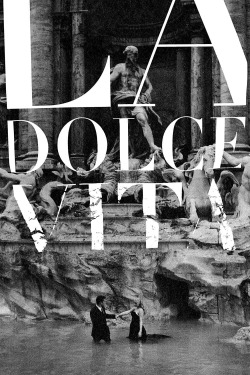
Review of La Dolce Vita (1960) by Daniel K — 23 Jul 2008
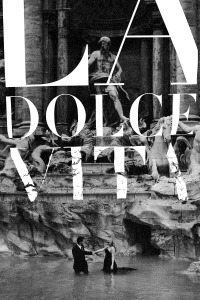
The opening of La Dolce Vita is quite unique, and I don't think I've ever seen anything like it: A helicopter flies over Rome, a huge statue of christ is suspended underneath it, a second helicopter behind it. A small group of women on a pation wonders where the statue is going. Marcello (Marcello Mastroianni), a journalist, pops his head out from the second helicopter, well it going to the Pope of course, and immediately after asks one of the girls for her number. Ha ha what odasity, it also tells us so much about Marcello, what a player he is. It's also a huge risk to take by Fellini as a scene like this could easily have come out as being too cheesy, but it just works so well.
Marcello lives with his work, he's a womaniser and a player, eventhough he's got a girlfriend waiting for him night after night, he's out there doing his job while seducing the most influential and famous women he can find. He's always going somewhere in his little sports car going to nightclubs and parties, almost always followed by his photographer Paparazzo (Walter Santesso). Because where Marcello is, the action is. Marcello loves women, but being on the move all the time and never finding rest makes Marcello miserable and unhappy. All this he does while his girlfriend Emma (Yvonne Furneaux) stays at home being neglected, yet she keps staying with him because she loves him and can't imagine a life without him. This angers Marcello, he doesn't love Emma and in another scene he almost blames her for his unhappy life. Calling her a slut and selfish eventhough it's him who's constantly cheating on her. It's Marcello that's the slut and selfish one, he can't see past his own paranoia. What Marcello needs to realise is that he needs to get away from this life, start over, yes he needs to leave Emma, he needs to leave all the parties and nightclubs, but in the end he always goes back to Emma and these things.
Marcello is a child, he wants what he can't have. As a young beautiful Scandianvian/American actress visits town Marcello ofcourse falls for her and in a belltower he almost suceeds in seducing her, but she too absorbed in the beauty of Rome, she doesn't fall for his tricks. He follows her all over Rome, all these scenes are almost dreamlike an illusion, he can't have her and thus it's like a dream that doesn't come true.
Marcello is so far gone in his own self-absorbness and in a druken orgie of a party, he goes completely overboard. Marcello makes himself the center of the party urging the women to strip their clothes and go wild, he rips pillows and throws bottles. He just becomes pathetic to look at at. The party goes dead and the party of people, now early morning, goes down to the beach, followed by a rather drunk Marcello, where they encounter some sort of giant dead fish. It's almost like Marcello for a moment there comes to his senses realising the dead fish is himself and looking into it's giant eye, seeing himself still living in the past. And then from nowhere he's giving the chance to redeem himself and become innocent again. There further down the beach and young pretty girl is waiving at Marcello telling him something. It's Paola, the young girl from the café, where Marcello goes to write sometimes. She's telling him to come with her and leave all this craziness. But because of this loud waves Marcello doesn't understand what's she trying to say, he smiles at her and waves back and then leaves her behind. She simply stands there smiles back and let him leave. Paola is the innocent, still untouched by the corruption of life, and like the lost child Marcello is, he doesn't see what she's trying to tell him.
The movie opens with a statue of Christ and ends with the smiling face of a young innocent virgin, now if that's doesn't make it unique and sublime, I don't know what does.
This review of La Dolce Vita (1960) was written by Daniel K on 23 Jul 2008.
La Dolce Vita has generally received very positive reviews.
Was this review helpful?