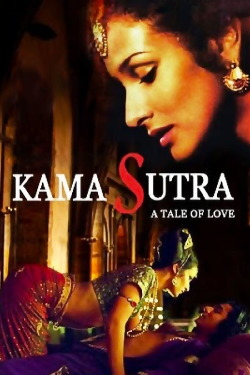
Review of Kama Sutra: A Tale of Love (1997) by Edith N — 21 Apr 2010
Ownership Does Not Confer Love.
In many traditions, the health of the land is inextricably tied to the health of the king. It's where the idea of the Year King, the king who is sacrificed for the benefit of the land, comes from. (We will not get into whether there ever was such a thing in the real world.) If the king is weak and decadent, it does not bode well for the land. Especially if, as with this king, he has gotten no heirs. I'm not sure we ever see this king do anything which does not suit his own pleasures; certainly, he does not interact with the common people. He does not make wise decisions. He even meets emissaries from his neighbouring country, which threatens to overtake his at any moment, in his harem, surrounded by many perfumed women. He even goes so far as to offer the emissary three of his women--or a boy. A master of diplomacy, this king.
Maya (Surabhi Bhansali, then Indira Varma) is a servant girl who grows up alongside Tara (Garima Dhup, then Sarita Choudhury), a princess. Maya envies Tara her opportunities and her future, which eventually means marriage to Raj Singh (Naveen Andrews) and entry into his court. In a moment of defiance, Maya sleeps with the king before Tara, and she is banished from Tara's presence. She ends up meeting a stone carver, Jai Kumar (an inexplicably uncredited Ramon Tikaram), who falls in love with her and uses her as his model. He also introduces her to his mother, Rasa Devi (Rekha), a teacher of courtesans and former courtesan. When Kumar declares he cannot love Maya, she ends up sent to court to be the head courtesan of the king. (It is never confirmed, but Kumar is Singh's half-brother.) She still loves Kumar, and it is in part this which allows her to renew her friendship with Tara. Only she cannot love Kumar and obey Singh.
Certainly this is an opulent movie. At one point, Maya is wearing a red silk top embroidered in gold, and I found myself hypnotized as much by the colour as by anything happening onscreen. The pearls bedecking everything looked remarkably fake, but the drapings and costumes and so forth were lovely. The bathtubs in which women lounge are desirable to someone who takes as many baths as I do--they are large and deep. The women's movements are graceful, the chiming of their jewelry alluring. We see very little of the world outside the harem, except during the time Maya is in exile, and even the old courtesan's training house has some of that same grace and beauty to it. It seems to be both her preparing her girls for it and wishing for it herself.
On the other hand, there isn't much more to the movie than that. It seems almost as much allegory as anything else. There is, per title, supposed to be a love story there, but it almost seems to be between Maya and Tara as much as anything else. There are scenes where Maya is cradling Kumar in her arms, and she hides him from Singh when necessary, but she's still perfectly willing to go off to court. Quite obviously, Tara does not love Singh. When Maya first sleeps with him, before the wedding, it is at least in part to get her own from Tara. She tells her that she has taken Tara's leavings all her life, and now it is Tara's turn. And Singh seems as much obsessed with Maya as in love with her. If there is love, it is a dry love, not one which excites the senses. It seems enough, at least on Maya's part, for her to believe that the king will not kill her for turning him away, but it seems as though she's turning him away in a show of power, not for love of Kumar.
Doubtless many people pick this movie up on the assumption that it's full of graphic sex. There's a certain amount of sex, but it's not very graphic. There's a lot more talking about it. Rasa Devi talks a great deal about how the Kama Sutra is the ultimate text of love, and that may be the problem with this movie. It focuses a great deal on love as the sensual, and of course sexual, but none of these people seem to have the least idea of how to live with each other on a day-to-day basis. Most of them don't seem to have anything to talk about. Again, that's entirely understandable when it comes to the king and queen; it's an arranged marriage. Tara is conscious of her position and its importance, and holding onto that is worth more than actually bothering to talk to her husband. And of course, she doesn't exactly have much in the way of opportunity to talk to any other man. Singh commands. It's all he needs to do. Maya and Kumar are just kind of confused, I think. This is not a true love story, no matter what the title says.
This review of Kama Sutra: A Tale of Love (1997) was written by Edith N on 21 Apr 2010.
Kama Sutra: A Tale of Love has generally received positive reviews.
Was this review helpful?