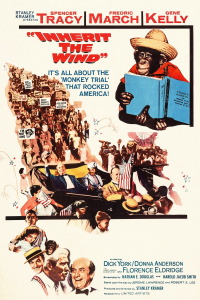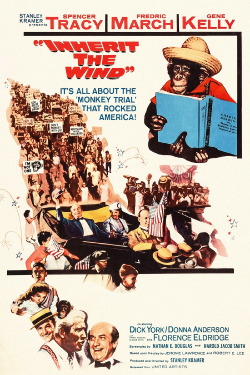
Review of Inherit the Wind (1960) by Aaron W — 11 Nov 2007
The films Judgment at Nuremburg and Inherit the Wind aren't so much artistic experiences as polemic ones. Although both movies hang their hat on historical events, neither film is actually about the surface events in the film. Directed by the same man and released within a year of each other, their purpose was to get audiences rooting for the forces of reason, and oppose the irrationality of the herd mentality.
Judgment at Nuremburg is about a fictional trial of German judges who let themselves be swept up in the ethnic hatred promoted by the Nazis, delivering verdicts that they had decided upon before the trials over violations of racial purity laws had even begun. The film was written as a reaction against McCarthyism, which had gripped America for a decade and burned out just five years before the film. The film intended to show the danger of movements of mass hysteria, and how easy it is for an entire society to commit atrocities in the name of defending their country. The movie's tactics are heavy-handed. You can almost see the defense attorney getting rabid as he uses the same vicious illogic to attack the prosecution's witnesses as he used to shred the defense's witnesses when he prosecuted defendants on behalf of the Third Reich. If that weren't obvious enough, the movie drives the point home with a monologue from one of the defendants about how the judges lied to themselves -- first to protect their country from the Russian threat, then to save themselves at the expense of innocent people. A modern American audience might be entitled shake their heads at the absurdity of Nazism and McCarthyism, if it weren't for the same phenomenon taking place today, with Muslim terrorists being the scapegoats and justification for a range of brutalities and civil rights restrictions.
Inherit the Wind is, on the surface, about the famous Scopes evolution-teaching trial in Tennessee in the 1930's. The movie paints a stark portrait of those enlightened by science and the ability to think for themselves as opressed by those caught in the mindless vise-grip of fundamental Christianity. There is some sparkling courtroom dialogue between the two leads, but the point was clearly to portray the fundamentalists as idiotic buffoons. While I'm all in favor of putting facts ahead of faith, caricaturing opponents of your viewpoint may make good propganda, but it's terrible drama. Despite this, the movie is instructive about the constancy of this particular struggle, since it continues today, using the same arguments on both sides. In fact, the divide between the rationalists and religionists is arguably worse today, as both camps diverge on a growing number of fundamental values.
My reactions to these movies was not so much to like them or dislike them, but to despair over the fact that as a nation and as human beings, we continue the insanely destructive patterns depicted 45 years ago. It seems that we have learned nothing from our past, or perhaps, as human beings, we are simply locked into a limited set of behaviors that doom us.
This review of Inherit the Wind (1960) was written by Aaron W on 11 Nov 2007.
Inherit the Wind has generally received very positive reviews.
Was this review helpful?