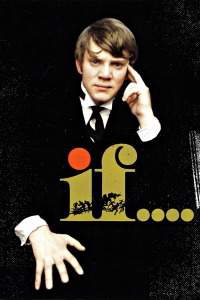
Review of if.... (1968) by Byron B — 13 Sep 2008
NOTE: For once, I give away straight ahead the entire film, because the plot is not the essence of the film's experience. If you wish a completely "virginal" experience of it, do not read any further.
I was sure I'd never remember the film that inspired me to begin this way, but it finally occurred to me. Bear with me, though in start this will appear to make absolutely no sense. I wandered past Roger Ebert's book Your Movie Sucks today, and, as always, thought of the absurd inclusion of 1954's Gojira. I've been known to have my disagreements with Ebert (some simple matters of taste, others ironically condescending laughter at his arrogant claims), but I recalled that a major point of his review was that the film was not effective any longer. I thought then of whether a film should be considered in its context only--as in, see that film from the attempted mentality of a culture scarred by atomic events in the 1940s and 50s. Is that why it works for me? I asked myself. I shrugged--I tend not to think of such things, but I do unconsciously ignore "80s hair" in my favourite films (or even revel in it, without tongue-in-cheek hipness, though not with admiration at any perceived beauty in it). Why on earth am I rambling about this? Because the first words from my parents' mouths after if.... ended were that it had aged very well, and not dated at all. And yet, they also made reference to the cultural events that followed/inspired the film at the time of its making. Is, then, this an issue of dating? Cultural relevance? Is it timeless? Malcolm McDowell and the critics involved in Criterion's release of the film seem to think it is. Yet, I felt some disconnection from it, myself. I did not think it completely alien and without reference points, nor that it was badly made or poor. But my age as compared to these critics, and the people involved in the film and everyone else judging it next to me--well, I'm rather young. I was not alive in 1968, far from it. And that makes me think: nuclear power used to kill remains a terrifying thought--yet it's not the same as being in a country that within the past decade had been actually attacked, and when it was a new horror, instead of a half-century old one. Is that then a flaw? Many love a film for its "timeless" nature--yet how easy can it be to address timely, culturally relevant issues and keep them important thoughout history?
Mick Travis (Malcolm McDowell) is a returning student at an English public school, coming in with a face wrapped in scarf and hat, for which he is criticized by Rowntree (Robert Swann), the head Whip--the seniors given authority over all other students. They treat first years as slaves, referring to them as "Scum," and requiring them to do the Whips' bidding. Sexually abusive under, no, overtones, are clear here, with Scum being asked to warm a lavatory seat for Rowntree before he goes there himself. Mick removes his coverings after avoiding the attentions of the Whips as best he can, and we find he has grown a moustache between school years, something forbidden at the school. He shaves it off as his friends see, they being Wallace (Richard Warwick) and Knightley (David Wood), all of whom together form an isolated community within their school. The Whips are drunk with power, focusing almost exclusively on their control of other students, adult authority figures like the Headmaster (Peter Jeffreys) and House Master Mr. Kemp (Arthur Lowe) leave the Whips in control, and the first years just keep their heads down as much as possible. Mick, Wallace and Knightley, however, sneak alcohol, listen to a record of Missa Luba repeatedly and loudly, and eventuall even sneak off campus (also forbidden), where Mick steals a motorbike and they travel to a diner, where he has a sudden and rather torrid affair with the girl who works there (Christine Noonan, whose character remains nameless). In spite of this list of misdeeds, when the Whips finally tire of their antics, they cane them--most viciously Mick, who refuses to keep silent his opinion of Rowntree--for their "attitudes." In the final, surreal (and most infamous) scene, Mick and his friends bring revolution, revenge and their personal freedom to the school in a bloody coup, ending the film on a snarling image of Mick as he fires a machine gun at the other students and faculty.
On the reverse side of timely films losing dark effects, there's certainly a greater discomfort mixed with the sense of shock the finale originally induced in light of far more recent events. The practice of, it's apparently called "fagging," that the Whips-Scum relationship refers to has deteriorated though, and many changes in school systems all around the world have taken palce. But, I suppose what does lead people to believe this film has not aged or dated itself is that these elements, while central to the plot and establishing the ideology that it rages against, they are not, in fact, central to the meaning of the film itself, not specifically required stimuli for the rage it portrays. Mick repeatedly lays out surreal philosophical declarations, usually leading us to the meaning that exists outside this particular setting: "There's no such thing as a wrong war. Violence and revolution are the only pure acts," "When do we live? That's what I want to know." I tried for some time to ascribe the black and white sequences to this philosophy--at times feeling that surely those colourless moments were relevant to the moments where Mick and his friends lacked this freedom. Strangely, it worked for the great majority of the film, but finally broke in the diner. I refined its definition, suggesting that perhaps this was the control of hormones and instinct removing freedom--but eventually gave even this up. I imagine I could wrangle that into being a reason for the division, carefully explaining how each instance represented one or the other, but it would be tenuous, stretched to the limits of reason. Thankfully, the special features clarify for the viewer on Criterion's release: it was a move first made for economic reasons with regard to lighting, then later established with an emotional basis. Director Lindsay Anderson would seemingly arbitrarily choose a moment to be colour or black and white based on his own reasons or feelings, not with any explanation. And so, we are left with a fascinating film that jumps mediums with no clear reason: nothing is enhanced or degraded or highlighted or subverted except for our experience of the film. It becomes something other than the usual, but not by completely ignoring reality and taking a surrealistic route. It suggests Anderson's self-espoused anarchic philosophy. The film randomly rotates between colour and its absence, with no clear reason, nor one to truly decipher. It doesn't feel forced or artificial, just like the rest of the film. Even when Mick makes his declarations, the ever-magnetic McDowell (a strong reason for my choice to purchase and view the film) makes them sensical for the character of Mick. It is indeed an unusual film, and quite a good one at that.
This review of if.... (1968) was written by Byron B on 13 Sep 2008.
if.... has generally received very positive reviews.
Was this review helpful?