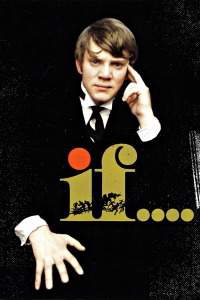
Review of if.... (1968) by Paul Z — 17 Aug 2010
If.... advances a plot with a clear-cut and self-classified beginning, middle, and end. Regardless, it's transmitted through a domain of poetic license, where the facts of existence and castles in the air mingle and become the same. The events, which are sectioned like a book into titled chapters, tackle all sorts of content major and minor. From how new students are obligated to learn the school's incredibly particular casual dialect, and tested on it by the Whips, to the impulsive quirks of a teacher to the delicate liaison of Richard Warwick and Rupert Webster to the conservative barbarism of the Whips, who indeed whip our lion-hearted trifecta for their "general attitude," we are in another world, a complementary world corresponding to the highs and lows of our own.
More than teachers and school administrators, it is fellow students, the senior classmates who literally dominate their lives, treating them not as equals but as prison inmates, who are the actual sitting ducks. As a result, it is hopeless to view If.... today without being reminded of the Columbine massacre. However, that was real, and Anderson's massacre is definitely meant to be symbolic. Nevertheless, American audiences of today are given a point of reference by a British audience of forty years ago. Not only is storytelling common to all cultures, but there is evidence that there are structural similarities between the tales, stories and legends produced by different cultures. The story structure found in the folk tales of one culture can recur in another, suggesting that there is something universal in the structure as well as in the function of storytelling. Because stories are human nature.
Ifâ?¦. has no allusions to its era's events or pop culture. No drugs (though the boys do drink vodka). And rather than a pop-music score, the African Missa Luba is heard like parentheses. Anderson's focus may best be characterized as refined instead of contemporary. If...., strictly speaking, is about adolescent longings to rebel that are concurrently of its time and all. When the key figure of If.... says that "violence and revolution are the only pure acts," he's being radical in a manner usual for a teenager of his class and education. He also says, "When do we live? That's what I want to know," words that almost any kid eager for individual freedom, despite class or education, would say. If.... transpires in that many-sided period when youth falls away as the adult to be is developed. And it's the development of that coming grown-up that is the core motif.
Black and white is sufficiently unusual to have some power as a special effect. If.... goes from black and white to color and back again without any evident purpose, the consequence underlining the reality that we're watching a movie, not life, and giving the movie the feeling of a hazily recalled flight of fancy. This feeling is everywhere sensed, as in such mystifying bits as when the prefect's libidinous but inhibited wife, rambling nude though the boys' rooms when they're out, or where our heroes, designated the task of cleaning out a cellar brimming with all kinds of refuse, find a dead fetus in a jar of liquid. And then there's Peanuts, the most intellectual of the boys, who peers through his telescope and expounds on the essence of the universe to Mick. However what Mick sees through his lens is the The Girl, whose introduction in the film is a signature of its total disregard for reality.
Warwick is readying to do his gymnastics routine, and as he does so he looks up at the gym's upper balcony, where a group of younger boys are exiting. Webster is pulling his sweater up over his head. As he does so, Wallace clutches the exercise bar and lithely and exquisitely performs the drill, which we see in just the subtlest slow motion, intercut with Webster beholding Warwick, entranced. Warwick is yielding his body as a gesture of affection, in what might possibly endure as the most sublime homoerotic scene ever filmed. It's why, though we later see these lovers asleep in bed, no sexual act is ever exhibited between them: That's the function of the gym scene. And it's superior to sex.
A good movie is one whose most noteworthy line comes just before the violence it motivates: "The thing I hate about you is the way you give Coca-Cola to your scum and your best teddy bear to Oxfam and expect the rest of us to lick your frigid fingers the rest of your frigid life." It's a very straightforward citation of a clear-cut turning point. And it's through this converging of the hallucinatory and the straightforward that Ifâ?¦ comes most richly to life. It's the domain of illusions (or delusions) made authentic.
This review of if.... (1968) was written by Paul Z on 17 Aug 2010.
if.... has generally received very positive reviews.
Was this review helpful?