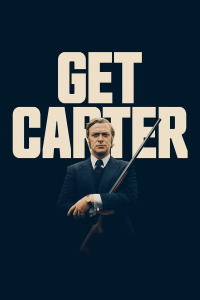
Review of Get Carter (1971) by Paul Z — 08 Jun 2010
Sometimes, a gang-related murder is so well covered up that only another gangster may suspect it was a gang-related murder. And if a gangster is the one who will carry out justice, it's going to be carried out in the ugly, unrelenting way a gangster will do it. That means that anyone who gets in his way, and anyone of whom he can take advantage, is subject to be tortured, beaten, killed, et cetera. Such is the case with Jack Carter's suspicion that his brother's death was no drunk driving accident.
If other, more powerful gangsters are those who a gangster seeking personal vengeance must confront, there will naturally be attempts to administer a taste of his own medicine to throw him off the trail, to run him out of town, to rub him out completely. This, as it does in the case of such a brutal brand of justice, simply makes matters worse. First of all, if what can loosely be referred to as his colleagues want him out of town so bad, it is a clear sign that his suspicions have been correct, so not only is he going to retaliate, his brutal plans are going to become even more brutal now. There is a revelation as to the reason for his brother's death that sends him, in a figurative sense, and someone else, in a literal sense, over the edge.
Violence breeds violence, which breeds more violence in this enjoyable British gangster picture, a seminal film for Michael Caine, who sharpened his ability in his string of crime films in the 1960s, particularly in this one, to give such a charismatic and arresting performance as a character who has no intention---and neither do the filmmakers---of making us like him. Get Carter is also a piece of efficient and effective stylistic economy. The spare, stationary camera-work is first-rate, capturing whole scenes in single unobtrusive let stylishly done takes, and Jack Carter's vicious and merciless revenge plays out against the backdrop of smoke-filled pubs, private social clubs and derelict urban housing, shot on location, a very clever approach as it includes intriguing spots like an apparently well-known raw concrete multi-storey parking garage with a rooftop café and a level in the process of being developed into a restaurant. This is the location for an utterly clean and graceful defenestration only the coolest gangland cucumber could execute so swiftly. There is also a gripping chase along a black industrial shoreline littered with piles of coal. Ultimately, a great deal of its charm comes from incidental detail.
That doesn't stop with the shrewd visuals. It's also in the distinctive jazz score, which is a welcome convention of the era's crime pictures, as well as the unapologetically down-home Cockney dialogue, a sort of precursor to the pervasive quotability of Guy Ritchie's contemporary East End thug throwbacks. Like Ritchie's popular Brit grit, Get Carter is what notoriously tough critic Pauline Kael referred to at the time of its release as "calculated soullessness," a description I can't put it any better as it is essentially a sadomasochistic testosterone dream full of business suits, sawn-off pump action shotguns and payback time, but it's all so clever and intelligently pulled off. Unlike Ritchie's whirlwind-speed genre exercises and what makes Mike Hodges' much more laconic film a drag at times is the transparent attempt at idolizing Carter as a Hugh Hefner-type playboy who effortlessly gets a woman off via phone and nails even his temporary landlady despite the harm he causes her. All women in the film are purely sex objects, not characters. However, unlike Ritchie's films and what makes Get Carter more interesting overall is that it makes little to no attempt to be endearing, light-hearted or funny; its title character is cold-blooded, cruel and even unkind.
In spite of its indulgences and what would become Hodges' signature lagging pace, Get Carter is a taut, potent procedural that doesn't bother with pious platitudes about the inability to live with a guilty conscience, that one doesn't want to see oneself as a bad guy, and instead gives us what is probably a much more realistic rendering of a gangster inhabiting a gang-controlled world, a guy who's content to see himself as a "villain," as he calls himself. There's a pervading mood in all storytelling media that's inclined to teach us the way to behave through showing us right-thinking people as our protagonists, which never comes across as particularly believable in crime films, even good ones. Here is a movie that isn't afraid to show a bad guy brutalizing other bad guys than which he's no better, as well as some halfway decent people, and the only reason he is the protagonist is because he's reacting instead of instigating.
This review of Get Carter (1971) was written by Paul Z on 08 Jun 2010.
Get Carter has generally received very positive reviews.
Was this review helpful?