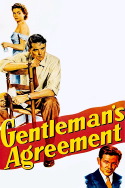
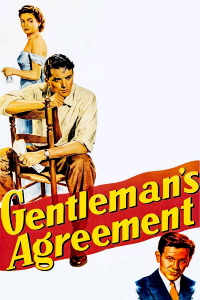
Review of Gentleman's Agreement (1947) by Edith N — 27 Jan 2009
As we discussed recently, this won Best Picture in 1947. This was just a few short years after the Second World War, just months after the most notable of the Nuremberg Trials. By all accounts, the American people were tired of hearing about the whole thing. The studio moguls were afraid of breaching the subject, in no small part because, as most of them were Jewish themselves, they didn't want to be accused of bias. The film was eventually made by Darryl F. Zanuck--a Methodist. Director (and later [i]very[/i] controversial figure) Elia Kazan was born in Constantinople, of all places. Gregory Peck was a wholesome American boy from La Jolla, California. It took a group like that to get the film made. On top of that, John Garfield--born Jacob Julius Garfinkle--was paid a full star's salary for his supporting perfomance, and he considered the role of the Jewish Dave Goldman to be one of the greatest heights of his career.
Philip Schuyler Green (Peck) has come to New York to live with his mother (Anne Revere) and work for a prominent magazine. He is assigned to write an article about anti-Semitism. Eventually, after many false starts, he decides to pose as a Jew. Only a very few people, including his girlfriend, Kathy Lacy (Dorothy McGuire), know the truth, and Green intends to keep it that way. Green's old Jewish army buddy, Dave Goldman, comes to stay with them, acting as Green's sounding board for the prejudices that he was experiencing. His son, Tommy (Dean Stockwell!), is picked on in school. There is much talk about "fitting in," which is code, of course, for "we don't want Jews." Better known, perhaps, is the designation of "exclusive," which prevents Green from getting a room at a fancy hotel.
Whether the story had an real impact on anti-Semitism, I cannot say. However, the liberal nature of the film drew the attention of the House Un-American Activities Committee. According to some sources, the Jewish nature of the film would have as well. Just as Hitler had, certain right-wing figures tied being Jewish and being Communist. The pressure on Garfield is believed to have contributed to his fatal heart attack just before he was scheduled to testify. And, of course, Elia Kazan talked. In his later years, he defended the decision, but his reputation in Hollywood never recovered--the Hollywood Ten managed to get work under assumed names, but even as late as 1999, when he received a lifetime achievement award from the Academy, there were some who did not feel he should have gotten it.
Some people accuse the movie of being too preachy, and I suppose it can come across as such to some, but I do think the story is strong enough to carry the message. For one thing, Gregory Peck is a strong enough actor to manage Green's increasing frustration at the world around him. It's true that the anti-Semitism he explores, as [i]New York Times[/i] critic Bosley Crowther pointed out, is from a very narrow circle of people. All he encounters, for the most part, is upper-class prejudice. He stays in the society circles of New York. On the other hand, I think that makes a valid point as well--these are people who think of themselves as enlightened, but practically the only Jew in their circle is an old professor who points out that, since he is not religious and there is no such thing as race, he isn't really Jewish anyway.
This is, indeed, a better film than [i]Miracle on 34th Street[/i] and [i]The Bishop's Wife[/i]; I never said it wasn't, only that I hadn't seen it and couldn't know for sure. I like both of those films, and I think they're charming, but I've never felt that "charming" and "Best Picture" are the same thing anyway. [i]Gentleman's Agreement[/i] is a more complicated film with more challenging performances. Its filming is superior to both. I, too, may have my problems with Elia Kazan, but those problems have never been that he was a poor director.
This review of Gentleman's Agreement (1947) was written by Edith N on 27 Jan 2009.
Gentleman's Agreement has generally received positive reviews.
Was this review helpful?