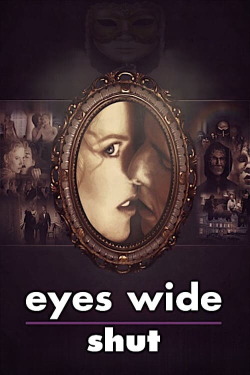
Review of Eyes Wide Shut (1999) by Reelviews94 — 23 Mar 2016
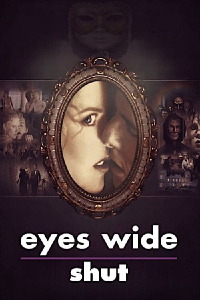
“Eyes Wide Shut” may have trouble living up to all the extreme and diverse expectations viewers may have for it, as almost any picture would under the circumstances. But after all the curiosity and attendant hype wash away, what one is left with is a riveting, thematically probing, richly atmospheric and just occasionally troublesome work, a deeply inquisitive consideration of the extent of trust and mutual knowledge possible between a man and a woman. Meticulous, deliberate and precise picture casts a particular sort of spell, one that will likely captivate older and thoughtful audiences more than it will mainstream Tom Cruise die-hards and those with short attention spans.
Less acerbic and, in its own tentative way, more optimistic about the human condition than any of the director’s previous films, this intimately focused updating by Kubrick and Frederic Raphael of Arthur Schnitzler’s beautifully observed 1926 novella “Dream Story” remains remarkably faithful to its source while also trading in familiar Kubrick concerns such as paranoia, deception, the literal and figurative masks people wear, and the difficulty for even intelligent human beings to transcend the base and self-destructive impulses that drive the species. Aside from its succession of delectable individual scenes, pic’s outstanding feature is its subtle and unstressed expression of a dreamlike state, a stylistic fusion of the gritty and the fanciful that allows for “reality” and the imaginary to merge to such an extent that it is of no concern which is which, if indeed they are distinct.
Kubrick first considered adapting Schnitzler’s Freudian, Vienna-set tale in the late ’60s, and in its sense of intellectual adventurousness and daring, as well as for its vaguely disembodied, out-of-real-space-and-time feel, pic seems rather more like a part of that era than of today’s cinema. Longtime Kubrick fans will therefore no doubt pick up on many nuances and meanings that could easily elude the masses of contempo viewers who are too young to have seen a Kubrick picture first-run in a theater.
Even though “Eyes Wide Shut,” like its source story, is seen from the male p.o.v. and largely concerns the obsessions, fears and limitations of its protagonist, pic is unique in the late director’s oeuvre in that it’s the women who far outshine the men. Kidman is sensational and luminous as she inhabits her character, who reps a convincing argument for the view that women are far more cognizant and expressive of their emotions than are men. When absent from the story during her husband’s wanderings, numerous other actresses willingly take up the slack in a succession of brief but indelible turns, most notably the intense Richardson as the bereaved neurotic daughter, the insinuating Shaw as the inviting prostie and Fay Masterson as the latter’s upfront roommate.
Where this leaves Cruise is the film’s most debatable issue. At face value, the star gives a limited, emotionally constrained, eyebrow-crinkling and grimacing performance, nor is he entirely convincing as an established favorite doctor to Gotham’s elite. No doubt the same complaints that were voiced about the ineffectuality of Ryan O’Neal in “Barry Lyndon” will be heard here about Cruise. On the other hand, it can be argued that the actor, who has none of the big thesping demands placed upon him that the women do, despite being onscreen nearly continuously, generously hands the picture over to his several outstanding female partners by allowing them to shine. While the role could have used an actor whose casual authority cloaked inner turmoil and desire, Kubrick found a way to use Cruise shrewdly, and thesp in no way impedes the picture from the full expression of its intentions and meanings.
As for the titillation factor, some of the dialogue is far more explicit than what’s on view. Kidman has much more action with her dream officer in her husband’s mind via black-and-white fantasy footage than she ever does with her mate. Orgy sequence features plenty of stunning nude women striding around as well as pretty standard soft-core simulations.
And so the career of a great filmmaker comes to a close with a work that, while not his most startling or innovative or subversive, nonetheless sees him striking out in exciting and sometimes new directions with his stylistic confidence and boldness intact. Given that the endings to his previous films have been variously absurdist, despairing, apocalyptic, mystical, corrosive, murderous and nihilistic, perhaps the fact that the conclusion here is at least guardedly hopeful suggests that, at the end, Kubrick believed in some sort of human progress after all.
This review of Eyes Wide Shut (1999) was written by Reelviews94 on 23 Mar 2016.
Eyes Wide Shut has generally received positive reviews.
Was this review helpful?